Africa's Mineral Paradox: The Continent That Powers the World's Future While Living in Its Past
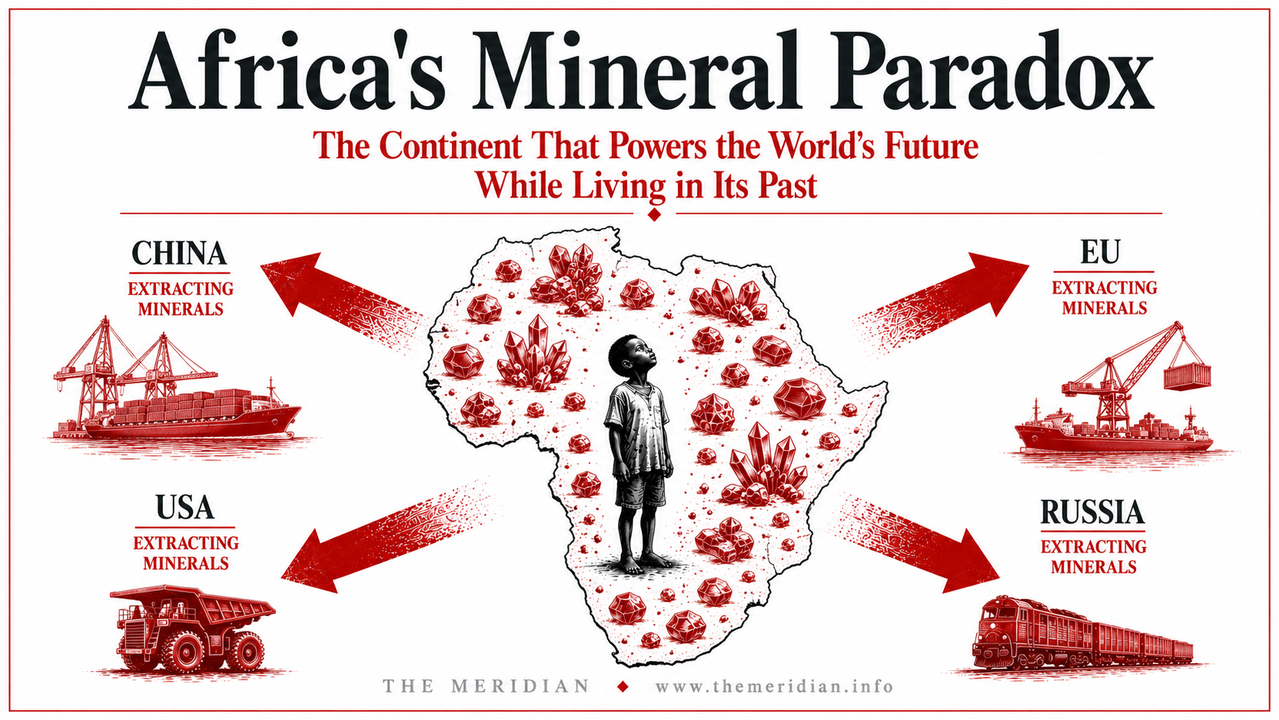
The Democratic Republic of Congo produces more than 70 per cent of the world's cobalt. Africa holds 26.7 million tonnes of identified lithium reserves. Global demand for critical minerals is projected to increase five-fold by 2035. The DRC war is fundamentally a mineral war. The Sahel juntas are partly sustained by mineral revenues. The Congo has accumulated $3.2 billion in Chinese debt with Russia holding 90 per cent of its primary oil pipeline. Africa's minerals power the electric vehicles, smartphones and renewable energy systems that the global energy transition depends upon. Africa captures almost none of the value. The Meridian Intelligence Desk analyses the paradox that defines a continent and asks how it ends.
There is a specific kind of injustice that is so structurally embedded in the organisation of the global economy that it becomes invisible through familiarity. It is not dramatic enough to generate a crisis response. It does not produce the acute suffering that triggers humanitarian intervention. It operates through contracts, commodity prices, logistics networks and debt agreements that are individually defensible and collectively devastating. Africa's mineral paradox is this kind of injustice. The continent sits on the resources that power the twenty-first century's defining technological transitions: the electric vehicle revolution, the renewable energy buildout, the smartphone economy and the artificial intelligence hardware stack. Cobalt, lithium, coltan, manganese, copper, nickel, graphite, rare earth elements — the periodic table of the energy transition runs through African soil with a concentration and a scale that no other continent can match. And yet the continent that holds these resources remains, in the aggregate, the world's poorest major region, with the highest debt-to-GDP growth rate, the largest share of populations without reliable electricity and the fewest value-added manufacturing jobs relative to its endowment of the raw materials that manufacturing everywhere else depends upon. The minerals leave. The poverty stays. The debt accumulates. And the wars that are fought over who controls the ground above the deposits become, in the international conversation, security problems rather than resource problems, obscuring the economic logic that drives them.
Mining sector 46% of DRC GDP in 2019. World Bank
Zimbabwe, DRC, Mali among top holders. AfDB 2026
IEA Critical Minerals Market Review 2025
Yet 600 million Africans lack reliable electricity access
Russia holds 90% of Pointe Noire-Makoulou pipeline stake
Despite record mineral export revenues. AfDB 2026
DRC cobalt coltan mineral war M23 Congo conflict energy transition supply chain sovereignty
The Democratic Republic of Congo is the single most concentrated expression of Africa's mineral paradox. It produces more than 70 per cent of the world's cobalt, which is an essential component of the lithium-ion batteries that power every electric vehicle manufactured anywhere in the world. Its eastern provinces hold significant reserves of coltan, which yields tantalum for the capacitors in every smartphone, and cassiterite, which yields tin for the solder in every printed circuit board. The DRC's mining sector represented 46 per cent of national GDP in 2019. And yet the DRC ranks among the lowest in the world on every human development index. Per capita income is below $600 per year. The majority of the population has no reliable access to electricity. The country's road network, built during the colonial era for extraction rather than connectivity, has deteriorated to the point where large portions of the country are accessible only by river or air. The mines produce the cobalt. The cobalt leaves. The money does not stay.
The M23 rebel movement's advance into eastern DRC, backed by Rwanda according to consistent UN Group of Experts reporting, is not primarily a political or ethnic conflict, although it has political and ethnic dimensions. It is a competition for territorial control over some of the world's most valuable mineral deposits at a moment when the global energy transition has made those deposits worth more than at any previous point in history. Whoever controls the territory controls the artisanal mining networks, the formal mining concessions and the transport routes through which the minerals move to the processing facilities that convert raw ore into the refined materials that battery manufacturers in China, Japan, South Korea and Europe require. The war is a supply chain conflict dressed in the language of political grievance. US and Qatari mediation efforts have produced ceasefires that have not held precisely because the economic incentives for the parties controlling mineral-rich territory to continue the conflict exceed the diplomatic incentives for resolution that external mediators can offer.
The China connection compounds the paradox in a specific and documented way. Chinese companies dominate the DRC's formal mining sector. Chinese investment has built the processing infrastructure that converts Congolese cobalt ore into the battery-grade material that Chinese battery manufacturers require. Chinese debt has financed the infrastructure that facilitates this extraction. The Republic of Congo, the smaller neighbour to the west, has accumulated $3.2 billion in debt to China, with Russia holding a 90 per cent stake in the Pointe Noire-Makoulou Pichot oil pipeline. The debt-for-resources model that The Meridian documented in the Mauritius sovereignty economy article applies across the Congo basin at a scale and with a consequence for human development that makes the Mauritian version look almost benign by comparison. At least in Mauritius, the hospitals are eventually built, even if fourteen months late. In the DRC, the cobalt that powers the world's electric vehicles is mined in conditions that Amnesty International has documented as including child labour, without the workers who extract it being able to afford the electricity that the batteries they make are designed to provide.
The DRC produces more than 70 per cent of the world's cobalt. It powers the electric vehicle revolution. Six hundred million Africans have no reliable access to the electricity that electric vehicles run on. The paradox is not accidental. It is structural.
Sahel juntas mineral revenues gold uranium Mali Burkina Faso Niger Russia Africa Corps sovereignty
The military juntas of Mali, Burkina Faso and Niger have presented themselves to their populations as nationalist correctives to the governance failures of their civilian predecessors — as governments that would end the dependence on French military presence, reclaim sovereign dignity and deliver the security that decades of democratic governance had failed to provide. The nationalist framing has genuine resonance with populations that experienced real failures of governance, real corruption and real security deterioration under the governments that preceded the coups. The economic logic beneath the nationalism, however, tells a more complicated story.
Mali is among the top gold producers in Africa, with gold representing more than 70 per cent of its export revenues. Burkina Faso has significant gold reserves and is also one of the world's largest producers of manganese. Niger holds uranium deposits that have historically supplied French nuclear power stations with a significant portion of their fuel. The juntas that control these states control, simultaneously, the mineral revenues that flow from them. The expulsion of French forces and the Barkhane counter-terrorism operation from Mali, Burkina Faso and Niger removed the security architecture that had provided some constraint on how those mineral revenues were allocated. The replacement of French forces with Russia's Africa Corps, which operates on a commercial model in which security services are provided in exchange for mineral concessions and cash payments, represents a straightforward exchange of one form of mineral-linked sovereignty concession for another. France had military presence in exchange for mineral access under colonial-era agreements. Russia has military presence in exchange for mineral concessions under junta-era agreements. The minerals remain the currency. The flags and the languages have changed.
Africa LNG minerals energy transition critical minerals cobalt lithium hydrogen corridor 2026 2030
The Iran war and the Hormuz closure have created, simultaneously, two distinct African resource opportunities that The Meridian has documented separately in this edition. The LNG Race article documented the competition between Nigeria, Mozambique, Senegal and the Republic of Congo for European long-term gas contracts, driven by the geopolitical premium now attached to Atlantic supply routes that avoid both Hormuz and the Red Sea. The Africa's Mineral Paradox analysis documents the structural position of African critical minerals in the global energy transition. These two opportunities are connected through the hydrogen corridor argument introduced in The Meridian's IORA article: Australia's vast green hydrogen production potential, connected to European and Asian markets through an Indian Ocean maritime corridor, would intersect with Africa's solar resources and mineral endowments to create an energy transition supply chain in which Africa is a net provider of value rather than a net provider of unprocessed raw material.
This is the theoretical framework. The practical reality is that the value addition Africa currently captures from its mineral endowment is minimal relative to the total value chain. A tonne of cobalt ore mined in the DRC is worth approximately $30,000. A tonne of refined cobalt hydroxide is worth approximately $50,000. A tonne of battery-grade cobalt sulphate is worth approximately $80,000. And the battery produced with that cobalt, installed in an electric vehicle manufactured in Germany, China or the United States, contributes to a vehicle worth $50,000 or more. The DRC receives the price for raw ore. China's processing industry captures the refining premium. German, Chinese or American manufacturers capture the manufacturing premium. The DRC worker who mined the ore earns less than $600 per year. This is the mineral paradox expressed as a value chain: Africa sits at the bottom of a chain that it makes possible but from which it extracts almost nothing proportionate to its contribution.
Africa mineral value addition processing refining battery manufacturing sovereignty resource nationalism 2026
The path from mineral endowment to mineral prosperity requires a specific set of policy choices that African governments have discussed at summits, articulated in frameworks and inconsistently implemented in practice. The African Continental Free Trade Area, if fully implemented, would create the market scale that makes domestic processing investment economically viable — a single African market of 1.4 billion people provides the demand base that individual country markets cannot. The African Mining Vision, adopted by the African Union in 2009, articulates a framework for linking mineral development to domestic beneficiation, skills development and infrastructure investment that would convert mining from an enclave sector into an economy-wide development driver. These frameworks exist. Their implementation has been constrained by the same political economy dynamics that The Meridian documented in the Mauritius context: the bilateral financing relationships with China, Russia, the Gulf states and Western powers that provide the infrastructure financing African governments need come with the same preference for raw material access over value-added processing that has structured the continent's resource relationships since the colonial era.
The most concrete near-term opportunity for value retention lies in battery precursor manufacturing. The DRC, Zimbabwe and Zambia collectively hold the cobalt, lithium and copper required to produce battery precursor materials domestically rather than exporting raw ore for processing in China. The Zambia-DRC battery manufacturing corridor, announced in 2023 with initial support from the European Union and the United States as alternatives to Chinese supply chain dominance, represents the most advanced attempt to insert African value addition into the critical mineral supply chain at the processing stage. Its progress has been slower than announced timelines suggested. The political economy of mineral processing investment is difficult: it requires sustained government commitment, infrastructure investment in power and logistics, skills development over years rather than months and protection of domestic processing margins against the competitive pressure of Chinese processors who benefit from economies of scale, lower energy costs and established customer relationships that African processors are only beginning to build.
The US CHIPS Act's extension into the Americas and the EU Critical Raw Materials Act both contain provisions designed to create alternative supply chains that reduce dependence on Chinese processing dominance. Both create, in principle, a demand signal for African-processed rather than Chinese-processed critical minerals. Whether African governments can convert that demand signal into the domestic industrial policy, the infrastructure investment and the institutional quality required to attract the processing investment depends on choices that are entirely within their own control. The minerals are there. The demand is growing. The geopolitical moment, in which the United States, the European Union and Japan are all actively seeking to diversify away from Chinese critical mineral processing dominance, is more favourable to African value addition than any period in the continent's post-independence history. What remains is the political will to capture it before the window closes, before China's processing dominance becomes so entrenched that alternatives become structurally uncompetitive, and before the next generation of young Africans concludes that the mineral wealth beneath their feet belongs, in practice, to everyone except them.
The minerals leave. The debt stays. The wars continue. The young people watch. Africa holds the resources that power the world's future and receives almost none of the value. This is not destiny. It is a choice. And it is a choice that can be unmade.
Add comment
Comments