The Africa Intelligence Brief: May 2026
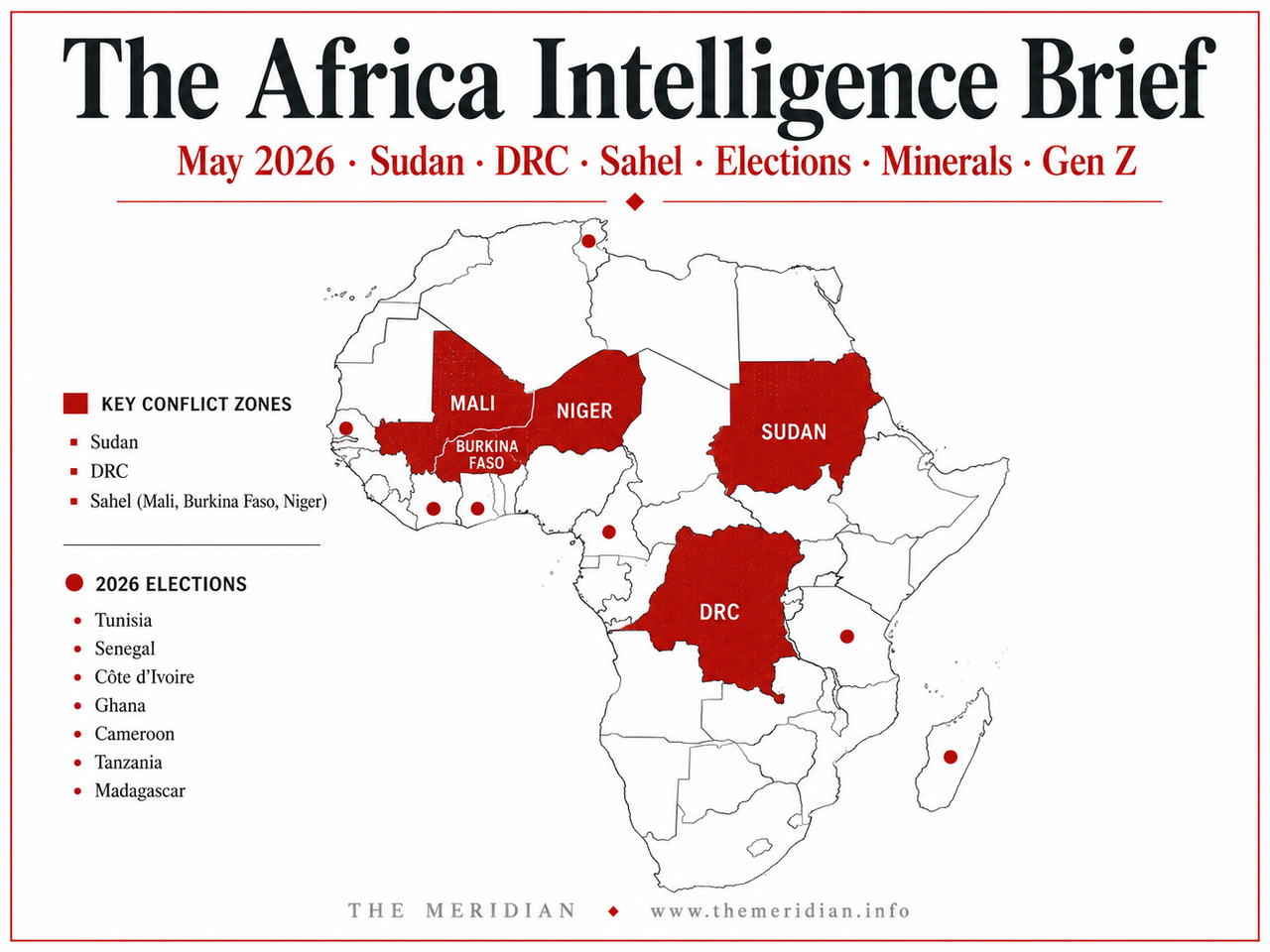
Sudan enters its third year of war with over 12 million displaced and 4 million refugees. M23 controls eastern DRC's mineral belt. The Sahel juntas are deepening their dependency on Russia's Africa Corps while presiding over worsening violence. Africa faces more than 20 elections in 2026. Public debt rose 170 per cent between 2010 and 2024. Gen Z movements are reshaping politics from Nairobi to Rabat. Great power competition for Africa's minerals, ports and strategic geography is intensifying. The Meridian Intelligence Desk publishes its first monthly brief on the continent.
Africa is simultaneously the world's most consequential emerging story and the world's most under-analysed major region. It holds 60 per cent of the world's best solar resources, the commanding share of the critical minerals that power the global energy transition and a demographic trajectory that will see it account for approximately 40 per cent of global population growth through 2050. It also contains three of the world's most severe active conflicts, more than a dozen governments of contested democratic legitimacy, a public debt stock that has risen 170 per cent in fifteen years and a generation of young people who are increasingly unwilling to accept the governance failures of their parents' political class. The Meridian Intelligence Desk establishes this monthly brief as a regular analytical fixture: one article, the essential threads, the verified data, the analytical framework. This is Africa in May 2026.
Third year of conflict. 4 million refugees. UN OCHA 2026
Infrastructure needs vs financing constraints. AfDB 2026
Including Ethiopia, Uganda, DRC, Zambia, Algeria
African Energy Chamber State of African Energy 2026
Sudan civil war displaced DRC M23 minerals Sahel juntas Russia Africa Corps conflict May 2026
Sudan's war is entering its third year with no credible ceasefire in sight. The conflict between the Sudanese Armed Forces and the Rapid Support Forces has produced over 12 million internally displaced people and more than 4 million refugees who have fled to Chad, Egypt, Ethiopia and South Sudan, making it one of the largest displacement crises in the world, receiving a fraction of the international attention proportionate to its scale. The RSF, which controls most of Darfur and significant portions of Khartoum, has been documented committing mass atrocities including ethnic targeting and systematic sexual violence. Neither the African Union, IGAD nor any external mediator has produced a framework that both parties have accepted. The humanitarian access situation remains critical, with aid organisations reporting severe constraints on reaching affected populations. The Iran war has absorbed the international media and diplomatic attention that Sudan requires. The scale of the catastrophe is not in question. The international will to address it is.
In the Democratic Republic of Congo, the M23 rebel movement, backed by Rwanda according to UN Group of Experts reports and Western government statements, controls significant portions of eastern DRC including Goma, the commercial capital of North Kivu. The eastern DRC conflict is fundamentally a mineral war. The territory M23 controls sits atop some of the world's richest deposits of coltan, tin, tungsten and tantalum, along with cobalt and copper reserves that are central to the global energy transition. The DRC accounts for more than 70 per cent of global cobalt production. Its mining sector represented 46 per cent of national GDP in 2019. The M23 advance gives whoever controls the territory effective control over a significant portion of the global supply chain for the minerals that power electric vehicles, smartphones and renewable energy systems. US and Qatari mediation efforts have produced ceasefires that have not held. The economic stakes for the regional actors who benefit from the conflict's continuation exceed the diplomatic incentives for resolution.
In the Sahel, the military juntas of Mali, Burkina Faso and Niger that seized power in successive coups between 2020 and 2023, each promising to deliver the security that their civilian predecessors had failed to provide, have presided over a consistent worsening of the security situation in each country. JNIM, the Sahel affiliate of Al-Qaeda, has extended its territorial control and launched what analysts describe as economic warfare through oil blockades that have paralysed northern Mali. The juntas have expelled French forces, ended MINUSMA and replaced Western security partnerships with Russia's Africa Corps, formerly the Wagner Group, whose presence has been documented alongside serious human rights violations against civilian populations. Security deterioration under junta rule is the documented regional pattern. The ideological appeal of the juntas' anti-colonial nationalism, particularly among young urban populations frustrated with decades of governance failure, remains strong despite the security record. That gap between narrative appeal and operational reality defines the Sahel's political trap.
Africa elections 2026 Ethiopia Uganda Zambia Algeria Morocco DRC democracy
Africa faces more than 20 elections in 2026, ranging from credible competitive contests to exercises in incumbent consolidation. Ethiopia's elections in June are set to consolidate one-party rule under Prime Minister Abiy Ahmed's Prosperity Party amid an ongoing security crisis in Tigray, Amhara and Oromia regions. The post-conflict reconciliation process following the Tigray war remains incomplete, and the electoral environment reflects the consolidated power of a government that has prosecuted a devastating internal conflict since 2020. Uganda's Museveni, in power since 1986, faces a further election in an environment of documented intimidation of opposition figures and civil society. The Republic of Congo's Sassou-Nguesso has been in power for over four decades in two separate periods. Zambia's elections will test whether the economic reform agenda of President Hakainde Hichilema, who came to power in 2021 on an anti-corruption and IMF reform platform, has produced results sufficient to win a second mandate. Algeria, Morocco, the Gambia and Benin are among the other electoral contests on the 2026 calendar. The pattern across the continent is bifurcated: a subset of elections that represent genuine democratic competition and an accountability mechanism, and a larger subset that represent the ritualisation of incumbent power.
Africa sovereign debt bond market 2026 IMF programmes risk Congo China debt minerals
Africa's public debt stock has risen 170 per cent between 2010 and 2024, reflecting the scale of infrastructure investment needs and the constraints of international development financing that has consistently fallen short of what the continent requires. The Iran war oil premium has added a further layer of fiscal pressure to oil-importing African economies including Ethiopia, Kenya, Uganda, Tanzania and the Sahel states, which are already managing elevated debt service costs in a high dollar interest rate environment. Several African sovereigns that returned to international bond markets in 2023 and 2024 are now navigating refinancing challenges as global risk appetite remains constrained by geopolitical uncertainty. The Republic of Congo has accumulated approximately $3.2 billion in debt to China, with Russia holding a 90 per cent stake in the Pointe Noire-Makoulou Pichot oil pipeline, illustrating the debt-for-resources model that has spread across the continent's oil and mineral producers. The IMF's engagement across Africa remains the primary institutional anchor for the most fiscally stressed sovereigns, but the conditionality of IMF programmes continues to generate political resistance in countries where austerity requirements conflict with developmental needs and electoral pressures.
Africa Gen Z protests youth movements 2026 Kenya Nigeria Senegal governance democracy
The most consequential long-term development in African politics in 2026 is not a conflict or an election. It is the emergence of youth-led mobilisations that are challenging governance failures and entrenched authoritarian models across the continent with a coherence, a technological sophistication and a cross-border solidarity that previous generations of African civil society could not sustain. Kenya's finance bill protests in 2024, which forced the withdrawal of proposed tax increases and demonstrated the organisational capacity of young Kenyans operating through social media and decentralised coordination, established a template that has been studied and partially replicated in Nigeria, Senegal, Madagascar, Morocco, Tanzania and Togo. These movements share common features: they are leaderless or multiply-led rather than organised around a single charismatic figure; they are driven by economic grievances, namely unemployment, cost of living and corruption, rather than ideological programmes; and they are connected across borders through digital networks that make national containment strategies less effective than they were for previous generations of protest movements. The established political class across Africa has not yet developed an effective response to this phenomenon. Repression has been tried and has produced martyrs and escalation. Co-optation has been tried and has produced temporary demobilisation followed by renewed organising. The underlying grievances of youth unemployment, governance failure and elite extraction are structural and will not be resolved by tactical political management.
Africa great power competition China USA Russia Gulf EU minerals ports 2026
The competition between China, the United States, Russia, the Gulf states, the European Union and increasingly India, Turkey and Brazil for strategic relationships across Africa has intensified in 2026 against the backdrop of the Iran war, which has elevated the strategic importance of African energy producers and transit routes. China's Belt and Road investments in African ports, railways, telecommunications and mining infrastructure remain the most extensive foreign investment presence on the continent. The United States has responded through the Lobito Corridor railway project connecting the DRC's mineral belt to the Angolan coast, the Minerals Security Partnership and the Prosper Africa initiative, each designed to provide an alternative to Chinese infrastructure financing without the debt sustainability concerns and sovereignty concessions that Belt and Road projects have generated. Russia's Africa Corps presence in the Sahel provides Moscow with a foothold in the continent's most volatile region at relatively low cost, sustained by the demand for security services that Western partners have failed to provide effectively. The Gulf states, particularly the UAE, Saudi Arabia and Qatar, have expanded investments in African logistics, agriculture and renewable energy that reflect both commercial opportunity and the strategic imperative of diversifying their own economic relationships before the oil revenue decline that the energy transition will eventually produce. Africa summits with France, Italy, Turkey and Russia are expected across 2026 as each external power attempts to position itself for the continent's demographic and resource future. The continent's 1.4 billion people, rising to 2.5 billion by 2050, and its commanding position in critical minerals for the energy transition make Africa the defining geopolitical prize of the twenty-first century's second half. The external powers understand this. The question is whether African governments will extract sufficient value from that competition to convert it into the productive investment their populations require.
Africa is globally indispensable but remains politically and economically underpowered. The minerals leave. The debt stays. The young people watch and organise. The Meridian will track all of it, every month.
The Africa Intelligence Brief is a monthly analytical fixture published by The Meridian Intelligence Desk on the last week of each month. It covers conflicts, elections, debt, minerals, climate and great power competition across the African continent. June 2026 edition will publish in the final week of June.
Add comment
Comments