Mauritius, Treasure Island, Amnesia Island
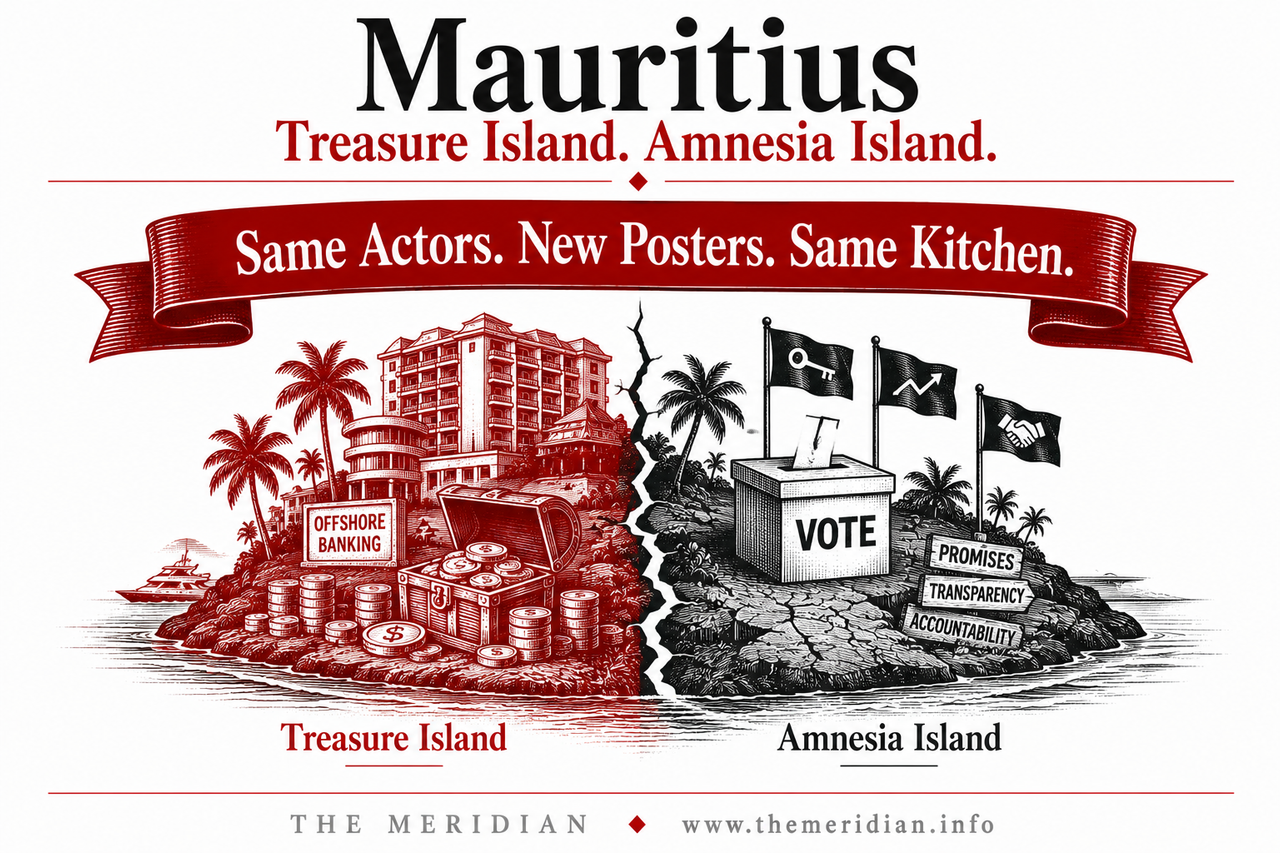
The ICIJ's Mauritius Leaks described 200,000 confidential records and an effective corporate tax rate as low as 3 per cent. Transparency International gives Mauritius 48 out of 100 on its Corruption Perceptions Index, with 60 per cent of Mauritians believing corruption is rising. Freedom House notes power has historically rotated among PTR, MSM, MMM and PMSD, dominated by a few families. Navin Ramgoolam was arrested in 2015. Pravind Jugnauth faced the MedPoint saga, was arrested again in 2025, with Rs114 million seized. In 2024, the country demanded change and returned an old face with 60 of 62 seats. Jim Browning on the island that calls amnesia changement.
There must be something in the water in Mauritius. Not merely because half the island spends its life wondering whether water will come out of the tap, but because the moment some Mauritians consume it, they appear to forget every insult, every scandal, every broken promise, every little national humiliation carefully gift wrapped by the very political class they later applaud at meetings. Election after election, the same show returns. Same actors, same surnames, same hand gestures, same slogans, same promises, same political perfume sprayed over the same damp smell of decay. A party loses public trust, disappears behind a new banner, borrows a new colour, hires a new slogan, discovers a sudden moral conscience and returns as though it has just been baptised in holy water. In reality, it is the same old car, battered, unreliable, coughing smoke, but freshly painted with fillers in all scratches and dents and polished so that the public may say, "Ah, oui sa meme nous bizain." No, dear voter. It is not new. It is the same old pile of junk with a campaign song.
The ICIJ's (International Consortium of Investigative Journalists) Mauritius Leaks investigation described Mauritius not simply as a postcard island of sandy beaches and resorts, but as a sophisticated offshore financial centre used to route money through low tax structures. The investigation was based on 200,000 confidential records and reported that Mauritius' system helped divert tax revenue from poorer nations towards Western corporations and wealthy elites. That is not a small accusation whispered at a bazaar. That is an international investigative finding. And what was the great Mauritian achievement here? We were not exporting genius, medicine, food security, scientific innovation or even reliable public services. No, we were apparently exporting clever paperwork. A national talent for making money pass through the island without necessarily leaving behind the moral burden of asking where it should have been taxed (one wonders why there are so many students learning law and accounting, is it not a saturated market? Apparently not).
The ICIJ reported that Mauritius promoted itself through low tax rates and a network of tax treaties, with some companies able to access an effective corporate tax rate as low as 3 per cent. Of course, the official defence was predictable. Mauritius was not a getaway car, apparently. It was a gateway. A bridge. A platform. A clean jurisdiction. A responsible international financial centre. How poetic. When ordinary citizens are late paying a bill, the system discovers the meaning of harsh discipline. When powerful structures are accused of helping large players reduce taxes across poorer countries, suddenly we are all invited to admire the elegance of international structuring. The ICIJ also reported that the Mauritian government at the time called the information outdated and pointed to reforms and tighter rules for companies wishing to benefit from low tax rates. But this is the Mauritian disease, is it not? We do not deny the smell. We spray air freshener over it and call it reform.
Transparency International's assessment added another layer to this national theatre. It noted that around 60 per cent of Mauritians thought corruption was rising and that the government was doing a poor job of tackling it. Yet Mauritius also had relatively low everyday bribery compared with many African countries, with only 5 per cent of Mauritians reporting having to pay bribes for public services and also happy to accept the same, because, well simply put; "Korek sa, tous dimoune faire sa". So here lies the contradiction. The average Mauritian may not always have to slip cash under a file to get a basic public service, and that is good. But corruption does not always arrive wearing sandals and asking for "enn ti zafer". Sometimes it wears a suit, sits on a board, signs a treaty, funds a campaign, appoints a cousin or two, rewards loyalty, punishes independence and calls the whole thing governance.
Transparency International also pointed to nepotism and cronyism, arguing that public sector positions were often filled through political connections rather than ability. It cited scandals involving senior political figures and noted that resignations, rather than prison sentences, followed several major controversies. There we have the Mauritian miracle. Accountability with no real accounting. Consequences without consequence. A resignation here, a press conference there, a dramatic statement, two weeks of outrage, then back to normal. The public becomes angry, the radios become loud, Facebook becomes philosophical, and then, at the next election, the same crowd returns with a new alliance name and the voters behave as though they have just discovered democracy for the first time. There are odd ones though, who are loyalist to a certain political party. However, the moment they do not get their own personal dose of "ti zafair", they abruptly leave the party they were loyal to and become hardened political gurus on social media, badmouthing the same party that has literally given them a platform to be somebody. But hold on, only spewing irrelevant information, nothing of real value, because they too are too deep in the mud with the party.
We do not deny the smell. We spray air freshener over it and call it reform.
Since independence, political power has largely rotated among the big familiar machines. Freedom House noted that power has historically moved mainly among the PTR, MSM, MMM and also PMSD; with minimal contribution only just representative of a certain community, while also observing that Mauritian political leadership remains dominated by a few families. This is why every election in Mauritius feels less like a democratic renewal and more like a family reunion with ballot boxes. The menu changes, the chairs move, the music is different, but the kitchen remains the same. New parties may indeed be born, but very often they are born already middle aged, carrying the same political baggage, the same grudges, the same ambitions, and the same convenient ability to oppose yesterday what they supported the day before. And it still happens to this day!
In 2024, the public, tired of cost of living pressures, corruption allegations and the broader atmosphere of political suffocation, delivered a landslide. Reuters reported that Navin Ramgoolam's Alliance du Changement won 60 of the 62 National Assembly seats (2 seats were amongst the best losers and appropriately named so; one chameleon of high standards and the other a drunk only using his dynasty's existence), with 62.6 per cent of the vote, returning him to the post of prime minister after he had already served three previous terms. There is the comedy. The country demanded change by returning an expired unworthy person. Mauritius did not so much turn the page as lick its finger and return to an earlier chapter. We called it "changement" because the poster said so. We called it renewal because the microphone said so. We called it hope because the alternative had become unbearable. Perhaps it was necessary. Perhaps it was inevitable. But let us not insult intelligence by pretending that old wine becomes holy water because it has been poured into a new bottle.
And this is where reality writes itself again. The voter complains about corruption, nepotism, arrogance, rising prices, public services, electricity, water, institutions and national decline. Then election season arrives and suddenly memory collapses like a cheap tent in a cyclone. The same voter who spent five years cursing the system suddenly stands in the sun waving a flag for another version of that system, convinced that this time the sincerity is real. Never mind that political sincerity in Mauritius often comes with an expiry date shorter than that of fresh milk. Meanwhile, internationally, the country is no longer simply judged by what politicians claim on platforms. It is judged by indices, investigations and credibility.
Transparency International's Corruption Perceptions Index gives Mauritius a score of 48 out of 100 and a ranking of 61 out of 182 countries. Forty eight. Not a national disaster, but certainly not the glowing certificate of moral superiority some would like to frame and hang in the Cabinet room. It is the mark of a country that still performs better than many, but knows very well it could be cleaner, fairer and less addicted to political recycling. And then there is the last decade, a comedy of errors performed on a national stage, with the taxpayer buying the ticket, cleaning the theatre and paying the actors.
Every election in Mauritius feels less like a democratic renewal and more like a family reunion with ballot boxes.
Mauritius has seen prime ministers and former prime ministers carrying legal baggage heavy enough to require its own customs declaration. Navin Ramgoolam was arrested in 2015 on suspicion of conspiracy and money laundering after police said a search at his home found a significant amount of cash in various currencies. Reuters reported at the time that police referred to vaults and suitcases containing more than Rs100 million. He was later released on bail. Then came Pravind Jugnauth and the MedPoint saga, a case that travelled from conviction to appeal to the Privy Council like a legal tourist with excellent air miles. He had been convicted in the Intermediate Court and sentenced to 12 months' imprisonment, before the Supreme Court quashed the conviction. The Privy Council later dismissed the DPP's appeal, and local reporting described him as having been cleared in the MedPoint case. So the public is left with the usual Mauritian spectacle. One camp shouts political vendetta, the other shouts corruption, lawyers sharpen their wigs, supporters dance outside party headquarters, and the taxpayer quietly pays for the circus. Nobody ever seems truly embarrassed. In fact, embarrassment in Mauritian politics appears to be treated like expired medicine: visible, ignored and left in the cupboard.
To make the comedy darker, Reuters reported in 2025 that former prime minister Pravind Jugnauth was arrested yet again and faced money laundering charges, with the Financial Crimes Commission saying Rs114 million had been seized. His lawyer said he denied the charges and that he had been provisionally charged. There we are again. Mauritius, the small island with big scandals, where political drama returns so often that even Netflix would say, please, enough, no more seasons. And yet, despite all this, the political machinery keeps moving. The same faces return. The same families return. The same surnames reappear. The same old engines are repainted, rebranded and paraded as national salvation. A man leaves office under a cloud, another returns under a slogan, and the public is told to clap because this time the cloud has been renamed hope.
One does not need a microscope to see how mediocrity has been elevated into a national management system. In Mauritius, proximity can often appear more useful than competence. Be close to the right person, clap at the right rally, repeat the right slogan, smile at the right dinner, and suddenly doors open with the speed of a government vehicle during campaign season. Qualifications become decorative. Experience becomes optional. Loyalty becomes a CV. Flattery becomes a career path. This is how people wake up one morning and find themselves wondering how certain appointments were ever made. One day someone is floating around political corridors, the next day he is working for the national airline, then a media institution, then a ministerial office, albeit a rather short stint, then perhaps somewhere else entirely. The island calls it opportunity. The rest of the civilised world might call it musical chairs with public institutions.
And what of national broadcasting and public communication? In a country where public institutions should serve the public, too many citizens have long suspected that some offices serve whichever political colour is fashionable that season. Some people change political loyalty with such elegance that even a chameleon might feel under-qualified. Yesterday orange, today red, tomorrow purple, and by next week possibly transparent, depending on who is appointing whom.
Then let us open the municipal drawer, if only to admire how much dust can collect in one place. Mauritius is tiny, yet it has a remarkable enthusiasm for local titles, local chairs, local presidents, local mayors and local ceremonial importance. The Ministry of Local Government states that local authorities comprise one Municipal City Council, four Municipal Councils, seven District Councils and 130 Village Councils. Of course, not everyone in local government is incompetent. There are civil servants who know their files, officers who work seriously and people who try to keep the system alive despite the political decoration placed above them. But the political layer, my goodness, often behaves as though it has mistaken a municipality for a miniature kingdom. Some mayors and political nominees appear to believe that a chain of office is the same as divine intelligence. It is not. A necklace does not make one a statesman. It merely proves that someone found a ceremony.
The real joke is that civil servants could probably run many of these local matters better without the theatre. They know the procedures. They know the files. They know the history. They know which complaints have been ignored, which letters have been unanswered and which permits raise eyebrows so high they almost need planning permission of their own. Meanwhile, political nominees arrive, sit, smile, pose for photographs, cut ribbons, attend functions and occasionally discover that governance involves more than wearing a suit and mispronouncing development. And citizens are expected to accept it all. A building rises where it should not. A permit appears where questions remain. A complaint is lodged and disappears into the administrative Bermuda Triangle. A chief executive suddenly becomes unavailable, a letter is not answered, a file is being looked into, and someone somewhere is allegedly close to someone who is close to someone who once stood near a minister. This, apparently, is how modern governance works on Treasure Island.
Mauritius does not suffer from a shortage of intelligence. It suffers from a surplus of political convenience.
The truth is painfully simple. Mauritius does not suffer from a shortage of intelligence. It suffers from a surplus of political convenience. It does not lack capable people. It lacks the courage to put capable people ahead of loyal ones. It does not lack institutions. It lacks institutions with a spine strong enough to stand upright when politics enters the room. The tragedy is that Mauritius has talent. It has educated people, capable professionals, a strong diaspora, experienced civil servants, entrepreneurs, teachers, doctors, lawyers, journalists and young people who deserve better than recycled slogans and hereditary politics. But talent cannot flourish properly in a country where too many doors open not because of merit, but because someone knows someone who knows someone whose uncle sat with someone at a political dinner in 1987. That is not governance. That is social choreography.
Mauritius does not need another slogan. It needs memory. It needs citizens who remember what was done to them before the music starts again. It needs voters who understand that changing the banner does not automatically change the machine. It needs institutions that do not tremble when a surname enters the room. It needs genuine transparency, proper party financing rules, serious protection for whistleblowers, meaningful follow up on audit findings, independent investigations and consequences that go beyond resignation and public relations management. Because a country does not become corrupt only when envelopes change hands. A country becomes corrupt when people stop expecting better. When mediocrity is defended because it belongs to one's political camp. When scandals are judged not by evidence, but by which party is implicated. When a politician's wrongdoing is excused because the others did worse. When voters become less like citizens and more like supporters of football clubs, cheering even when their own team kicks them in the teeth.
The Mauritius Leaks story should have forced a deeper national conversation about what kind of economy Mauritius wants to be. A country of real innovation, productivity and fairness, or a polished office corridor through which other people's money quietly passes? The corruption debate should have forced a deeper question about what kind of democracy Mauritius wants to remain. A republic of citizens, or a rotating theatre of clans, alliances and slogans? There are more of these stories, enough to write a book that could reach the moon and back. But then again, in Mauritius, even that book might require a permit, three signatures, one cousin, two political blessings and a committee chaired by someone who has never read.
Until then, Mauritius will continue to do what it does best. Smile for the brochure, argue on the radio, forget at election time, then act shocked when the same story returns wearing a different tie. The island is beautiful. The people deserve better. But the political class knows one thing too well: in Mauritius, memory is the first casualty of campaign season.
Add comment
Comments