Small States Absorb Every Shock They Cannot Prevent
Trade openness above 70% of GDP, debt service running at more than double the rate of comparably positioned economies, and average annual disaster damage of 2.1% of GDP. Small island economies sit at the exact point where global shocks land hardest and where the architecture of international finance offers the least protection. A structural account.
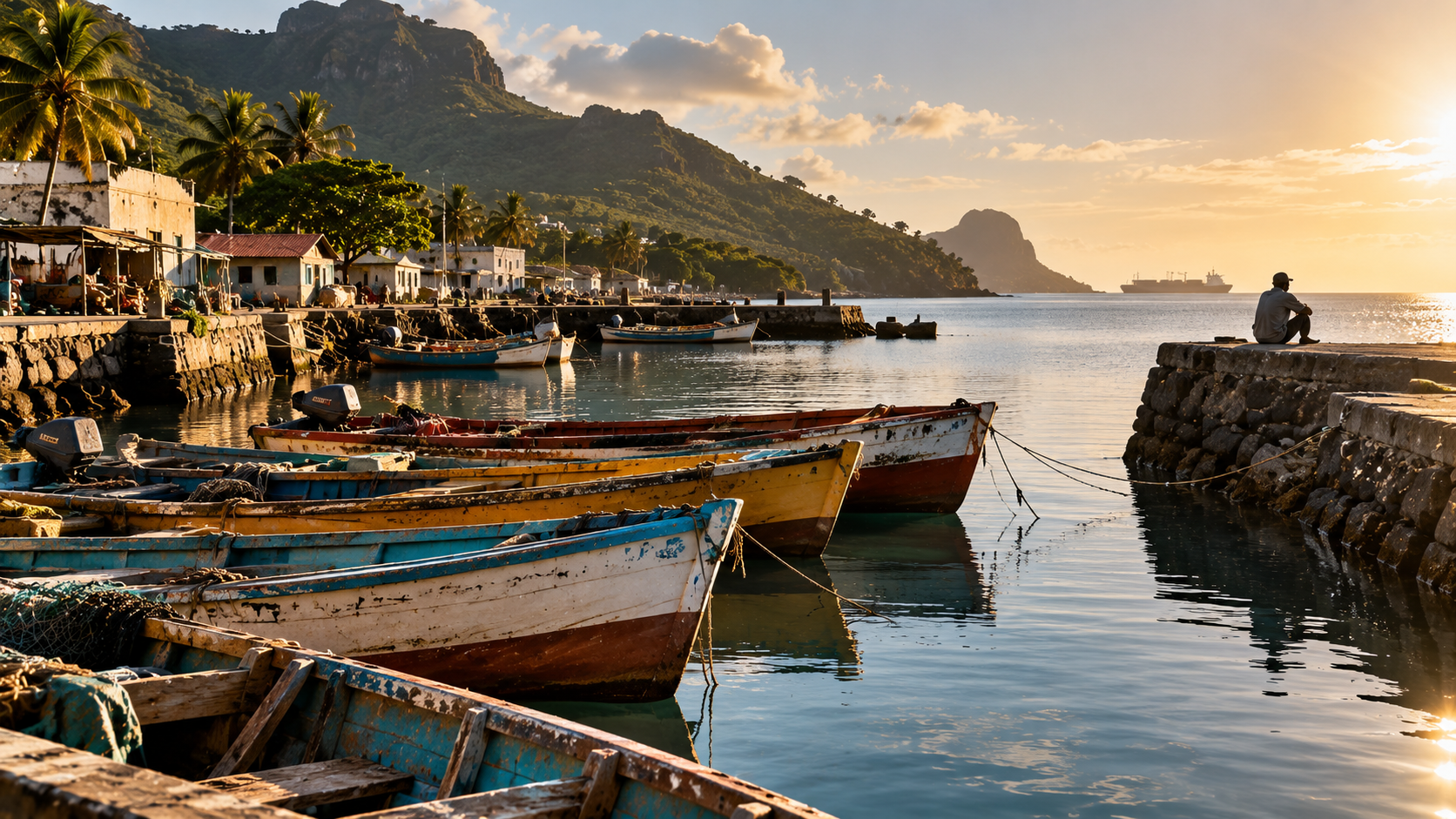
There is a category of economy that the standard frameworks of international political economy were not built to describe. It is small enough that its domestic market cannot generate sufficient demand to buffer against external shocks. It is open enough that trade, as a share of economic output, exceeds 70% of GDP. It is exposed enough that a single disruption to tourism, shipping costs, or commodity prices can move its growth rate by several percentage points in a quarter. And it is classified, by the income-based criteria that determine access to concessional finance, as middle income — which is to say, ineligible for the terms that its structural vulnerability profile would otherwise warrant. Small island developing states occupy this position permanently. It is not a transitional stage. It is the architecture.
70%+ — trade as share of GDP in SIDS, vs 50% for least developed countries (UN / FCDO, 2025)
18% — SIDS debt service as share of government revenue, vs 8% for non-SIDS LICs (ODI, 2024)
17% — higher output volatility in small states vs other emerging and developing economies (World Bank, 2024)
2.1% — average annual disaster damage as share of GDP in SIDS (UNCTAD, 2020)
13 of 30 — SIDS spending over 30% of government revenue on total debt service in 2023 (ODI, 2024)
139.2% — Mauritius external debt as share of GDP, 2024 (IMF Article IV, 2025)
The defining characteristic of a small island economy is not its size. It is the ratio between the size of the domestic economy and the scale of its exposure to external conditions. An island economy with a GDP of $15 billion and trade equivalent to 70% of that GDP has $10.5 billion of its economic activity directly tied to conditions set outside its borders. Its government cannot control import prices. It cannot control the interest rates at which its debt is refinanced. It cannot control the weather systems that periodically destroy a significant share of its fixed capital. It can set domestic policy. The range within which that policy operates is determined elsewhere.
This is the structural position. It is not produced by poor governance, fiscal irresponsibility, or the specific decisions of any particular administration. It is produced by geography, scale, and the design of an international economic architecture that was built around the needs and capacities of continental economies. The rules of the system — how debt is classified, who is eligible for concessional lending, how disaster recovery is financed, how trade agreements are structured — were written without the small island state in mind. The small island state then tries to operate within them.
Access to concessional borrowing — lower interest rates, longer maturities, grace periods — is determined primarily by income per capita. A country above the World Bank's threshold for lower-middle-income status is, by definition, ineligible for the most favourable lending terms from multilateral institutions. The threshold does not account for trade openness, disaster exposure, climate vulnerability, size of domestic market, or the structural dependence on imported food, fuel, and capital goods that characterises most small island economies.
"74% of SIDS' debt owed to multilateral and bilateral creditors is on non-concessional terms. The classification system was not designed with them in mind."
The consequence is measurable. In 2022, 74% of small island developing states' debt owed to multilateral and bilateral creditors was on non-concessional terms. SIDS pay external debt service at a rate of 18% of government revenue, compared with 8% for non-SIDS low-income and lower-middle-income countries. By 2023, 13 of 30 SIDS were spending over 30% of total government revenue on debt service. Six exceeded 60%. These figures describe the fiscal cost of a classification that categorises small island economies as comparably positioned to continental middle-income economies with large domestic markets, diversified export bases, and the capacity to absorb external shocks through internal adjustment. The comparison is structurally false. The classification persists.
Small states' output volatility is 17% higher than that of other emerging and developing economies. This is not principally a consequence of weak institutions or poor macroeconomic management. It is a consequence of the ratio between the size of the economy and the scale of the shocks to which it is exposed. A hurricane that destroys 10% of a country's fixed capital is a catastrophe in Dominica — where Hurricane Maria in 2017 caused damage equivalent to 225% of GDP — and a manageable regional event in Brazil. The same storm, the same destruction, radically different macroeconomic consequence, because the denominator is different.
In 2020, small state output fell approximately 11%, roughly seven times the average decline recorded by other emerging and developing economies. Tourism-reliant small states contracted nearly 13% on average. Tourism-dependent Caribbean economies contracted 15.4%, against an average of negative 1.9% for all emerging and developing economies. The pandemic did not hit all economies equally. It hit small island economies at a multiplier determined by their structural dependence on a single external income stream they had no mechanism to replace.
Between 2010 and 2022, debt service on external public debt in small island economies grew several times faster than spending on education, health, and capital investment. The spending that might have built the domestic economic diversification capable of reducing external dependence was the spending that was displaced by servicing the debt accumulated to absorb the shocks that were the product of that dependence. The cycle is not accidental. It is structural.
Mauritius presents a useful case study precisely because it is among the more economically developed small island economies. Its GDP per capita of approximately $11,883 in 2024 places it in the upper-middle income category. Its institutions are stable. Its macroeconomic management is, by regional standards, sophisticated. And in the IMF's 2025 Article IV Consultation, its external position is assessed as weaker than fundamentals and desirable policies imply.
The country's external debt stood at 139.2% of GDP in 2024, projected to fall to 128.9% in 2025. Public sector debt reached 88.3% of GDP in FY2023/24, above the country's own statutory ceiling of 80%. Moody's maintained its Baa3 rating in January 2025 but moved the outlook to negative. The rupee depreciated 6.7% against the US dollar in 2024. The current account deficit widened to 6.5% of GDP. Tourism receipts, which recovered to pre-pandemic levels, are projected to fall 4.6% in 2025.
"Mauritius has stable institutions, sophisticated macroeconomic management, and external debt at 139% of GDP. This is what maximum exposure looks like at the better end of the small island spectrum."
None of these figures indicate a governance failure. They indicate the position of an economy whose imports of goods and services represent approximately 57% of GDP, whose exchange rate is subject to the dollar's movements, whose primary export sector (tourism) is entirely dependent on external demand conditions, and whose borrowing costs are determined by global interest rate cycles set in jurisdictions where Mauritius has no voice. The country did not design these conditions. It operates within them.
What distinguishes the small island state from the large developing economy is not only the scale of its exposure but the ceiling on its available responses. A large economy facing currency depreciation can adjust through export competitiveness. A small island economy whose exports are concentrated in tourism and financial services has a narrower adjustment mechanism. A large economy facing a debt service crisis can restructure over a period of years while continuing to function. A small island economy spending 60% of government revenue on debt service has already compressed its public services to a degree that large economies rarely approach before restructuring becomes unavoidable.
The sovereignty ceiling is the point at which a government's formal legislative authority over its own economy exceeds its practical capacity to determine economic outcomes. Small island developing states reach that ceiling faster and at lower levels of external pressure than larger economies. The storms come from outside. The debt refinancing costs are set outside. The commodity prices that determine import bills are set outside. The tourism flows that fund current accounts depend on decisions made in source markets outside. What remains within the sovereign boundary is the management of the consequences. That is a significantly different definition of economic sovereignty than the one taught in most economics curricula, and it is the definition under which most small island economies operate every year, not only in crisis.
- ODI, Breaking the Cycle of Debt in Small Island Developing States, 2024 — odi.org
- IMF Country Report No. 25/136, Mauritius Article IV Consultation, 2025 — imf.org
- FCDO / UK Government, SIDS Vulnerability Note, 2025 — publishing.service.gov.uk
- UNIDO, Industrial Statistics Factsheet: SIDS, 2025 — stat.unido.org
- World Bank, Small States — Economic Vulnerability and Resilience, 2024 — worldbank.org
- UNCTAD, SIDS Commodity Dependence and Disaster Risk, 2020 — unctad.org
- IIED, Disaster-related Damage as Share of GDP in SIDS, 2023 — iied.org
- RESI / Tonga Disaster Finance Review, 2024
Analysis and editorial production: The Meridian Desk. All data verified against primary sources at time of publication. November 2026.