A President's Bank Collapsed. He Then Resigned. Three Million People Are Still Waiting.
Paraguay's government seized Ueno Bank, one of the country's largest digital lenders, trapping the savings of three million people. The bank had direct ties to President Santiago Peña. On 5 November, facing impeachment, he resigned. The money is still frozen.
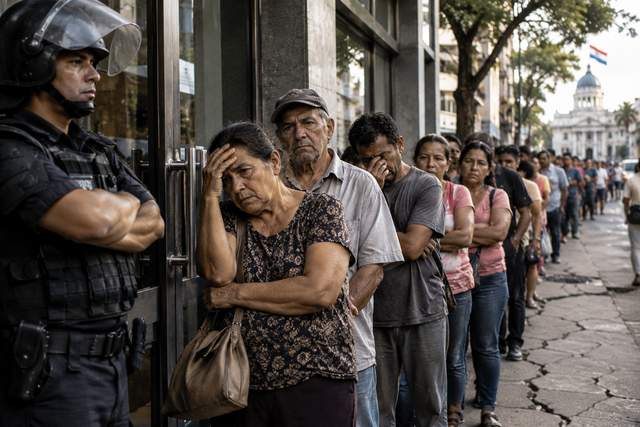
On the morning of 3 November 2026, three million Paraguayans woke up unable to access their money. Their bank, Ueno, one of the country's largest digital lenders, had been seized overnight by the central bank. Accounts were frozen. Branch doors were locked. Salaries could not be withdrawn. Pension payments did not arrive. And the government of President Santiago Peña, the man whose former business partners owned the bank, assured the public that everything would eventually be fine.
They did not find that reassuring. By midday, angry depositors had gathered outside Ueno branches across Asunción. The demonstrations turned tense. Clashes broke out between protesters and police. The images coming out of Paraguay's capital looked familiar to anyone who has watched what happens when ordinary people are told their savings are inaccessible and to please wait for official guidance.
Ueno Bank is not a small institution. It claims approximately three million customers, representing close to 60% of Paraguay's adult population. It had positioned itself as a modern digital lender, the kind of institution that was supposed to represent financial inclusion and economic progress. When the central bank's board voted unanimously on the night of 2 November to place it into resolution, the solvency ratio had fallen to below half the legal minimum. It was not a close call. The institution had been deteriorating for months.
As early as June 2026, Paraguay's central bank had warned Ueno formally about lending excessive amounts to companies connected to its own owners. In October, Fitch Ratings revised its outlook on the bank to negative. Less than a week before the seizure, Ueno announced plans to raise $100 million in new capital. The announcement was not a sign of strength. It was a signal that the bank already knew it was running out of time. Eight people, including Ueno's president and chief executive, were arrested by prosecutors within hours of the seizure. Two bank directors were in custody by afternoon.
3 million customers locked out , approximately 60% of Paraguay's adult population
$800m–$850m in public funds at risk, including $380m from the state pension and health fund
Below 50% of legal minimum solvency ratio at time of seizure
$38,000 insured deposit ceiling per person; first payout capped at approx. $1,700 , no date confirmed
8 arrests ordered by prosecutors; bank president and CEO among those detained
June 2026 central bank first warned Ueno formally , six months before seizure
Santiago Peña was a business partner of Grupo Vázquez, which owns Ueno, until March 2025. That is twelve months before the central bank issued its first formal warning to the bank. During the period in which Ueno's finances were deteriorating, Peña dismissed concerns publicly and repeatedly. State institutions continued depositing government funds with the bank. The state pension and health fund had approximately $380 million sitting inside Ueno when the doors were closed. This was not money belonging to investors or shareholders. This was money set aside for the medical costs and retirement of Paraguayan workers.
"The state pension fund had $380 million inside a bank the central bank had already warned about. This was not an oversight. This was a policy."
The man Peña had appointed to run the central bank, Carlos Carvallo, had previously served as chief executive of Ueno's predecessor institution. When the crisis broke publicly, Peña asked Carvallo to resign. Carvallo says he has signed the resignation but will oversee the takeover process in the interim. The regulator has stated that Carvallo recused himself from decisions relating to Ueno. The public has been asked to find this reassuring. It is not clear that they do.
The charges against Peña go beyond political embarrassment. He is accused of negligence and of having known that Ueno was insolvent while permitting public funds (pension contributions, health fund allocations, social security reserves) to continue flowing into it. He divested his own stake in Grupo Vázquez, Ueno's holding company, last year. The public money stayed in.
Opposition senators moved quickly. Within 48 hours, they announced their intention to file impeachment articles against President Peña. Under Paraguay's constitution, removing a president requires support from the legislature. The Colorado Party, which Peña belongs to, controls both chambers of Congress. The arithmetic for removal was difficult. But the politics had already shifted. Rodolfo Friedmann, vice president of the Colorado Party itself, called publicly for Peña's expulsion from the party. Senate President Basilio Núñez defended Peña and blamed the central bank instead.
It did not hold. Nearly three and a half hours after impeachment proceedings formally began in the lower house, Peña posted a short message on social networks addressed to the people of Paraguay. He apologised. He said that if he had misled them or done them any harm, he was sorry. He said that no position, not even the presidency, stood above the stability and necessities of the Paraguayan people. He said history would eventually put things in their place. He did not accept direct responsibility for the banking crisis. He resigned before the vote could remove him.
The Colorado Party, which has governed Paraguay with only a brief interruption since 1948, did not protect him. The party threw its weight behind the impeachment. Congressmen called it the biggest fraud of the century. One described it as the assassination of national credibility, at the precise moment Paraguay had begun attracting foreign investment. Another said Peña had destroyed the hopes and dreams of the entire Paraguayan people. With the Colorado Party itself joining the opposition, the lower house vote was a formality. The Senate was already in session expecting to approve it : what would have been the fastest impeachment in the country's history. Peña rendered that vote unnecessary by leaving first. Vice President Pedro Alliana is expected to assume the presidency.
Paraguay's government has stated that insured deposits will be returned. The legal ceiling is approximately $38,000 per depositor, and preliminary estimates suggest that covers approximately 97% of customers. The first payout is capped at around $1,700 per person, with any debts owed to Ueno deducted first. No date has been confirmed. The 15-day window, extendable once, provides the government with up to 30 days before the first payment must be made. For the families who had salary payments, rent money, and pension disbursements inside Ueno on 3 November, 30 days is not an abstract policy timeline. It is a month without money.
The collapse of Ueno Bank is not a Paraguayan story alone. It is a story that repeats across the Global South wherever the boundary between political power and financial institutions is managed by the same people who benefit from blurring it. A president's former business partner owns the bank. A president's appointee runs the regulator. State funds are deposited into the bank while warning signs accumulate. When it collapses, the pension savings of workers are inside. And when it finally becomes impossible to ignore, eight people are arrested and the president cancels his travel plans.
The pattern is not unique to Paraguay. The names and capitals change. The structure does not. What is notable here is that it happened to a digital bank, an institution that had positioned itself as modern, inclusive, and technologically advanced. The form of the institution was new. The relationship between money, power, and the exposure of ordinary people was not.
Three million people are waiting to find out when they will see their money again. The president who presided over the crisis has resigned. His successor has inherited a frozen banking system, a criminal investigation, 7,000 Ueno employees without pay, and a public that watched its pension savings disappear into a bank it was given no warning about. The government has issued assurances. The streets of Asunción have not yet returned to normal.
- Associated Press via AJC : Paraguay seizes major digital bank tied to president, leaving millions of customers in limbo (3 November 2026)
- Reuters via The Star : Paraguay's central bank chief resigns at president's request as digital lender crisis deepens (4 November 2026)
- TeleSur : Se hunde en Paraguay el banco ligado a Peña (November 2026)
- Euronews : Paraguayan president resigns amid bank collapse leaving 3M people without access to accounts (5 November 2026)
- NBC News : Paraguay President Peña resigns under mounting pressure from bank collapse (5 November 2026)