The Dollar Is Costing the World More Than America
When the US Federal Reserve raises interest rates, it is making a domestic decision about domestic inflation. But the dollar is the world's reserve currency, and every country that borrowed in dollars, prices its commodities in dollars, or holds its foreign reserves in dollars pays the cost of that decision too. Nobody outside the United States voted for this arrangement. Most of the world has no mechanism to escape it.
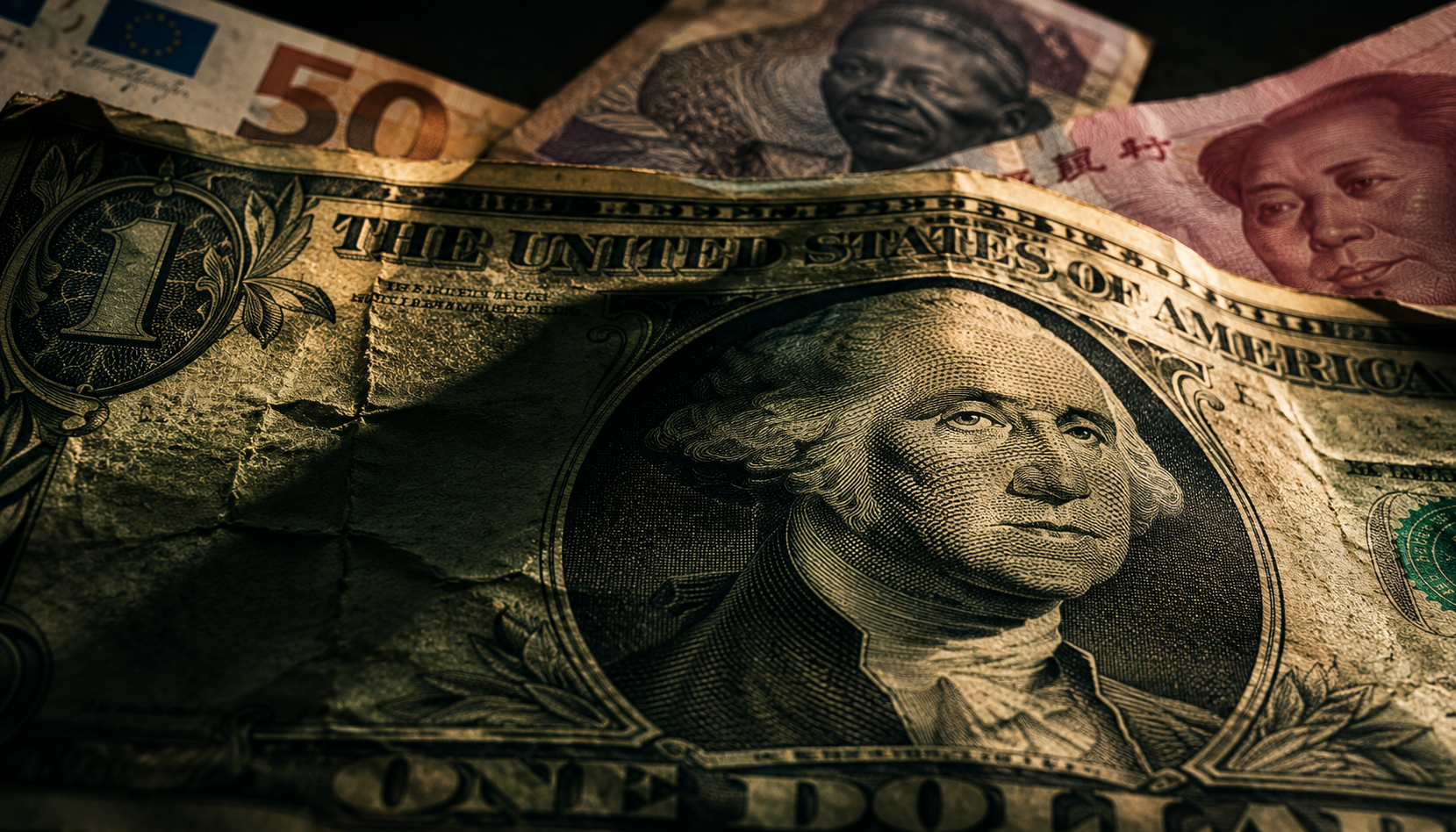
In 1971, US Treasury Secretary John Connally told a group of European finance ministers something that has not lost its relevance in the half-century since. The dollar, he said, is our currency but your problem. He was explaining why the United States was about to unilaterally abandon the Bretton Woods gold standard, a move that would reshape the global monetary order. His diagnosis of the structural relationship between American monetary policy and the rest of the world remains, in 2026, the most honest summary of that relationship available.
The dollar accounts for approximately 58 per cent of global foreign exchange reserves. Around 54 per cent of international trade is invoiced in dollars. Roughly 60 per cent of all international loans and 70 per cent of all international debt securities are denominated in dollars. This is not because the United States negotiated these shares in any formal sense. It is because the dollar, as the world's dominant reserve currency, became the default unit of account for global commerce over the course of the twentieth century, and inertia, network effects, and the depth of US financial markets have kept it there.
The consequence of this arrangement is a structural asymmetry that the mainstream economic commentary in Washington and London rarely names directly: the United States sets its monetary policy for the United States, and the rest of the world adjusts. When the adjustment is painful, the pain falls disproportionately on countries that had the least say in creating the system.
The mechanism by which US monetary policy propagates outward is not complicated, though its effects compound in ways that are. When the Federal Reserve raises its benchmark interest rate, it increases the return available on dollar-denominated assets. Capital flows toward those assets from elsewhere in the global system. The dollar appreciates. Countries holding dollar-denominated debt find that debt more expensive to service in their own currencies. Countries that import commodities priced in dollars find their import bills rising even if the commodity price in dollars has not changed, because their currency has weakened against the dollar. Countries that borrowed in international capital markets at variable rates find their debt servicing costs rising directly.
Between March 2022 and July 2023, the Federal Reserve raised its benchmark rate from near zero to 5.25 per cent, the most aggressive tightening cycle in four decades. It was responding to US domestic inflation that peaked at 9.1 per cent in June 2022. The Fed's mandate is price stability and maximum employment in the United States. It has no mandate to consider the effect of its decisions on Sri Lanka, Zambia, Ghana, Pakistan, or any of the other countries that entered sovereign debt crises during or immediately following that tightening cycle.
58 per cent of global foreign exchange reserves held in US dollars (IMF COFER, 2025)
54 per cent of global trade invoiced in dollars
70 per cent of international debt securities denominated in dollars
Sri Lanka, Zambia, Ghana, Pakistan, Ethiopia: sovereign debt restructurings initiated 2022 to 2024, all coinciding with the Fed tightening cycle
$400 billion estimated net capital outflow from emerging markets in 2022, the year the Fed began raising rates
Sub-Saharan Africa: average debt service to revenue ratio reached 54 per cent in 2023, up from 24 per cent in 2012
The five sovereign debt restructurings that occurred between 2022 and 2024, Sri Lanka, Zambia, Ghana, Pakistan, and Ethiopia, were not identical in their causes. Each country had its own history of fiscal decisions, political instability, and external shocks. But they shared a common structural vulnerability: significant dollar-denominated external debt in an environment where the dollar was strengthening rapidly and capital was flowing out of emerging markets toward higher-yielding US assets. The Fed tightening was not the only cause of any of those crises. It was a material accelerant of all of them.
In 1965, French Finance Minister Valery Giscard d'Estaing coined the phrase "exorbitant privilege" to describe the advantage the United States derives from issuing the world's reserve currency. Because the dollar is universally demanded, the United States can run persistent current account deficits without facing the balance of payments constraints that would force any other country to adjust. It can finance its government debt at lower rates than would otherwise be possible, because global demand for dollar assets is structurally elevated. It can conduct monetary policy without reference to exchange rate consequences that other countries cannot ignore.
What is less often named is the mirror image of this privilege: the exorbitant burden carried by countries on the other side of the arrangement. If the United States benefits from the world's structural demand for dollars, the world pays for that benefit through subordination to US monetary conditions. A central bank in Nairobi or Jakarta must maintain dollar reserves not because holding dollars serves its domestic economy directly, but because dollar reserves are the global system's insurance policy. That insurance comes at a cost: it ties up capital that could otherwise be deployed domestically, and it means that a portion of every developing country's savings is effectively lending to the United States government at the rate the US government chooses to pay.
"If the United States benefits from the world's structural demand for dollars, the world pays for it through permanent subordination to US monetary conditions. Nobody voted for this. Most countries have no mechanism to escape it."
The frustration with dollar dominance is not new, but its political expression has become considerably louder since 2022, for two reasons. The first is the Fed tightening cycle and its consequences for developing country debt. The second is the United States government's decision to weaponise the dollar system in response to Russia's invasion of Ukraine, freezing approximately $300 billion in Russian central bank reserves held in Western financial institutions and cutting Russian banks off from SWIFT, the international payments messaging system.
The SWIFT exclusion and reserve freeze were effective as sanctions instruments. They were also a demonstration to every government in the world that dollar reserve holdings are not unconditionally safe assets. They are safe conditional on the holder maintaining political alignment with Washington. For governments that have reason to doubt that alignment, the demonstration had a clarifying effect. China, India, Brazil, South Africa, and the Gulf states all accelerated bilateral currency arrangements and conversations about alternative payment systems in the period following the Russia sanctions.
The BRICS grouping, which expanded in 2024 to include Saudi Arabia, the UAE, Iran, Ethiopia, and Egypt, has made currency diversification a stated priority. The mBridge project, a cross-border digital payments platform developed jointly by the central banks of China, Hong Kong, Thailand, and the UAE, completed its minimum viable product phase in 2024 and is processing live transactions. India has expanded bilateral rupee trade settlement agreements with over twenty countries. China's renminbi share of global payments, while still small at around 4.5 per cent, has grown consistently.
None of this amounts to dedollarisation in any near-term meaningful sense. The structural depth of dollar markets, the network effects of dollar invoicing, and the absence of a credible alternative reserve asset at scale mean that dollar dominance will not be dislodged quickly. But the direction of travel has shifted. The question is no longer whether dollar dominance will erode, but how fast, and what replaces it.
The more fundamental issue, one that the dedollarisation conversation frequently skips past, is whether the global monetary system should be organised around any single national currency at all. The original Bretton Woods negotiation in 1944 included a proposal by John Maynard Keynes for an international reserve currency he called the bancor, managed by a supranational institution and designed to place symmetric adjustment obligations on both surplus and deficit countries. The proposal was rejected by the United States, which had no interest in surrendering the advantages of dollar dominance at the moment it was acquiring them.
The bancor argument has never gone away. The IMF's Special Drawing Rights, introduced in 1969, were a partial concession to the idea of an internationally managed reserve asset, but SDRs have never been issued at sufficient scale or made sufficiently accessible to developing countries to function as a genuine alternative. The 2021 SDR allocation of $650 billion was the largest in history. It was also distributed in proportion to IMF quota shares, meaning that the richest countries received the largest allocations of an instrument designed to help the poorest ones.
"The question is no longer whether dollar dominance will erode. The direction of travel has shifted. The question is how fast, and whether what replaces it will be better or merely different."
The governance of the global monetary system remains, in 2026, substantially as it was in 1971 when Connally made his remark. The United States sets its monetary policy for the United States. The rest of the world adjusts. The countries with the least institutional capacity to absorb that adjustment bear the most concentrated costs when the adjustment is severe. The arrangement is not the result of malice. It is the result of a system designed at a moment of overwhelming American power and never seriously reformed since.
The cost of that unreformed system is not abstract. It is measurable in the debt service ratios of sub-Saharan African governments, in the reserve accumulation strategies that divert developing country savings into US Treasury bills, in the sovereign debt crises that erupted across four continents between 2022 and 2024. The dollar is costing the world more than America. The world has known this for decades. What it has not had, until recently, is the political momentum to say so clearly, and to begin, however slowly, to build something else.
- IMF Currency Composition of Official Foreign Exchange Reserves (COFER), Q2 2025
- Bank for International Settlements: Triennial Central Bank Survey of Foreign Exchange and OTC Derivatives Markets, 2025
- IMF: Sovereign Debt Restructuring in Low-Income Countries, 2024
- World Bank: International Debt Report 2025
- BIS Innovation Hub: Project mBridge progress report, 2024
- SWIFT: RMB Tracker, monthly reporting on renminbi internationalisation, October 2026
- Keynes, J.M.: Proposals for an International Currency Union, 1942 (UK Treasury paper)
- Eichengreen, B.: Exorbitant Privilege: The Rise and Fall of the Dollar, Oxford University Press, 2011