Democrats Win Congress. What Happens to the World?
Democrats took the House on 3 November. For Americans, this is a check on Trump. For everyone else, it is a shift in who controls the legislative brake on US foreign policy, military authorisation, and the aid flows that keep fragile states from collapse.
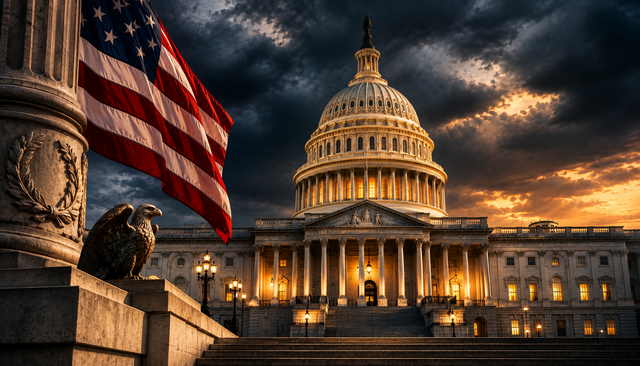
The American midterm elections of 3 November 2026 produced a result that domestic commentators have framed as a verdict on Donald Trump. That framing is not wrong. But it is incomplete. What changed on the night of 3 November was not only the composition of the House of Representatives. What changed was the global architecture of risk. The United States Congress controls the purse strings for Ukraine, the terms of engagement in the Middle East, the funding lifelines for fragile states across Africa, and the legislative authorisation for military action. For two years, one party held all of those levers. It no longer does.
The result gives Democrats control of the House while Republicans retain the Senate and the White House. Washington is now divided in the precise configuration that American constitutional design intended as a check on executive power. The question for the rest of the world is what that check means in practice, across the five theatres where US Congressional decisions most directly determine outcomes beyond American borders.
The Democratic House will constrain US military action against Iran. That is presented in most Western coverage as a stabilising development. It is worth examining that assumption carefully, because it rests on a premise that the evidence does not fully support: that Iran, left without decisive military pressure, will moderate its behaviour.
Iran's regional agenda has not been passive. Its proxy network, Hezbollah in Lebanon, the Houthis in Yemen, militias across Iraq and Syria, has continued to operate, fund, arm, and coordinate attacks throughout 2026. Houthi strikes on Red Sea commercial shipping disrupted global supply chains and forced insurers to reprice risk across the entire Gulf corridor. The Strait of Hormuz, through which approximately 20 per cent of the world's oil supply passes, is not threatened by American military action. It is threatened by Iran's consistent willingness to use its geographic position and proxy capacity as leverage against any government that challenges its regional ambitions.
The Strait of Hormuz is not threatened by American military action. It is threatened by Iran's consistent willingness to use its position as leverage against any government that challenges its regional ambitions.
A Democratic House that blocks military options against Iran without offering an alternative framework for constraining Iranian behaviour is not protecting global energy security. It is removing one form of pressure while leaving the threat fully intact. The governments most exposed to that threat are not in Washington. They are in the Gulf states, in Asia, and across the Global South, where energy import costs determine whether budgets balance and populations eat. They were not consulted about the Democratic Party's position on Iran. They will absorb its consequences regardless.
Congressional authorisation for military action against Iran was never formally requested under the previous Republican majority. Under a Democratic House, it will not be granted. Whether that outcome reduces risk or simply transfers it from the battlefield to the shipping lane and the proxy front is the question that Western coverage is not asking seriously enough.
Ukraine aid was blocked, delayed, and instrumentalised as domestic political leverage for most of the past two years. The Republican House majority used supplemental appropriations bills as a negotiating tool, attaching conditions, demanding offsets, and in several instances simply allowing votes to lapse. That is the domestic account of what happened. The global account is different: every month that Ukraine went without guaranteed resupply was a month in which Russian logistics, production capacity, and strategic patience were tested and found sufficient. A war of attrition favours the side that does not need a democratic legislature to fund it.
The stakes for the rest of the world are not abstract. If Ukraine loses territorial control to the point where its viability as a state is in question, the pressure on NATO's eastern flank does not remain theoretical. The Baltic states, Poland, and Romania are not geopolitical thought experiments. They are member states with treaty obligations that bind every NATO signatory, including the United States. A Russia that has absorbed Ukraine without decisive Western consequence is a Russia with a different risk calculus about what it can do next. The question of whether America funds Ukraine is not, at its core, a question about Ukraine. It is a question about whether the post-1945 European security architecture survives the decade.
What makes the Democratic majority's position on Ukraine more complicated than its public posture suggests is that the blockage on aid was not carried by Republicans alone. A faction within the Democratic Party, concentrated in the progressive left and operating under the banner of anti-interventionism, repeatedly voted against or delayed Ukraine supplementals. Their stated rationale was opposition to military spending and a preference for diplomatic solutions. The practical effect of their votes was indistinguishable from the isolationist right: Ukrainian forces waited longer, with less, against an adversary that faced no such constraint. Whether that outcome reflected naivety, ideological consistency, or something harder to name, the voting record is public. Several members who cast those votes returned in November. The Democratic House majority is not a monolith on Ukraine, and those within it who have consistently served Russian strategic interests, whatever their intentions, have not disappeared from the caucus.
What changes with a Democratic majority is the removal of the faction most aggressive in weaponising aid as domestic leverage. For Kyiv, that is a material improvement. It is not a guarantee.
The limits of Congressional influence over the Gaza situation are real and should not be overstated. The executive branch retains broad authority over arms transfers and diplomatic positioning. Democrats have been more vocal than Republicans about humanitarian conditions in Gaza and about the terms under which US military support to Israel is provided. That vocal opposition, however, has not translated into binding legislative constraints, and it is unlikely to do so through a divided Congress where the Senate and White House remain on the other side.
What changes is the pressure environment. House committee hearings, subpoena power, and the ability to hold aid packages hostage to conditions give the Democratic majority tools for raising the cost of policies it opposes, even when it cannot reverse them outright. Whether Democratic leadership chooses to use those tools aggressively on Gaza will depend on internal party dynamics that remain unsettled. The progressive wing, which has been most forceful on the issue, gained seats in November. The leadership calculus has shifted, even if the outcome has not.
The programmes that sustain the United States' relationships with fragile states across sub-Saharan Africa are not headline issues in American domestic politics. PEPFAR, the President's Emergency Plan for AIDS Relief, funds antiretroviral treatment for over 20 million people across the continent. The Millennium Challenge Corporation finances infrastructure in qualifying low-income countries. USAID operations provide humanitarian support across active conflict zones. All of these depend on Congressional appropriations. All of them were subject to Republican proposals for reduction or elimination in 2025 and 2026.
A Democratic House does not simply restore these programmes, but it creates a firewall against the most aggressive cuts. For governments and health ministries in countries where American development finance represents a material share of programme budgets, the midterm result is not an abstraction. It is a signal about whether the floor holds for the next two years.
Split government in Washington has historically been associated with fiscal gridlock, which carries its own global implications. A Congress that cannot agree on a budget produces continuing resolutions, debt ceiling standoffs, and the periodic threat of a government shutdown that rattles dollar-denominated financial markets worldwide. That risk is real and should be priced into any assessment of what 3 November produced.
The countervailing signal is on trade and tariffs. Trump's tariff agenda has been pursued largely through executive authority rather than Congressional legislation, which limits the House's ability to constrain it directly. But the Democratic majority changes the political cost of further escalation. Tariff policy that generates visible economic pain, in the form of higher prices and disrupted supply chains, now faces a House majority with both the incentive and the platform to amplify that pain as a political issue. That is a soft constraint, not a hard one. But in a presidency where domestic political calculations shape foreign economic policy, soft constraints matter.
This is not an American story. It is a story about who holds the brake on the most consequential foreign policy apparatus in the world.
The Democratic House majority will not resolve the conflicts that define the current global moment. It will not end the war in Ukraine, secure a ceasefire in Gaza, or prevent a confrontation with Iran if the administration determines that confrontation serves its interests. What it does is reintroduce institutional friction into a system that had been operating without it. For two years, the executive and legislative branches of the most powerful government on earth were aligned on the proposition that American power should be deployed with fewer constraints. That alignment is over.
The consequences will not be felt first in Washington. They will be felt in the Gulf, in Kyiv, in Nairobi, in every capital that has been watching the American legislative process determine whether its security, its funding, or its exposure to conflict would be managed with restraint or with impunity. The midterms of 3 November are, for those governments and their populations, a foreign policy event of the first order. The American electorate was choosing between parties. The world was watching something larger: whether the institutional architecture of the most powerful democracy would hold.
It held. For now.