South Africa Took Israel to The Hague. Its Own Criminals Are Still Free.
The Zondo Commission documented R57 billion in state capture. Not one top-tier minister has gone to prison. Months later, Pretoria filed a genocide case at the ICJ built on figures that Hamas's own Ministry of Health cannot substantiate. The world should ask why.
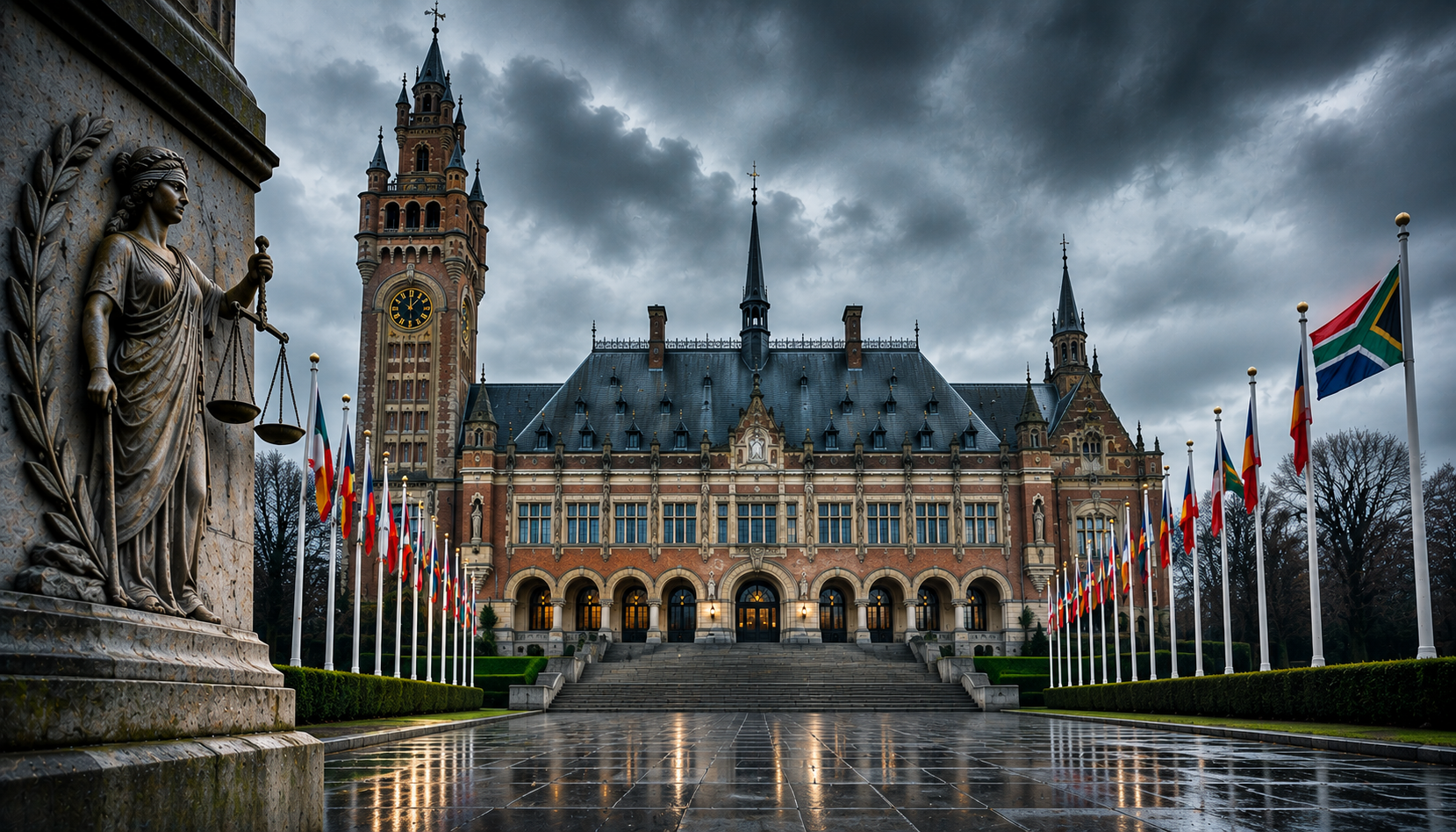
On 29 December 2023, the Republic of South Africa filed a case at the International Court of Justice accusing Israel of genocide under the 1948 Genocide Convention. The filing was presented by the African National Congress government as an act of principled international solidarity, a continuation of the moral tradition that Nelson Mandela built, and a defence of the rules-based international order. It received international attention commensurate with its ambition. What received considerably less attention was what South Africa had not done in the eighteen months before it walked into The Hague.
The Zondo Commission of Inquiry had concluded in June 2022. Chief Justice Raymond Zondo had sat for nearly four years, heard over 300 witnesses, produced a six-volume, 5,000-page report, and documented one of the most comprehensive cases of institutional looting in democratic history. Over R57 billion was directly funnelled through Gupta-linked networks alone, with broader estimates of total economic damage exceeding R500 billion. The Commission made over 350 recommendations, naming approximately 1,400 individuals and entities for criminal investigation. By the time South Africa filed its ICJ case, not a single top-tier cabinet minister had been convicted. Not one served a day in prison. The National Prosecuting Authority, deliberately gutted during the years of state capture, was still rebuilding itself. The criminals named in the report were still, in many cases, seated in Parliament.
A government that cannot prosecute its own looters went to the world's highest court to prosecute another country for genocide. That is the first thing the world should understand about South Africa's case at The Hague.
The legal threshold for genocide under the 1948 Convention is specific and demanding. It requires proof of intent to destroy a national, ethnic, racial, or religious group "as such." Intent is not inferred from civilian casualties alone, however tragic. It must be demonstrated as the purpose of the acts, not their consequence. South Africa's submission relied heavily on casualty figures and humanitarian conditions in Gaza. The figures deserve examination, because the most authoritative source for them is not the United Nations. It is Hamas's own Ministry of Health.
An analysis by the Australia/Israel and Jewish Affairs Council of Hamas's own Ministry of Health data for 2025 produced findings that directly contradict the genocide framing. Gaza's population grew by 1.2 per cent in 2025. Non-violent deaths, those unrelated to direct conflict, were lower than in 2022, the year before the October 7 attack and the war it triggered. These are not Israeli government figures. They are Hamas's own numbers, submitted by its own health ministry and cross-referenced against demographic baselines.
The claim that 70 per cent of casualties were women and children, repeated by the United Nations and embedded in South Africa's ICJ submission, is not supported by Hamas's own data. The Hamas Ministry of Health reported that 74 per cent of deaths in 2025 were male, and of approximately 19,000 violent deaths, around 77 per cent fit the demographic profile of combatants. A population that grows during a genocide. A famine that produces lower non-violent mortality than peacetime. South Africa built a legal case on figures that the accused's own enemy cannot substantiate.
None of this erases the suffering of Gaza's civilian population, which is real, documented, and deserving of serious international attention. What it does is establish that the specific legal claim of genocide, the claim South Africa chose to press at the world's highest court, rests on a factual foundation that collapses under scrutiny of the evidence Hamas itself provided.
On 7 October 2023, Hamas launched a coordinated attack on southern Israel that killed approximately 1,200 people, the single deadliest day for Jewish people since the Holocaust. Two hundred and fifty-one people were taken hostage into Gaza. Women were raped. Families were burned in their homes. Children were killed. The attack was planned, coordinated, and celebrated by the organisation whose governance of Gaza is the context for every subsequent development that South Africa's ICJ case describes.
South Africa's filing does not begin on 7 October. It treats the conditions in Gaza as a self-contained humanitarian crisis rather than the consequence of a sequence of events in which Hamas's actions are the opening chapter. That is not a legal oversight. It is an editorial choice. A submission to the world's highest court that omits the founding act of the conflict it is prosecuting is not a neutral legal document. It is a political one.
A submission to the world's highest court that omits the founding act of the conflict it is prosecuting is not a neutral legal document. It is a political one.
It is also worth noting what Hamas's own fighters do not do. They do not wear uniforms. They operate from civilian infrastructure: hospitals, schools, mosques, and a tunnel network stretching over 500 kilometres beneath civilian population centres. Under international humanitarian law, the deliberate embedding of military operations within civilian areas transfers a portion of moral and legal responsibility for civilian casualties to the party making that choice. South Africa's filing does not engage with this dimension. The ICJ process will.
Pretoria's decision to file at the ICJ did not emerge from a vacuum. The sequence of events in the months before the filing is worth setting out in full.
In October 2023, then-Foreign Minister Naledi Pandor visited Tehran. Iran had recently been admitted to the BRICS bloc, a development championed by South Africa. Shortly after the October 7 attack, Pandor made phone calls to Hamas leadership. In November 2023, the ANC was facing existential financial insolvency: sheriff attachment orders covered nearly R400 million in unpaid debts, with staff salaries in arrears. On 29 December 2023, South Africa filed the ICJ case. In the weeks that followed, the ANC's debt crisis abruptly eased.
Intelligence assessments and think-tank analyses, including reports by the Institute for the Study of Global Antisemitism and Policy and the Jerusalem Institute for Strategy and Security, alleged that Iran and Qatar-linked intermediaries provided financial backing for both the ANC's operational costs and the ICJ legal team's fees. The South African government flatly denied these claims, stating the case was funded through the Department of Justice budget. The ANC stated the debt resolution was unrelated to the filing.
The government's denials may be entirely truthful. The sequence of events, however, is public record. October: Tehran visit, Iran joins BRICS. November: R400 million in debts. December: ICJ filing. January: debt resolution. No accusation is required. The timeline speaks for itself, and South Africa has not provided an alternative explanation for the coincidence that withstands scrutiny.
The most devastating argument against South Africa's claim to principled international solidarity is not legal. It is geographical. While Pretoria was preparing its ICJ submission, the following was occurring elsewhere on the African continent and in the world.
| Crisis | Scale | SA ICJ Case | BRICS Statement | Pandor Phone Call |
|---|---|---|---|---|
| Gaza | Contested casualty figures; population grew 1.2% in 2025 | ✅ Filed Dec 2023 | ✅ Multiple | ✅ Hamas, Oct 2023 |
| Sudan | 150,000+ dead; 10.7 million displaced — largest displacement crisis on Earth | ❌ None | ❌ None | ❌ None |
| DRC | 6 million dead since 1998; 7 million currently displaced | ❌ None | ❌ None | ❌ None |
| Mozambique (Cabo Delgado) | 5,000+ killed; 1 million displaced | ❌ None | ❌ None | ❌ None |
| Somalia | Decades of conflict; Al-Shabaab controls significant territory | ❌ None | ❌ None | ❌ None |
Sudan has the largest displacement crisis on the planet. The Democratic Republic of Congo has accumulated six million dead over a generation. Mozambique's Cabo Delgado insurgency has displaced one million people from an economy that cannot absorb them. South Africa shares a continent with all three. It filed not a single case, issued not a single BRICS statement, and made not a single ministerial phone call about any of them.
The pattern is not explained by the scale of suffering. Sudan's figures dwarf Gaza's by any measure. It is not explained by geographic distance, since all three are in Africa. It is not explained by the absence of a legal mechanism, since the same ICJ and ICC processes Pretoria used against Israel are available for every conflict on this list. The pattern is explained by something else entirely, and South Africa has not been asked to explain it clearly enough.
In 2023, a Palestinian man from Gaza filed a complaint at the International Criminal Court against Hamas. He accused the organisation of using Gaza's civilian population as a human shield, looting humanitarian aid intended for ordinary Gazans, and committing crimes against the people it claimed to govern. His case was largely ignored by the same international institutions that amplified South Africa's filing against Israel.
South Africa's submission spoke at length on behalf of Gaza's civilians. It did not mention this man. It did not engage with the documented pattern of Hamas aid diversion, which multiple UN agencies have separately confirmed. It did not address the tunnel infrastructure built beneath civilian homes without the consent of the families living above. The civilians of Gaza have suffered enormously. Some of their suffering was caused by Israeli military operations. Some of it was caused by the organisation that governs them, fires rockets from their neighbourhoods, and has held over 250 hostages in tunnels beneath their feet. South Africa's legal team chose to prosecute one cause and not the other. That choice reveals the politics beneath the principle.
In November 2026, Washington formally notified Congress that South Africa's duty-free access under the African Growth and Opportunity Act will terminate on 1 January 2027. The triggers cited by the US administration included Pretoria's domestic land expropriation laws, its deepening ties with Iran, and its ICJ case against Israel. AGOA had underpinned approximately R28.67 billion in annual South African exports to the United States, with the automotive sector alone accounting for 64 per cent of that total.
The workers who will lose those jobs did not vote on South Africa's ICJ filing. The citrus farmers in Citrusdal who will lose their US market access to duty-free Chilean and Peruvian competitors were not consulted. The automotive component manufacturers in the Eastern Cape, already battered by earlier US tariffs, did not commission the legal team that walked into The Hague. South Africa's foreign policy is conducted by the ANC. Its costs are distributed across the entire population.
The irony is that the ANC's ICJ filing was partly an act of domestic electoral politics, designed to outflank the EFF on the Palestinian issue among Muslim voters in the Western Cape and Gauteng ahead of the 2024 election. The ANC lost its parliamentary majority anyway. The AGOA termination, the most economically consequential result of that filing, will be felt most heavily in the Western Cape — the province the ANC was trying to win.
South Africa currently holds membership in a bloc that includes China and India, two nuclear powers with an unresolved Himalayan border dispute that has produced military casualties as recently as 2020. It includes Iran and the United Arab Emirates, whose competing regional agendas have been in direct proxy conflict across Yemen, Iraq, and Syria for years. It includes Russia, which is conducting a land war in Europe. South Africa's Foreign Minister championed Iran's admission to this bloc in the same year Pretoria was preparing its genocide case at The Hague.
The selective application of international legal principles is the charge South Africa levels at the West. It is the charge the evidence levels at South Africa. A government that takes Israel to the ICJ for genocide while sitting in a bloc with countries engaged in active military conflicts, that files against one power while ignoring six crises on its own continent, that invokes international law selectively and in a direction that happens to align with the interests of its creditors, is not defending the rules-based order. It is performing solidarity while practicing something else entirely.
A government that cannot prosecute its own looters went to the world's highest court to prosecute another country for genocide. That is the first thing the world should understand about South Africa's case at The Hague.
The Zondo Commission cost close to R1 billion and produced 5,000 pages of documented evidence. Its findings named names, traced money, and proved beyond reasonable institutional doubt that the South African state was systematically looted by its own governing party and its allies. That evidence sits largely unacted upon. The criminals it named continue to use South Africa's courts to delay their own prosecution while the state that investigated them files cases at international tribunals.
Justice, it appears, is easier to pursue abroad than at home. Especially when it costs nothing politically, earns international headlines, and someone else may be paying the legal fees.