Paid in Full
In 1965, the colonial government of Mauritius sold the Chagos Islands for three million pounds. Within twelve months, the United States had agreed to contribute up to five million pounds toward the costs of the new territory through a defence offset arrangement. On the parliamentary record, the net British cost was negligible. Sixty years later, the Chagossians have been presented with a bill of £3.4 billion. This investigation examines who sold what, who got paid, and who was never asked.
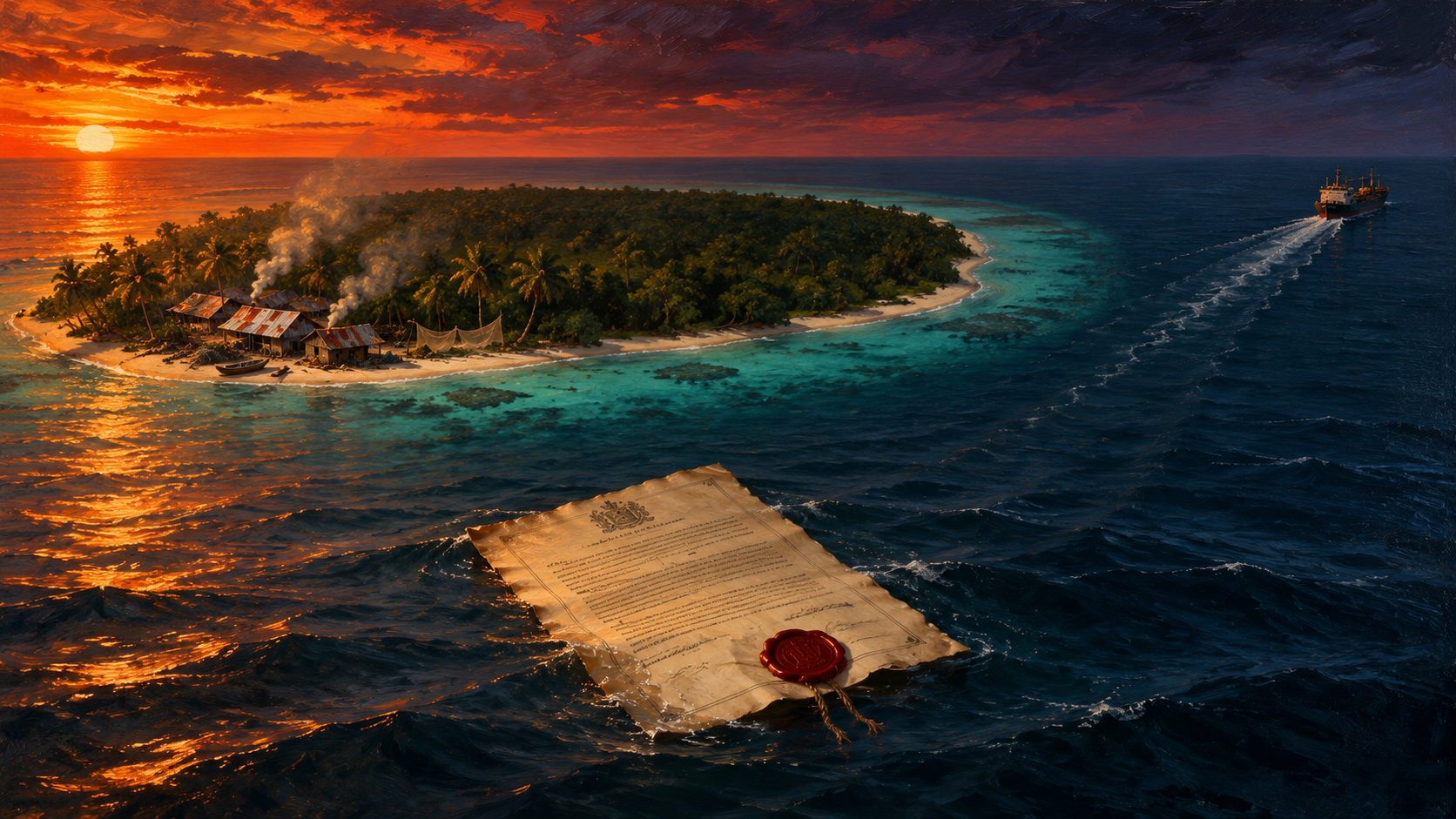
On 8 November 1965, the British Indian Ocean Territory was created by Order in Council. The islands of the Chagos Archipelago, which had been administered as a dependency of Mauritius since 1814, were detached and placed under a new administrative unit. In exchange, the colonial government of Mauritius had received three million pounds sterling. No one on the islands was told. No one on the islands was consulted. No one on the islands was offered anything.
Mauritius was not yet independent. It would not be independent for another three years. The men who accepted that payment had no mandate from the Mauritian people. They held office under the British Crown. And the islanders themselves, the Chagossians, the people of Diego Garcia, of Peros Banhos, of Salomon, were told nothing, consulted on nothing, offered nothing.
Michel Mandarin was fourteen years old when he was removed from the islands, in the late 1960s, as the expulsions gathered pace. He did not return. His son, Misley, was born in Mauritius. Misley Mandarin has never stood on the soil of the islands from which his family came. He knows them only through his father's account of a place that no longer exists in any form his father would recognise.
What followed was one of the most meticulously documented acts of colonial displacement in modern British history. The files are in the National Archives. The memos are on the record. One Foreign Office official, Denis Greenhill, wrote in 1966 that the eviction could be managed by creating a fictional distinction between the permanent population and what he called "contract labourers." There were, in Greenhill's estimation, no permanent inhabitants at all. It was, he wrote, a fiction.
He wrote that word down. He meant it to help.
The Lancaster House Agreement of November 1965 was not a treaty between equals. On one side sat the British government, negotiating for the construction of a military base it had already promised to the United States. On the other sat representatives of a colony that would not become independent for another three years, whose people had no vote, no parliament, and no standing in international law to alienate territory on behalf of future generations.
The price agreed was three million pounds. In the archives of L'Express Maurice, the record of that transaction is clear. A 2016 article, sourced from colonial-era documents, carries the headline: "1965: Maurice vend les Chagos pour trois millions de livres sterling." Mauritius sold the Chagos Islands. That is the verb the historical record uses.
The British National Archives (FCO 32 series) contain the internal record of how Britain approached those negotiations. A top-secret Colonial Office brief prepared by Sir Oliver Wright, Private Secretary to Harold Wilson, on 22 September 1965, the day before the decisive meeting with Ramgoolam, set out the British strategy in plain terms: "The object is to frighten him with hope: hope that he might get independence; fright lest he might not unless he is sensible about the detachment of the Chagos Archipelago." Harold Wilson duly informed Ramgoolam that he could return from Lancaster House either with independence or without it. The choice was not between accepting or refusing the detachment. It was between accepting the detachment and receiving a country, or refusing it and receiving nothing.
Ramgoolam initially resisted. The Colonial Office files record that he proposed a long-term lease of the islands to the United States or the United Kingdom, and argued that negotiations over Diego Garcia should be deferred until after Mauritius had achieved independence, so that at least two sovereign states would be at the table. The British refused both options. They raised the compensation from one million pounds to three million. Ramgoolam, facing the choice his colonial masters had constructed for him, accepted. He extracted what concessions he could: a reversionary clause requiring the islands to be returned to Mauritius when no longer needed for defence purposes, and a reservation of Mauritius's rights to any minerals or fishing discovered in surrounding waters. In 1979, he described his position at Lancaster House as having had "a noose around his neck." He said: "We had no choice."
The nature of that consent requires examination it has rarely received. Mauritius in 1965 was not a polity that had formed through its own processes of self-determination. It was a society Britain had assembled by design. The enslaved Africans who first formed the plantation workforce were brought by French and then British colonial administrators. The indentured labourers from India who replaced them after abolition were recruited and transported under British colonial contracts into a social hierarchy Britain had structured for the purpose of producing agricultural output at minimum cost. The electoral system that translated those demographics into political representation was written in London. The constitution under which SSR governed was a British grant. The recognition of his government came from the Crown. The reserve powers over his administration were held by a Governor who answered to Whitehall.
SSR's authority was therefore not independent of the party he was negotiating with. It was derived from it. His majority was a majority Britain had built through two centuries of colonial labour policy. His mandate was a mandate issued within a constitutional framework the other party to the Lancaster House negotiation had designed. When SSR agreed to the detachment of the Chagos Archipelago, he did so in secret, without a parliamentary vote, without a public debate, and without a referendum. The Mauritian population did not know what was being agreed in their name. The Creole community, whose ancestors had been on Mauritian soil the longest, had no seat at the table. The Chagossians, whose home was being traded, were not mentioned in the proceedings at all. SSR spoke for a political coalition, operating under a British-designed constitution, on behalf of a population Britain had structured, in a negotiation conducted in secret with the power that had built the entire arrangement from the beginning.
The International Court of Justice examined whether the decolonisation of Mauritius was completed lawfully. It found that it was not. But the Court did not ask the prior question: whether the constitutional framework within which SSR operated was itself the product of genuine self-determination, or whether it was a colonial construction so complete that the "consent" it generated was indistinguishable from the consent of the colonial power itself. That question was outside the scope of what the Court was asked to decide. It also carried implications the international legal order is not equipped to absorb, because answering it honestly would require reopening the legal foundations of postcolonial statehood across the entire former British Empire.
The Oliver Wright brief is routinely cited as evidence of coercion. It is that. But it is also something else, and this second reading has received far less attention. A government does not prepare a top-secret strategy to frighten a prime minister for a small matter. A government does not hold the independence of an entire people hostage unless it considers what it is extracting to be worth that price. The brief of 22 September 1965 is not only a record of what was done to SSR. It is a record of what Britain privately believed the Chagos Islands were worth: worth a nation's freedom, worth coercion, worth a carefully constructed ultimatum delivered the morning before a prime minister walked into a room with no real choice. Britain did not want to give Chagos away. The declassified files prove it beyond argument.
Sixty years later, the same British government decided to give the islands away after all. Not to the Chagossians, who were expelled from them. To Mauritius, the government whose independence Britain once withheld as the price of taking the islands in the first place.
That account is accurate and Mauritius is entitled to make it. But it does not resolve the position of the people whose home was being negotiated over. The reversionary clause ran between Britain and Mauritius. The Chagossians were not a party. Their interests were not represented by SSR, who had no mandate to speak for them. They were not represented by the British government, which was arranging their expulsion. They were not mentioned in the minutes at all.
But there is a detail the history books do not always include. On 30 December 1966, the United Kingdom and the United States exchanged notes making the territory available for defence purposes. A confidential annex confirmed that the US would contribute up to five million pounds toward the costs of establishing the British Indian Ocean Territory, by waiving research and development surcharges on Britain's Polaris missile purchase. The parliamentary record of this arrangement, confirmed in a written answer to the House of Commons on 6 November 1975, shows that the contribution was structured to offset BIOT setup costs in full. Britain had paid three million pounds for the Chagos Islands. The US contribution to BIOT costs exceeded that sum.
The net financial cost to Britain of the Lancaster House Agreement was, on the available parliamentary record, negligible. The Chagossians were not party to any of these calculations.
The strategic context is not incidental to the financial one. By 1965, the United States was escalating its military commitment in South-East Asia. The Vietnam War was driving American military planners toward a fundamental question: where in the Indian Ocean could the United States project force if its existing arrangements in the region were to fail? Diego Garcia answered that question. The island sits at the centre of the Indian Ocean, within reach of the coasts of Africa, India, and South-East Asia, with a lagoon deep enough for the largest naval vessels and an atoll flat enough for a strategic airstrip. The Americans wanted it. Britain wanted to give it to them. Everything else — the payment, the legal instruments, the expulsions, the colonial government pressed into agreeing to terms it could not refuse — followed from that single strategic requirement. Britain was not going to let law, or principle, or the rights of fifteen hundred islanders, stand in the way of what Washington wanted and London needed to provide.
"A government does not hold an entire people's independence hostage unless it considers what it is extracting to be worth that price. Britain did not want to give Chagos away. The declassified files prove it beyond argument. Sixty years later, it decided to give them away after all — not to the Chagossians, but to the government whose independence was once used as the price of taking them."
Between 1967 and 1973, the entire population of the Chagos Archipelago was removed. The process was gradual, administrative, and in several cases brutal. Islanders returning from medical treatment in Mauritius found they could not go home. Those still on the islands were told that resupply vessels would no longer call. Pets were gassed. Cargo ships were loaded not with supplies but with the last of the people and whatever they could carry. The International Court of Justice, in its 2019 advisory opinion, found as a matter of fact that "the entire population of the Chagos Archipelago was either prevented from returning or forcibly removed" during this period (ICJ Advisory Opinion, Paragraph 43). The British government later acknowledged before the Human Rights Committee that "its prohibition of the return of Ilois who had left or been removed from the territory was unlawful" (ICJ Advisory Opinion, Paragraph 123). That admission is on the record.
A declassified internal United Kingdom document, cited by the Court from Foreign Office file FO 371/184529, makes the planning explicit. The document, dated 23 and 24 September 1965 — the very days of the Lancaster House meeting — records that the United Kingdom had already explained to the United States that the detachment of the Chagos Archipelago from Mauritius would take place in three stages. In the final stage, it was envisaged that, when the defence facilities were installed on an island, "it would be free from local civilian inhabitants" (ICJ Advisory Opinion, Paragraph 96). The expulsion of the Chagossians was not an improvisation. It was a precondition, built into the planning from the moment the Lancaster House deal was being made.
Approximately 1,400 to 1,700 Chagossians were displaced in total. Many were sent to Mauritius. Others went to the Seychelles. They arrived without money, without land, without a plan for where they would live or how they would survive. In Mauritius, they were settled in the poorest districts of Port Louis. The promised resettlement package was inadequate, delayed, and contested.
The mechanism of the expulsion was straightforward because Britain held every administrative instrument required. The Chagossians' ancestors had been brought to the islands by French and then British colonial administrators — as enslaved Africans and as indentured labour — over generations, from the early nineteenth century onwards (ICJ Advisory Opinion, Paragraph 113). Mauritius itself had served as the administrative centre through which that labour was organised and distributed across the Crown's Indian Ocean territories. The Crown that had transplanted their forebears to those islands now transported their descendants away. The Seychelles, to which some Chagossians were sent, was itself a Crown colony. Britain was moving its own subjects between its own territories, with no legal process, no adequate compensation, and no acknowledgment that the people being moved had rights that required answering. The word used internally by British officials for the Chagossians was "Ilois." In later legal proceedings, the government described them as a "floating population" (FCO 32 series; see also Chagos Islanders v Attorney General [2003] EWHC 2222). The fiction that they had no permanent right of abode was constructed after the decision to remove them had already been made, because the decision to remove them had been made first, and the legal justification was required to follow.
The settlement of 1982 did not arrive by goodwill. In February 1975, Michel Vencatessen, a Chagossian who had been removed from Diego Garcia on the Nordvaer's last voyage, issued a writ in the High Court in London against the Attorney General and the Secretaries of State for Defence and for Foreign and Commonwealth Affairs. His claim was for damages for intimidation, deprivation of liberty, and assault. He was granted legal aid. Gaetan Duval, the Mauritian barrister and opposition politician, had put him in touch with Sheridans, the London solicitors who brought the case. A Chagossian who might never have found his way to an English court had been given a door in.
Britain's opening offer to settle, made in 1978, was £500,000. By 1979, under continued pressure from the live writ, it had risen to £1.25 million. The final figure was £4 million, paid in addition to the £650,000 already given to Mauritius in 1973. The agreement was signed by both governments on 7 July 1982. The cheque was handed over on 22 October 1982. The Vencatessen action was stayed by agreement on 8 October 1982, after pressure was applied on Vencatessen himself to stand down.
Chagossians who signed the agreement received approximately £2,976 each. In exchange, they renounced all claims to return. Many signed under duress. Many did not understand what they were signing. The International Court of Justice noted that the renunciation form was "written in English, without a Creole translation" (ICJ Advisory Opinion, Paragraph 120). Twelve people refused to sign, among them Simon Vencatessen, who did not receive the final payment and subsequently sued the Ilois Trust Fund Board in Mauritius, challenging its power to require the form. He lost, in 1989. The British government treated the settlement as final.
It was not final.
UN General Assembly Resolution 1514 (XV), 1960: Colonial powers were prohibited from dismembering territories before independence. The detachment of Chagos from Mauritius in 1965 took place before Mauritian independence in 1968.
TNA Colonial Office brief, 22 September 1965: Sir Oliver Wright, Private Secretary to Harold Wilson, briefs the Prime Minister that the object of his meeting with Ramgoolam is to "frighten him with hope: hope that he might get independence; fright lest he might not unless he is sensible about the detachment of the Chagos Archipelago." The brief is declassified and held in the British National Archives.
Vencatessen v Attorney General and Others, High Court, London (writ issued February 1975): Michel Vencatessen, a Chagossian removed from Diego Garcia on the Nordvaer's last voyage, sued the British government for intimidation, deprivation of liberty, and assault. Gaetan Duval, the Mauritian barrister and opposition politician, put Vencatessen in contact with Sheridans, the London solicitors who brought the action. The live writ forced Britain to negotiate. Its settlement offer rose from £500,000 in 1978 to £1.25 million in 1979 to £4 million by 1982. The action was stayed on 8 October 1982 after the settlement was agreed. Britain paid under no admission of liability.
Bancoult v Secretary of State [2008] UKHL 61: The House of Lords upheld the ban on Chagossian return by three votes to two. The two dissenting judges described the Order in Council as an abuse of the prerogative power.
British Overseas Territories Act 2002: British Overseas Territory Citizen passports were issued to Chagossians. Britain's own legislation thus acknowledged that Chagos is British territory and its people are British.
ICJ Public Hearings, 2018: Sir Anerood Jugnauth, former Prime Minister of Mauritius and his country's most prominent voice on the Chagos claim, appeared as Head of the Mauritian delegation at the ICJ's September 2018 oral hearings. He confirmed attending the 1965 Constitutional Conference at Lancaster House. His oral submissions described the critical detachment negotiations as having been conducted in small private meetings attended by only a limited number of delegates, with Sir Seewoosagur Ramgoolam as the principal Mauritian representative in those sessions. By Mauritius's own account before the Court, the moment of alleged coercion rests on what Ramgoolam was told and agreed to in those restricted private meetings.
ICJ Advisory Opinion, 25 February 2019: The International Court of Justice concluded, by 13 votes to 1, that the decolonisation of Mauritius "was not lawfully completed" when Mauritius became independent in 1968 (Operative Paragraph 3), and that the UK is "under an obligation to bring to an end its administration of the Chagos Archipelago as rapidly as possible" (Operative Paragraph 4). In Paragraph 96, the Court cited a declassified UK-US document (FO 371/184529) showing that the final stage of defence planning envisaged the island "free from local civilian inhabitants" — proof the expulsion was a planned precondition. In Paragraph 172, the Court found it "not possible to talk of an international agreement" when Mauritius "was under the authority" of Britain, and concluded the 1965 consent "was not based on the free and genuine expression of the will of the people concerned." In Paragraph 120, the Court noted that the 1982 renunciation form was "written in English, without a Creole translation." The Court found as a matter of fact that "the entire population of the Chagos Archipelago was either prevented from returning or forcibly removed" between 1967 and 1973 (Paragraph 43). The Court noted the UK's own admission that its prohibition on the Chagossians' return was unlawful (Paragraph 123). In Paragraph 177, the Court held that the UK's continued administration "constitutes a wrongful act entailing the international responsibility of that State." The Court deliberately avoided the word "sovereignty" because it had no jurisdiction to determine sovereignty without Britain's consent. The opinion was advisory, not binding.
ITLOS, 2021: The International Tribunal for the Law of the Sea referenced the ICJ opinion for the purposes of maritime boundary jurisdiction only. It was not a sovereignty ruling.
Jus cogens: The right to self-determination is a peremptory norm of international law, from which no derogation is permitted. Mauritius cannot invoke that principle against Britain while denying it to the Chagossians themselves.
The legal landscape around Chagos is frequently misrepresented, both by those who wish to see the islands transferred to Mauritius and by those who wish to prevent it. A clear account is necessary.
The ICJ's 2019 advisory opinion did not award sovereignty to Mauritius. The Court was asked whether the decolonisation of Mauritius was completed lawfully. It concluded it was not. In its operative conclusions, adopted by 13 votes to 1, the Court found that the decolonisation of Mauritius "was not lawfully completed" when Mauritius became independent in 1968 (Operative Paragraph 3). The substantive reasoning behind that conclusion is set out in Paragraph 172, where the Court observed that when the Council of Ministers agreed in principle to the detachment, Mauritius was "as a colony, under the authority of the United Kingdom," and concluded that "it is not possible to talk of an international agreement, when one of the parties to it, Mauritius, which is said to have ceded the territory to the United Kingdom, was under the authority of the latter." The Court therefore considered that the detachment "was not based on the free and genuine expression of the will of the people concerned" (ICJ Advisory Opinion, 25 February 2019, Paragraph 172). But the Court expressly and deliberately avoided the word "sovereignty." Its jurisdiction was advisory, not adjudicative. Britain had not consented to any binding ruling on the territorial question, and without that consent, the Court could not and did not issue one.
The ITLOS 2021 judgment went no further. The Tribunal accepted the Mauritian position for the purposes of establishing jurisdiction over a maritime boundary dispute. It did not rule on sovereignty. It could not. Several of the world's leading international lawyers have noted that accepting jurisdiction on the basis of a position is not the same as endorsing that position as law.
There is a dimension of the archival record that has received insufficient attention in the public account of these proceedings. Sir Anerood Jugnauth, who served as Prime Minister of Mauritius on multiple occasions and has been closely associated with his country's Chagos claim, appeared as Head of the Mauritian delegation at the ICJ's 2018 public hearings. He confirmed attending the 1965 Constitutional Conference at Lancaster House. His oral submissions described the critical detachment negotiations as having taken place in small private meetings attended by only a limited number of Mauritius delegates, with Sir Seewoosagur Ramgoolam as the principal Mauritian voice in that room. By Mauritius's own account before the Court, the coercion narrative rests on what Ramgoolam was told and agreed to in those private sessions. That account is Ramgoolam's account. Ramgoolam died in 1985. He cannot be cross-examined. Mauritius's position on what happened in those meetings rests entirely on a version of events that the man at the centre of them can no longer be asked to confirm or qualify.
What is also notable is this: Mauritius argues that the Chagossians are Mauritians. It argues that, as Mauritians, they have no separate claim. But jus cogens, the peremptory norm of self-determination that Mauritius invokes against Britain, applies with equal force to the Chagossians themselves. They were a people. They had a homeland. They were removed without consent. If self-determination is the argument, it is theirs to make, not Mauritius's to make on their behalf and then deny to them.
And there is a further legal fact that receives insufficient attention. The British Overseas Territories Act of 2002 extended British Overseas Territory Citizenship to the Chagossians. Louis Bancoult, the man who brought the most prominent legal challenge against the ban on return, now holds a British passport. He has two nationalities, as the courts confirmed. That act of legal recognition constitutes an admission by the British state that Chagos is British territory and that its native people are British subjects. You do not issue British passports to the people of someone else's territory.
In 1835, Britain abolished slavery throughout the Empire. The enslaved people received nothing. Their former owners received twenty million pounds in compensation, funded by the British taxpayer. The last payments on that debt were made in 2015. British taxpayers were still, as recently as eleven years ago, paying off loans taken out to compensate those who had held other human beings as property.
The Chagossians received no such reparation. They received a contested settlement in 1982. They received British passports in 2002. They received decades of legal proceedings at their own expense. They did not receive the right to go home.
Liseby Elysé was born on Île du Coin, in the Peros Banhos atoll. She was expelled from her island on 27 April 1973, while pregnant. She has never returned. She gave testimony to the ICJ in 2018 by pre-recorded video, because she could not read a prepared text. She said: "I was born in the Chagos Islands. It is my country. I have the right to return to my country." She is still waiting for that right to be recognised.
On 3 October 2024, the British and Mauritian governments announced a political agreement in principle on the future of the Chagos Islands. The formal treaty, known as the Kensington Treaty, was signed by Prime Minister Keir Starmer and Mauritian Prime Minister Navin Ramgoolam on 22 May 2025.
Under its terms, Britain would transfer sovereignty over the Chagos Archipelago to Mauritius. In return, Mauritius would grant a 99-year lease allowing Britain and the United States to continue operating the Diego Garcia military base. The financial arrangements were valued by the British government at approximately £3.4 billion in present-value terms. Figures produced by the Government Actuary's Department and obtained by the Conservative opposition through a Freedom of Information request, published in August 2025, put the total nominal cost of payments over the full 99-year term at £34.7 billion.
The announcement provoked immediate opposition. Chagossians who wished to remain British objected that they had not been consulted on the transfer of the territory that was theirs. Parliamentarians raised concerns about national security, cost, and the legal standing of Chagossian rights under any future Mauritian administration. Constitutional lawyers questioned whether the government had the power to transfer a British Overseas Territory without an Act of Parliament.
The implementing legislation was introduced. It fell at the end of the parliamentary session.
In September 2026, the government confirmed that the agreement would be reviewed.
On 23 October 2026, Lord Weir of Ballyholme introduced the British Sovereignty Protection (Chagos Islands) Bill for its second reading in the House of Lords. The Bill passed that stage without a division. The Labour government made clear it would not support the legislation.
The Bill proposes three conditions that must be satisfied before any transfer of sovereignty can take place. First: approval through an Act of the UK Parliament. Second: the consent of the Chagossian people, expressed through a referendum open to all British Overseas Territory Citizens of the British Indian Ocean Territory aged 18 and over, regardless of where they now live. Third: the approval of any lawfully established and elected government of the British Indian Ocean Territory that exists at the time of transfer.
The referendum provision includes a specific arithmetic safeguard. Sovereignty cannot be transferred unless more eligible Chagossians vote in favour of transfer than vote to remain a British Overseas Territory. A tied result, or a result in which fewer than half of those voting support transfer, means no transfer.
The Bill also provides a framework for the right to return. Qualifying Chagossians would be entitled to visit and reside on Île du Coin and Île Boddam. Residence on Diego Garcia would be permitted if the island is no longer required for defence purposes. Chagossians would be eligible to work at the military base if they meet the relevant requirements.
In December 2025, a worldwide ballot was held on establishing a Chagossian Government-in-Exile. Of 1,341 valid votes cast, 1,233 supported the proposal: 91.9 per cent. Misley Mandarin was subsequently elected Interim First Minister of that body. Not all Chagossian community leaders recognise the Government-in-Exile structure; existing diaspora organisations maintain separate positions. A separate survey of 3,389 Chagossians, conducted by BIOT Citizens, a Chagossian community advocacy organisation, with methodology independently endorsed by polling expert Andrew Hawkins of Whitestone Insight, found that more than 99 per cent supported the islands remaining British.
These are not the numbers of a people who wish to become Mauritians.
"The referendum provision includes a specific arithmetic safeguard. Sovereignty cannot be transferred unless more eligible Chagossians vote in favour than vote to remain British. These are not the numbers of a people who wish to become Mauritians."
On 5 November 2026, Louis Michel Mandarin and Louis Misley Mandarin appeared before the court for a fresh permission hearing on their judicial review of the government's handling of the Chagos sovereignty agreement. The hearing followed a successful appeal against the High Court's initial refusal to grant permission. The Great British PAC had provided funding toward the legal costs of the proceedings.
Following that hearing, the court refused permission. The Mandarin judicial review will not proceed. The challenge has been dismissed.
The decision closes one legal avenue. It does not alter the underlying legal record, which no permission ruling can rewrite. No court has awarded sovereignty to Mauritius in binding terms. The ICJ advisory opinion said the decolonisation process was not lawfully completed. It did not say sovereignty now belongs to Mauritius. Those are different statements. They are not the same statement. Those who claim they are should be asked to produce the paragraph and the case reference. It does not exist.
Separately, in March 2026, the Supreme Court of the British Indian Ocean Territory ruled in favour of the Chagossians who had returned to Île du Coin. Chief Justice James Lewis KC found section 9 of the BIOT (Constitution) Order 2004 — the provision denying a right of abode in the territory — unlawful, and quashed the removal notices issued against Louis Misley Mandarin, Louis Michel Mandarin, Louis Antoine Lemettre, and Guy Shane Adrien Castel, who had landed on Île du Coin on 16 February 2026. The territory's administration appealed.
On 12 November 2026, the British Indian Ocean Territory Court of Appeal handed down its judgment in R (Mandarin) v HM Commissioner for the British Indian Ocean Territory [2026] BIOT CA (Civ) 1. The Court allowed the Commissioner's appeal on all grounds and dismissed the claimants' cross-appeal, overturning the March 2026 ruling. It held that the BIOT Supreme Court had lacked jurisdiction to invalidate section 9 and had failed to follow binding precedent established by the House of Lords in Bancoult (No 2). The Court also found the lower court's process procedurally unfair. The removal notices are reinstated. The Chagossians on Île du Coin are under a legal order to leave the island their families were removed from sixty years ago.
That ruling closes a domestic door. It does not close the international human rights record. Jus cogens obligations — peremptory norms of international law from which no derogation is permitted — exist independently of what any domestic or territorial court decides. The right to self-determination is a jus cogens norm. It cannot be extinguished by an Order in Council, a domestic statute, or a Court of Appeal judgment that declines to override one. No court in the BIOT hierarchy has the authority to dissolve a peremptory norm of international law. The Human Rights Committee, acting under the Optional Protocol to the International Covenant on Civil and Political Rights, has previously found the United Kingdom's prohibition on Chagossian return to be unlawful. The United Kingdom's own acknowledgement of that finding was placed before the International Court of Justice and recorded in its 2019 Advisory Opinion at Paragraph 123. Those findings do not expire. An application to the Judicial Committee of the Privy Council, fresh proceedings in English courts, and recourse to UN treaty bodies — the Human Rights Committee, the Committee Against Torture, and the broader UN human rights architecture — all remain open avenues. The domestic legal record has narrowed. The international legal record has not.
There is a constitutional consequence of the Kensington Treaty that has received almost no attention in the public debate, and it is this: if Britain transfers sovereignty over the Chagos Islands, the British Indian Ocean Territory ceases to exist. And if BIOT ceases to exist, every legal instrument built on it collapses at the same moment.
British Overseas Territory Citizenship in respect of BIOT is conferred by the British Overseas Territories Act 2002 on the basis that the British Indian Ocean Territory is a British territory. That is the foundation of the citizenship. Remove the territory, and you remove the foundation. The passports held by Chagossians do not automatically convert into full British citizenship upon transfer. There is no provision in the Kensington Treaty, as published, that guarantees it. Some Chagossians would hold documents whose constitutional basis had been dissolved beneath their feet.
The name itself would become a legal fiction. You cannot call it the British Indian Ocean Territory if it is no longer British. Every Order in Council, every piece of secondary legislation, every administrative instrument that references BIOT would require unwinding. Parliament has not been presented with that list. The implementing legislation that fell at the end of the last session did not address it adequately. Ministers have not answered for it publicly.
The right of abode question is equally unresolved. BOTC status provides a route toward right of abode in the United Kingdom, but it is not automatic for all holders, and the route requires the underlying citizenship category to remain live. A transfer of sovereignty that dissolves BIOT before those rights are fully crystallised could leave some Chagossians effectively stateless, holding a passport category with no living territory behind it.
This is precisely why Lord Weir's triple lock matters beyond the question of sovereignty alone. The Bill requires an Act of Parliament before any transfer can proceed. An Act of Parliament is the only instrument capable of addressing the citizenship cascade: converting BOTC status into full British citizenship, winding up BIOT in law, and providing the Chagossians with the legal security they were promised when those passports were issued. Without it, the transfer is not just a sovereignty question. It is a statelessness question.
Mauritius's claim to Chagos is made against a background that deserves scrutiny. In 2021, Mauritius granted India the right to develop military infrastructure on Agalega Island, approximately 1,100 kilometres north of the Mauritian mainland. The arrangement attracted significant criticism within Mauritius for the absence of parliamentary scrutiny and the failure to formally consult Agalega's resident population, which numbers approximately 300 people.
The parallel is instructive. Mauritius argues that it is the legitimate sovereign of Chagos and that the Chagossians, as its citizens, have no separate right of self-determination. It advances this argument while simultaneously having concluded a military basing arrangement affecting another of its outer islands, without consulting those islanders either.
If the principle is that a government may bind its outer island populations to military and sovereignty arrangements without their specific consent, then Mauritius has already applied that principle to its own territory. If the principle is that outer island populations deserve a say, then Mauritius has failed to apply that principle at home while demanding it be applied in its favour abroad.
The position that emerges from the legal record, the archival evidence, and the democratic expression of the Chagossian people themselves, is this:
Mauritius sold the Chagos Islands in 1965. The government that sold them was a colonial government, not an independent one. The people of those islands were not party to the agreement. The people of Mauritius were not party to the agreement. The sale was made by British-appointed officials who had no democratic mandate to alienate the territory of others.
That sale was made in violation of the principles of international law as they existed in 1965. UN General Assembly Resolution 1514 of 1960 prohibited precisely this: the dismemberment of colonial territories before independence. The ICJ in 2019 confirmed, by 13 votes to 1, that the decolonisation of Mauritius was not lawfully completed (Operative Paragraph 3). In Paragraph 172, the Court set out precisely why: the 1965 consent was given by a colonial government "under the authority of the United Kingdom," and the Court found it "not possible to talk of an international agreement" when one party was under the authority of the other. That 1965 consent "was not based on the free and genuine expression of the will of the people concerned" (Paragraph 172). The same Court, in the same operative conclusions and by the same majority, found that Britain is "under an obligation to bring to an end its administration of the Chagos Archipelago as rapidly as possible" (Operative Paragraph 4). In Paragraph 177, the Court went further still: "the United Kingdom's continued administration of the Chagos Archipelago constitutes a wrongful act entailing the international responsibility of that State." Britain disputes the legal effect of that advisory opinion. It does not dispute the historical facts.
But the solution to an unlawful sale in 1965 is not an unlawful transfer in 2025. The Chagossians are not Mauritians by choice. They are not Mauritians by the evidence of any democratic process. They are Mauritians by the designation of a government that removed them from their homes and then asserted jurisdiction over them in absentia. That assertion of jurisdiction is precisely the kind of fiction that Denis Greenhill pioneered: the administrative reclassification of a people in order to deny them rights.
One further detail of the Kensington Treaty deserves attention. The agreement transfers sovereignty over the Chagos Archipelago to Mauritius. It does not transfer Diego Garcia. The island for which Britain held an entire people's independence hostage in 1965, the island that required the expulsion of every man, woman and child who lived in the archipelago, the island that was always the point of the entire exercise — Diego Garcia is retained under a ninety-nine-year leaseback arrangement. Britain and the United States continue to operate the military base. After sixty years, the transaction has been restructured but its essential logic is unchanged. Britain is returning the outer islands, which it never needed. It is keeping Diego Garcia, which it always did. The people who were expelled from all of those islands — Diego Garcia and the outer islands alike — are still waiting to go home to any of them.
The self-determination that Mauritius invokes as the basis for its claim is a principle of jus cogens. It cannot be deployed selectively. It applies to the Chagossians. If Mauritius wishes to govern Chagos, it must first ask the Chagossians. The House of Lords, through Lord Weir's Bill, has begun to say the same thing.
The Kensington Treaty is currently under review. The implementing legislation is dead. And on the islands themselves, a small group of Chagossians who went home and refused to leave again had been living on Île du Coin. On 12 November 2026, the BIOT Court of Appeal reinstated the removal orders against them. They are, once again, legally required to leave the land their families were expelled from sixty years ago. The legal avenues are not yet closed. But the people on that island are running out of them.
The invoice for 1965 has been presented many times. The Chagossians have always been the ones asked to pay it. Britain was paid in full within twelve months. Everyone else is still waiting.
- UK National Archives, FCO 32 series — Commonwealth Office and Foreign and Commonwealth Office: Pacific and Indian Ocean Department: Registered Files, 1950–1978, including BIOT files 1964–1973
- TNA Colonial Office files — Sir Oliver Wright (Private Secretary to Harold Wilson), top-secret brief dated 22 September 1965, setting out British strategy for Lancaster House negotiations with Ramgoolam: "The object is to frighten him with hope: hope that he might get independence; fright lest he might not unless he is sensible about the detachment of the Chagos Archipelago."
- ICJ Public Hearings, Legal Consequences of the Separation of the Chagos Archipelago from Mauritius in 1965, September 2018 (testimony of Sir Anerood Jugnauth)
- L'Express Maurice, "1965: Maurice vend les Chagos pour trois millions de livres sterling" (2016)
- Vencatessen v Attorney General and Others, High Court, London (writ issued February 1975; action stayed 8 October 1982). Detailed account at paras 54–83: Chagos Islanders v Attorney General [2003] EWHC 2222 (QB)
- Bancoult v Secretary of State for Foreign and Commonwealth Affairs [2008] UKHL 61
- ICJ Advisory Opinion, Legal Consequences of the Separation of the Chagos Archipelago from Mauritius in 1965 (25 February 2019) — Operative Paragraph 3 (decolonisation not lawfully completed, 13-1); Operative Paragraph 4 (UK obligation to end administration, 13-1); Paragraph 43 (entire population either prevented from returning or forcibly removed); Paragraph 96 (FO 371/184529: final stage of defence planning envisaged island "free from local civilian inhabitants"); Paragraph 120 (1982 renunciation form "written in English, without a Creole translation"); Paragraph 123 (UK admission that prohibition on return was unlawful); Paragraph 172 (1965 consent not based on the free and genuine expression of the will of the people; "not possible to talk of an international agreement" when Mauritius was under UK authority); Paragraph 177 (UK's continued administration "constitutes a wrongful act entailing the international responsibility of that State"). Full text: ICJ official PDF
- ITLOS, Mauritius v United Kingdom, Arbitral Award (18 March 2015); ITLOS Case No. 28 (2021)
- British Overseas Territories Act 2002, c. 8
- UN General Assembly Resolution 1514 (XV), 14 December 1960
- Lord Weir of Ballyholme, British Sovereignty Protection (Chagos Islands) Bill, HL Second Reading, 23 October 2026
- Kensington Treaty (UK–Mauritius Agreement on the Chagos Archipelago), signed 22 May 2025
- Full Fact, "How much is the UK spending on the Chagos deal?" (2025) — Government Actuary's Department figures: £34.7 billion total nominal cost over 99-year lease; £3.4 billion net present value as calculated by HM Treasury
- Chagossian Government-in-Exile worldwide ballot, December 2025 — 1,341 votes cast; 91.9% in favour of establishing the Government-in-Exile; Misley Mandarin elected Interim First Minister; BIOT Citizens survey of 3,389 Chagossians: more than 99% support remaining British; methodology endorsed by Andrew Hawkins of Whitestone Insight
- BIOT Supreme Court (Chief Justice James Lewis KC), ruling on Chagossian removal orders, 31 March 2026 — section 9 BIOT Constitution Order 2004 found unlawful; removal notices quashed
- R (Mandarin) v HM Commissioner for the British Indian Ocean Territory [2026] BIOT CA (Civ) 1, British Indian Ocean Territory Court of Appeal, 12 November 2026 — Commissioner’s appeal allowed; March 2026 ruling overturned; removal notices reinstated. Judgment: biot.gov.io. See also: Blackstone Chambers; Brick Court
© 2026 The Meridian. All rights reserved. Published at themeridian.info. Reproduction, distribution or republication without written permission is prohibited. For licensing enquiries contact The Meridian editorial team.