The World's Oil Has Two Doors. Both Are Closing.
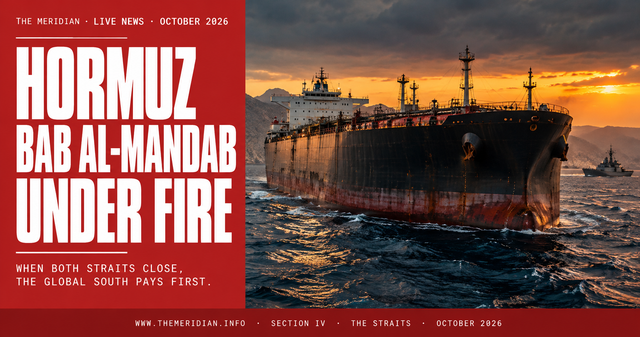
When the world's two most critical oil transit corridors come under attack in the same week, the price is not paid in Washington or Riyadh. It is paid in Nairobi, Dhaka, and Port Louis.
Between 28 September and 5 October 2026, maritime security sources recorded at least 12 attacks on oil, LNG, and LPG tankers in and around the Strait of Hormuz, the highest weekly attack count since the current phase of US-Iran hostilities began. In the same week, Saudi Arabia confirmed it is preparing a military offensive to retake the Bab al-Mandab Strait from Houthi forces, who seized the port of Al-Turbah after government troops withdrew. These are not two separate crises running in parallel. They are two pressure points on the same arterial system, and they are being compressed simultaneously.
One fifth of the world's daily oil supply has historically transited the Strait of Hormuz. The Bab al-Mandab controls the entry point to the Red Sea and the shortest maritime route between Asia, the Gulf, and European markets via the Suez Canal. When either corridor becomes too dangerous to transit reliably, vessels reroute via the Cape of Good Hope, adding between 10 and 14 days per voyage and an average of $1.5 million in additional operating costs per tanker. That cost does not disappear. It enters the pricing chain immediately, transmitted first into freight rates, then into commodity import bills, and finally into the retail price of fuel, food, and every manufactured good that required energy to produce. The further a country sits from either strait, the less say it had in the escalation and the more of the cost it will absorb.
Tanker traffic through Hormuz averaged 10 commodity vessels per day over the 10 days to 5 October, according to analytics firm Kpler, its lowest level since May. Iran's Islamic Revolutionary Guard Corps stated it had targeted vessels travelling through what it described as unauthorised routes, as well as three US-linked ships in adjacent waters. Maritime intelligence firm Marisks described the strikes of 4 October as a major escalation. Goldman Sachs stated publicly that oil could reach $120 a barrel if vessel attacks continue to intensify. OPEC+ kept its output policy unchanged at its October meeting, with a full supply recovery not expected before early 2027.
"The countries with no calculation to make absorb the cost with no seat at the table where it was incurred and no instrument to reduce their exposure."
Gulf producers occupy an uncomfortable position: higher oil prices increase their revenues even as attacks in their own maritime neighbourhood threaten their export infrastructure. The United States repositioned B-52 long-range bombers from RAF Fairford in the same week, a threat signal directed at Tehran rather than a defensive posture, which makes the situation more volatile rather than less. China imports approximately 80% of its oil through corridors that include both straits and has offered no diplomatic engagement. That silence is not neutrality. It is a calculation: disruption to Western-aligned shipping routes raises the relative energy costs of Beijing's competitors more than China's own, given its pipeline infrastructure investments northward through Central Asia and its longer-term positioning in Russian energy markets. Kenya, Bangladesh, Pakistan, Sri Lanka and Mauritius have no comparable calculation to make. They absorb the cost with no seat at the table where it was incurred and no instrument to reduce their exposure.
Oil-importing developing economies spend a systematically higher share of GDP on energy imports than advanced economies, a structural asymmetry the IMF's World Economic Outlook has documented across multiple editions. Sri Lanka's 2022 collapse provides the clearest recent precedent: usable foreign exchange reserves fell below $50 million, less than one day of fuel imports, as oil prices surged in the aftermath of Russia's invasion of Ukraine, and the resulting inability to finance import bills contributed directly to the fall of the government. Pakistan is a more acute case in the present conjuncture. It allocates over 50% of its federal budget to debt service, its currency has depreciated by more than 40% against the dollar since 2022, and it is conducting a land war on its western border with Afghanistan while operating under an active IMF programme. A sustained fuel price shock layered onto that arithmetic does not resolve into a controlled adjustment. Mauritius, which imports 100% of its petroleum products and charges a fuel levy, a road infrastructure levy, and a cross-subsidy for rice and flour on top of the base import price, has no structural mechanism to insulate consumers from a $120 oil scenario without dismantling the fiscal architecture that currently funds the government's revenue position. For small island economies with no domestic energy production and no fiscal buffer, there is no version of this crisis that does not arrive at the pump.
The diplomatic channels that might reduce pressure at either strait are not currently operational: substantive US-Iran negotiations, a Yemeni ceasefire with credible Saudi commitment, a Houthi stand-down. If both corridors remain disrupted for longer than 30 days, the fiscal shock reaches import-dependent developing economies before any resolution is reached. The countries that will pay first had no part in creating the conditions that made the bill necessary.
Add comment
Comments