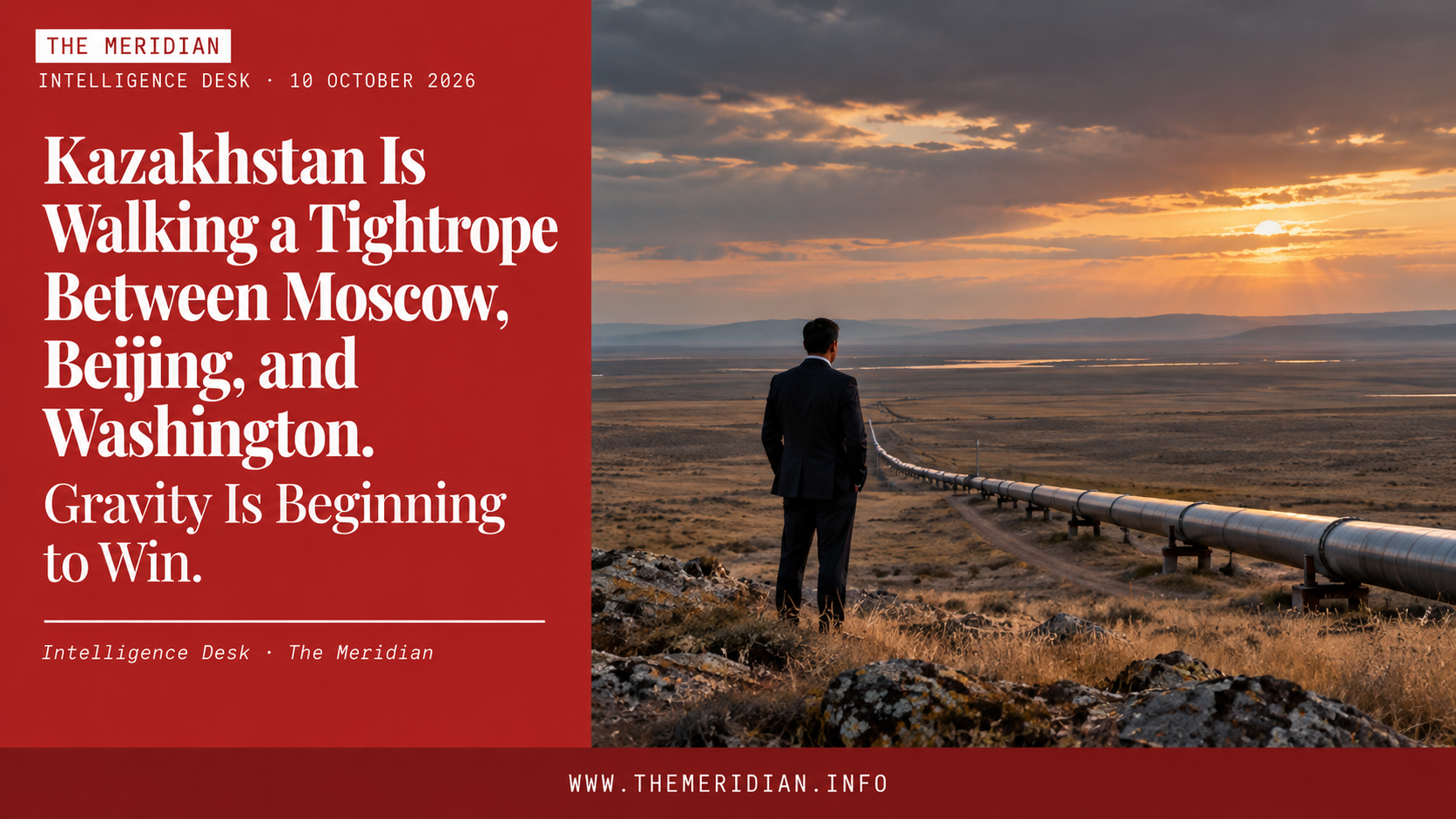
Kazakhstan Is Walking a Tightrope Between Moscow, Beijing, and Washington. Gravity Is Beginning to Win.
Kazakhstan has run the most sophisticated multi-vector foreign policy of any post-Soviet state. It has sold oil westward, borrowed eastward, and deferred to Moscow when required. The war in Ukraine changed the geometry. The margins are narrowing on every side simultaneously.
Kazakhstan has run the multi-vector foreign policy doctrine since Nazarbayev codified it in the 1990s. The idea was elegant: cultivate Russia, China, and the West simultaneously, extract from each, commit to none. For three decades, it worked. Kazakhstan joined the CSTO but did not send troops to Ukraine. It joined the SCO and signed BRI agreements but did not subordinate its energy exports to Chinese preferences. It hosted a Western-integrated oil sector — TotalEnergies and Chevron operate the Tengiz and Kashagan fields respectively — and directed roughly 80% of its crude exports through the Caspian Pipeline Consortium, which runs through Russian territory to Novorossiysk and onward to European markets. The arrangement served everyone. It no longer does.
The Tengiz and Kashagan fields produce a combined 1.7 million barrels per day when operating at capacity. Most of it transits Russia through the CPC pipeline. In March 2022, Russian authorities suspended CPC flows for maintenance over a period of weeks following Kazakhstan's refusal to send CSTO forces to Ukraine and its public statement that it would not violate Western sanctions. The suspension lasted long enough to establish the point: Russia holds infrastructure leverage over Kazakhstan's primary export route. Astana has since pursued the Trans-Caspian corridor — shipping crude under the Caspian Sea to Azerbaijan and onward to Turkey and Europe — as a diversification route. Its capacity is approximately 10% of the CPC volume. It is not a replacement. It is a signal.
The Chinese dimension of Kazakhstan's position is structural in a different way. Beijing's BRI financing has built roads, logistics hubs, and processing capacity across Kazakhstan, and China is Kazakhstan's second-largest trading partner. Kazakhstan has accepted this investment without accepting subordination, but the asymmetry of dependence is real: Chinese infrastructure debt sits on Kazakh balance sheets, Chinese SOEs operate across the special economic zone in Khorgos, and Kazakh exporters are increasingly routed through Chinese logistics networks. The leverage is commercial rather than military, but it is leverage.
“Kazakhstan did not choose to be at the centre of three competing imperial projects. It chose to survive them. That choice is becoming harder to execute.”
The American dimension arrived with secondary sanctions enforcement. OFAC guidance issued in 2023 and 2024 made clear that financial institutions facilitating Russian export circumvention — including those in Kazakhstan, whose re-export of Western goods to Russia rose sharply after 2022 — would face USD correspondent banking restrictions. Astana quietly tightened customs controls. The business model of Kazakh transit to Russia, which had been commercially significant, was curtailed under US pressure applied without a single public ultimatum. Washington did not need to threaten. It calibrated.
What Tokayev is managing is not simply a foreign policy dilemma but a structural squeeze. Russia controls the primary export infrastructure. China holds substantial commercial positions within the country. The United States controls the dollar-clearing system through which Kazakhstan's hydrocarbons are denominated and sold. Each of those actors now requires something from Astana that is incompatible with what the other two require. The multi-vector doctrine was sustainable when each vector could be managed in parallel. It assumed a world where the three powers maintained their own separation. That assumption has dissolved. The Trans-Caspian corridor, the Khorgos expansion, the cautious CSTO distancing, and the customs tightening on Russian transit goods are all moves within a geometry that is narrowing. Kazakhstan is not choosing sides. It does not have that luxury. It is managing proximity to three projects it cannot join, cannot leave, and cannot afford to antagonise simultaneously. The tightrope is not a metaphor. It is the policy.
Add comment
Comments