Famine in Madagascar. The Evidence Is There. The Declaration Is Not.
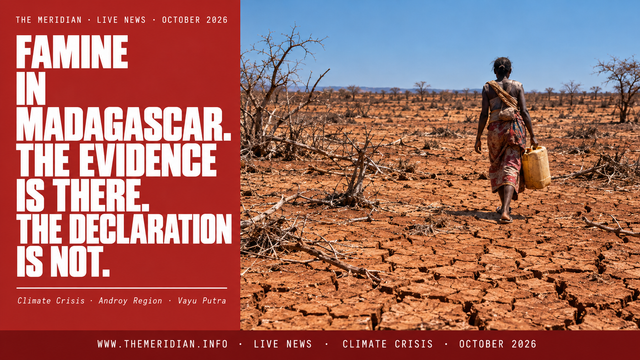
Southern Madagascar has been classified at IPC Phase 4 emergency hunger for the third consecutive year. The WFP appeal is 35% funded. The word “famine” has not been formally applied. That is not a scientific finding. It is a political one.
In the south of Madagascar, at least 1.3 million people are facing severe food insecurity. The Integrated Food Security Phase Classification, the UN's own measurement tool, has placed several districts in the Androy and Anosy regions at Phase 4, emergency level, for the third consecutive year. The lean season began early this year. It was not unexpected. It was not prepared for.
The south of Madagascar has a name for this. It is called Kere. It translates, approximately, as the hungry season. It has existed for generations, driven by the semi-arid climate of the island's southern tip and the subsistence farming and herding communities that have always been its most exposed population. What has changed is the severity, the frequency, and the duration. Three consecutive years of below-average rainfall. Two major cyclone events that damaged northern agricultural output and diverted government attention and resources. A lean season that now arrives before the previous one has properly ended. The WFP's own assessments indicate that acute malnutrition rates in some southern communes have reached levels consistent with emergency thresholds. The IPC tool has the language for what comes next. That language has not been formally applied.
The reason it has not been applied is partly technical and partly political. A formal Phase 5 famine declaration requires that at least 20% of households in a defined area face an extreme lack of food, that acute malnutrition rates exceed 30%, and that two people per 10,000 per day are dying from starvation or starvation-related disease. Those thresholds are not easily met in a population that has developed generational coping mechanisms for periodic hunger. They are also politically significant. A famine declaration triggers specific international obligations and creates reputational exposure for the Malagasy government and for the donor community that has underfunded the WFP's Madagascar response for three consecutive years. The WFP's 2026 Madagascar appeal is currently funded at approximately 35%. The gap is not an administrative oversight. It is a choice.
“It is easier to fund a named emergency than to prevent an unnamed one. The people in the south of Madagascar are living inside that calculation.”
Madagascar is not Gaza. It is not Sudan. There is no armed actor to sanction, no Security Council resolution to pass, no satellite image of a burning convoy to circulate. The cause is climate. The mechanism is drought, cyclone damage, and the systematic failure to build adaptive agricultural capacity in a region that has been visibly deteriorating for a decade. The Green Climate Fund has pledged adaptation financing to Madagascar. Disbursement has been slow. The gap between what was committed at COP and what has arrived in Androy is not measured in years. It is measured in the weight of the harvest that did not come.
The Malagasy government has not formally requested a famine declaration. The donor governments that pledged climate adaptation finance at COP26 and COP27 have not been asked publicly to account for the disbursement shortfall. The WFP has documented the crisis and published its funding gap. No government has responded with emergency appropriations. The word “famine” remains unused. This is not an accident. It is easier to fund a named emergency than to prevent an unnamed one. The people in the south of Madagascar are living inside that calculation.
Add comment
Comments