France Has Left. Russia Has Arrived. The People of the Sahel Are Still There.
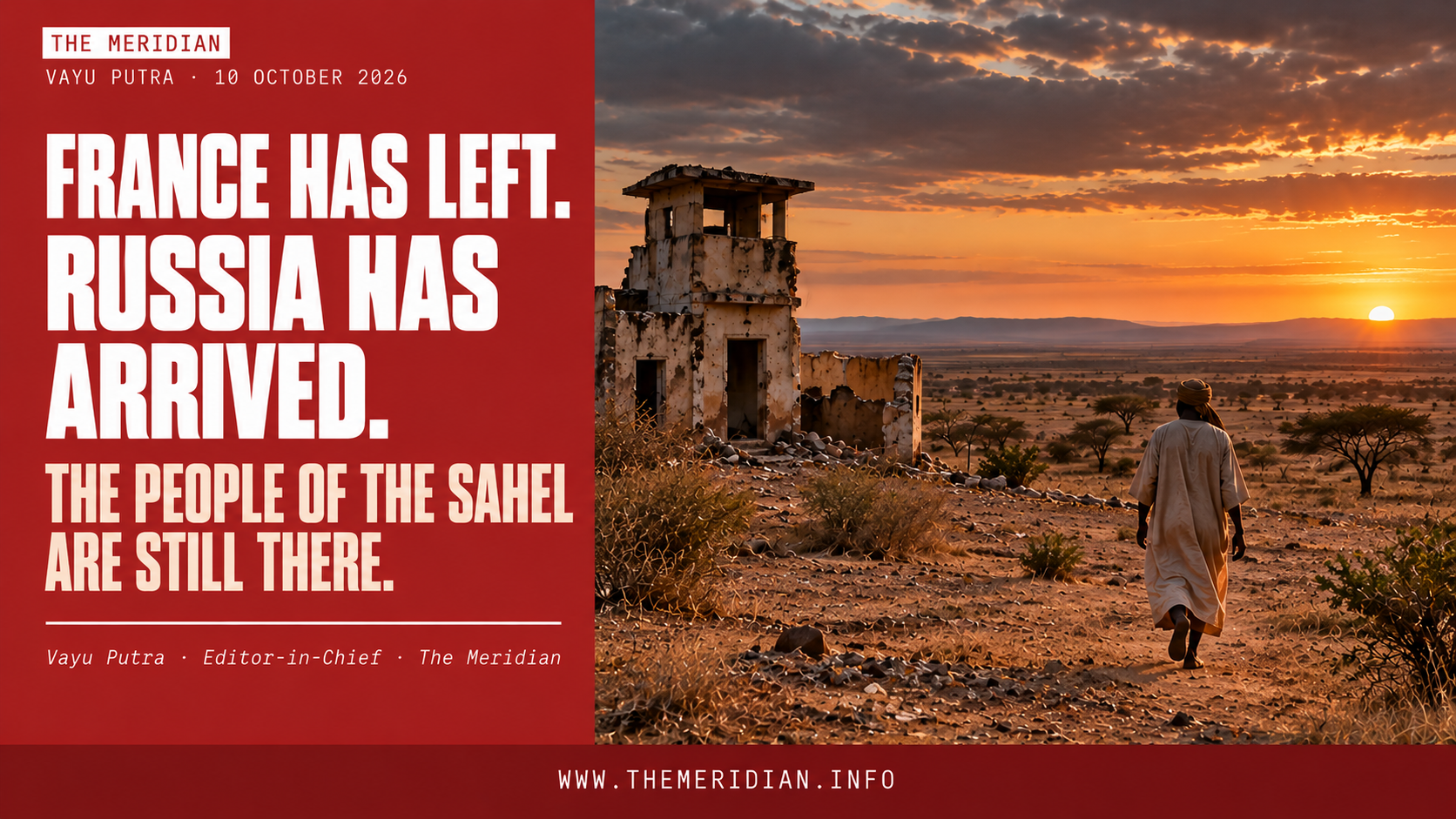
France's Opération Barkhane ran nine years in the Sahel and left the insurgency larger than it found it. Russia's Africa Corps arrived with fewer troops, fewer rules, and no accountability to anyone. The people who live between those two projects are the ones paying the price of both.
Opération Barkhane launched in 2014 as France's attempt to contain the jihadist insurgency that had nearly overrun northern Mali in 2012–13. At its peak it deployed 5,500 troops across five Sahel countries — Mali, Niger, Burkina Faso, Chad, and Mauritania — at a cost of approximately €600 million per year. It ran for nine years. When it ended, the territory under jihadist influence was larger than when it began. That is not a disputed assessment. It is the finding of France's own Senate evaluation of the operation, published in 2023. Barkhane killed significant numbers of jihadist combatants. It did not degrade the insurgency. The two things are not the same.
The manner of France's departure was not a withdrawal. It was an ejection, carried out in sequence by three military juntas. Mali's government ordered French forces out in January 2022 and turned to Russia within weeks. Burkina Faso followed in January 2023. Niger followed in August 2024 after its own coup, completing a clean sweep across the three countries at the centre of the Sahel crisis. In each case the sequence was similar: a military government with a nationalist mandate, a public rejection of the French security partnership framed as an assertion of sovereignty, and a rapid pivot toward what was then Wagner Group and is now the Africa Corps, the Russian Defence Ministry's successor structure. The pivot was not unprompted. French forces had been present for years. The insurgency had expanded regardless. The juntas offered their populations a change of partner rather than a change of outcome.
The Africa Corps arrived with smaller numbers and fewer institutional constraints than Barkhane. It offered governments what Wagner had offered elsewhere: troops, advisers, and a security guarantee with no public conditionality on governance or human rights. It also offered resource access as part of the commercial architecture that had structured Wagner's African deployments in the Central African Republic and Sudan. In Mali, Africa Corps personnel have been documented operating alongside the Malian Armed Forces in areas where civilian casualty incidents have subsequently been recorded by UN monitoring bodies. The accountability mechanisms that applied to French forces — imperfect as they were — do not apply to Africa Corps. There is no parliamentary oversight, no ECOWAS reporting obligation, no press access. The terms of the partnership are not public. The commercial arrangements are not disclosed.
“The Sahel has not been abandoned by the West and rescued by Russia. It has been used by both. The difference is that one of them had to pretend otherwise.”
The ACLED database records that civilian fatalities from political violence in the Sahel reached their highest levels in 2024 and 2025 since systematic monitoring began. The jihadist groups operating under the JNIM umbrella — affiliated with al-Qaeda — and the Islamic State in the Greater Sahara have expanded their area of operations southward into coastal West Africa, into Togo, Benin, and northern Côte d'Ivoire, regions that were not active conflict zones five years ago. This is the inheritance of nine years of Barkhane and two years of Africa Corps. Neither arrested the expansion. The insurgency moved faster than the external powers could adapt, and adapted faster than the external powers could follow.
What the Sahel's population has received from this rotation of external guarantors is a sequence of promises about security that were not kept, a series of transitions that created instability rather than resolving it, and a humanitarian situation that deteriorates alongside the security one. The WFP reports that 18.6 million people across the Sahel are acutely food insecure. UNHCR records over 2.7 million internally displaced persons in the region. The governments in Bamako, Ouagadougou, and Niamey have formed the Alliance of Sahel States and positioned themselves as sovereign actors refusing external imposition. That is a political position. It does not change the insurgency's trajectory, the food insecurity figures, or the question of who, in the absence of a functional security architecture, the people of the Sahel are meant to call when the village is attacked. Neither France nor Russia has answered that question. They have simply taken turns not answering it.
Add comment
Comments