April has ceased to be a month of executive management under pressure. It has become a month of rupture. What began as a period shaped by energy insecurity, diplomatic strain and the politics of shielding Mauritius from external shocks has widened into something more serious: a visible fracture inside one of the country’s historic governing pillars. The central political question is no longer only whether the state can manage imported pressure. It is whether the governing order itself can hold its shape while doing so.
To understand what has just happened, it is necessary to understand what the Mouvement Militant Mauricien has always represented. The MMM grew out of student activism in 1969, when protests against Princess Alexandra’s visit to Mauritius led to the arrest of twelve student-activists, including Paul Bérenger. Following their release, the movement formalised its first Executive Committee and adopted the name Mouvement Militant Mauricien in September of that year. From the outset, the party positioned itself against ethnic and communal politics, advocating instead for class solidarity, workers’ rights and a fairer society without discrimination based on race, caste or religion. It established the General Workers’ Federation and mobilised labour against economic inequalities in post-independence Mauritius.
Over the following decades, the MMM evolved and fractured repeatedly. In 1982, in alliance with the Parti Socialiste Mauricien, it achieved an unprecedented electoral sweep, winning all directly elected seats in the National Assembly. Bérenger became Minister of Finance under Prime Minister Anerood Jugnauth. That alliance broke dramatically on 22 March 1983. Bérenger eventually served as Prime Minister from September 2003 to July 2005, the first and, to date, only non-Hindu to hold that office in independent Mauritius. By the time the November 2024 general election brought the MMM back into government as part of the Labour-led Alliance du Changement, Bérenger was serving as Deputy Prime Minister for the third time in his career. The tension between that institutional role and his standing as the party’s historic conscience has now broken into the open.
The MMM swept every seat in 1982. It fractured before the year was out. Forty years later, the same founder, the same pattern, the same breaking point: power held without programme is power that cannot be defended.
At the start of the month, the government’s line looked clear enough. On April 9, after meeting Prime Minister Navin Ramgoolam, India’s External Affairs Minister S. Jaishankar described a strengthened Mauritius-India framework that included movement on petroleum supply, alongside wider cooperation on transport, development and digital systems. In political terms, this mattered because it allowed the government to present itself as active, connected and prepared in the face of instability in West Asia and the wider threat of imported cost pressure. Around the same time, Mauritian official communications stressed coordinated responses to external economic risk and the acceleration of a 405 MW renewable-energy pipeline. The message was direct: difficult times may be coming, but the state is not asleep at the wheel.
That remains Labour’s principal advantage. In month-to-date terms, the party still looks like the strongest force in the system, not because public anxiety has disappeared, but because the machinery of government remains firmly in its hands. Ramgoolam’s political position is strengthened by the fact that he can still act through diplomacy, state coordination and executive agenda-setting rather than through rhetoric alone. If April had continued on that trajectory, the month might have been remembered chiefly as a test of statecraft under external pressure.
April has also been shaped by a second front: Chagos. Reporting on April 11 showed Mauritian officials adopting a sharper tone after the anticipated handover process appeared to stall. Foreign Minister Dhananjay Ramful stated that Mauritius would spare no effort to pursue diplomatic or legal avenues, while Attorney General Gavin Glover pointed toward further talks with the British side. The political significance is considerable. A question once framed as a national diplomatic prize now risks becoming a site of managed frustration, in which the government must defend a process it cannot fully control and deliver results it cannot guarantee on any fixed timetable.
That does not erase Labour’s wider strengths, but it complicates the claim to steady strategic momentum at precisely the moment when the coalition’s internal coherence is also under strain. Two fronts under pressure simultaneously is a different political condition from one.
The Chagos question was central to the Alliance du Changement’s 2024 electoral offer. Ramgoolam returned to power in part on the expectation that he could deliver what the Jugnauth government had negotiated but not completed. Each month that passes without a formal handover converts that expectation into a source of political exposure.
The government cannot simply lower expectations. Too much political capital was staked on the outcome. It cannot accelerate the process unilaterally. The British side controls the timetable. The result is a diplomatic position that requires the government to appear confident while managing a process it does not control. That posture is sustainable when the rest of the political environment is stable. It is harder to sustain when a major coalition partner is simultaneously fracturing.
The structural risk: if Chagos remains unresolved into the second half of 2026, it transitions from a diplomatic asset to a political liability. The opposition, particularly any Bérenger-led formation with credibility on statecraft, would have a clear line of attack.
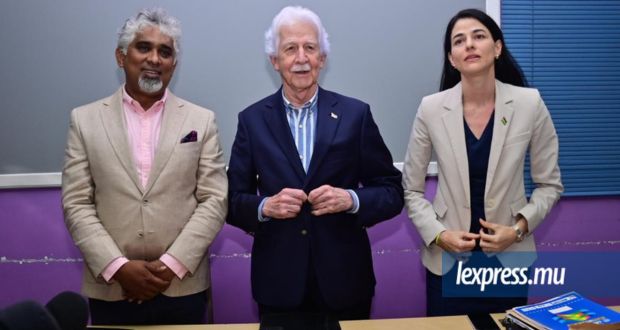
The fracture had been building for weeks. Bérenger resigned as Deputy Prime Minister on March 20, 2026, citing divergences with the Labour Party and describing himself as heartbroken. On April 4, Bérenger, alongside his daughter Joanna Bérenger and fellow MP Chetan Baboolall, announced that their faction would sit as independent MPs while he retained his role as party leader. The internal split at that point stood at fifteen MMM deputies supporting the government against the three who had moved to the opposition benches. Bérenger contested the legitimacy of the forthcoming delegates’ assembly, describing its participant list as irregular, and announced that his faction would boycott it.
On April 12, the MMM’s Assemblée des Délégués met nonetheless, at the municipal hall in Belle Rose, to decide whether the party should remain in government. The majority voted to stay, with 306 of 400 branches represented. A party does not convene such a meeting unless the internal strain is real and the leadership is no longer certain of the line. But it also demonstrated that the organisational apparatus still functioned: the delegates could be called, the room could be tested and a formal verdict secured. In ordinary circumstances, that might have been enough to settle the matter.
It was not.
Within a day, Bérenger formally resigned from the MMM, the party he had helped to found more than fifty years earlier. In his departure statement, as reported by Le Mauricien, he described the decision as one that carries the weight of an entire life and said he was leaving with immense sadness but without having compromised his convictions. He criticised the decision to remain in government without conditions and without clear guarantees that the programme on which the party had sought the confidence of voters would be implemented. He announced that his political engagement would continue under a new form.
Stage one · March 20: Bérenger resigns as Deputy Prime Minister after a final call with Prime Minister Ramgoolam. He cites divergences with Labour and describes himself as heartbroken. He does not immediately resign from the MMM or from Parliament.
Stage two · April 4: Bérenger, Joanna Bérenger and Chetan Baboolall announce they will sit as independent MPs. The parliamentary split is confirmed at 15 MMM deputies supporting the government versus 3 in opposition. Bérenger declines the role of Leader of the Opposition, citing his age and the need for fresh economic management. He contests the legitimacy of the forthcoming delegates’ assembly.
Stage three · April 12: The Assemblée des Délégués meets at Belle Rose without the Bérenger faction. 306 of 400 branches are represented. The majority votes to remain in government. The apparatus holds. The founder’s legitimacy does not.
Stage four · April 13: Bérenger formally resigns from the MMM after more than fifty years. He announces his political engagement will continue under a new form. A new formation is in preparation. The schism is now irreversible.
Rester au pouvoir ne peut être une finalité en soi. Remaining in power cannot be an end in itself. — Paul Bérenger, on his resignation from the MMM, April 2026.
For the governing alliance as a whole, this is the most consequential political development of April so far. Labour may benefit in the short term from the contrast: a divided partner can make the executive core look more stable and more necessary by comparison. But coalition fracture is not a neutral event. It consumes attention and political energy. It alters the internal balance of confidence between partners. It raises a larger question about the durability of coalition discipline under sustained pressure, particularly when economic strain, diplomatic uncertainty and questions of programme delivery are all simultaneously in play. The issue is no longer whether the alliance is formally intact. It is whether it still feels strategically coherent to those inside it.
This gives fresh relevance to actors who previously sat at the edge of the month’s central narrative. Rezistans ek Alternativ had already been signalling discomfort with the government’s direction, calling for the coalition to recentre itself around a more principled and social programme. In a coalition where one major partner has now split, that kind of internal corrective voice carries greater weight. ReA does not command the historical or institutional scale of the MMM, but under conditions of coalition stress its role as an ideological pressure point becomes more consequential than its parliamentary numbers alone would suggest.
The opposition’s position is more complicated than the parliamentary numbers alone suggest. The formal weakness of the traditional opposition remains real; the National Assembly record still reflects a chamber in which executive business moves with little structural resistance. But rupture inside a governing pillar changes the political field in ways that the vote count does not immediately capture. It creates oxygen. The unresolved question is who captures it first. The established opposition may attempt to do so. A new Bérenger-led formation, carrying the symbolic authority of the MMM’s founding generation, may attempt to do so more effectively. On April 4, Bérenger himself declined the role of Leader of the Opposition, citing his age and a desire for fresh economic management. That signals that the new formation, when it comes, is intended as something beyond a simple parliamentary regrouping.
The month-to-date reading must therefore be revised. April is no longer simply the story of executive control under external pressure. It is also the story of coalition durability under internal fracture. Labour remains the strongest single force in the field. The state continues to project administrative motion. Parliament still reflects an overwhelming asymmetry of power. But the idea of coalition solidity has now been punctured in a way that cannot be described as minor turbulence or routine coalition friction. April, so far, is the month the MMM broke.
- Whether the Bérenger-led formation moves beyond declaration and begins to attract institutional and electoral weight that could structurally alter the opposition landscape.
- Whether the rump MMM can sustain internal discipline and governing credibility after the formal departure of its founding figure.
- Whether Labour moves to consolidate the rupture to its own advantage or finds itself drawn into costly coalition repair that limits its executive freedom of action.
- Whether the Chagos impasse and energy-security pressures continue to define the external agenda, or whether internal political fracture overtakes diplomacy as the month’s dominant narrative.
April began as a month about external pressure. It will be remembered as a month about internal fracture. The two are not unrelated. A coalition that enters a period of external stress already divided is a different political entity from one that enters it whole. The MMM’s schism does not immediately threaten Labour’s hold on government. But it changes the texture of that hold from confident to managed, from stable to supervised.
Bérenger’s departure is not merely symbolic. He is the only figure in Mauritian politics whose personal authority exceeds that of any institutional structure he belongs to. When he was inside the MMM, the party borrowed legitimacy from him. Now that he has left, the party retains the apparatus and loses the aura. A new formation built around that aura, even without the apparatus, may prove more electorally resonant than the numbers of its founders currently suggest.
The governing alliance will survive April. The question worth watching is not survival but coherence: whether the government that emerges from this month still commands the political confidence to make difficult decisions on energy, fiscal consolidation and Chagos, or whether it governs in a more defensive register, managing the coalition rather than leading the country. That distinction will define the rest of 2026.
This is a month-to-date political monitor, not a final end-of-month assessment. It is based on official statements, parliamentary records and contemporaneous reporting from L’Express and Le Mauricien, verified against public historical records, all available to The Meridian up to April 13, 2026. Historical data on the MMM is drawn from verified public sources. This is a structured analytical reading and is not a polling exercise or predictive model.
Add comment
Comments