The Double Extraction Mechanism: How Foreign Capital Takes Value From Mauritius Three Times
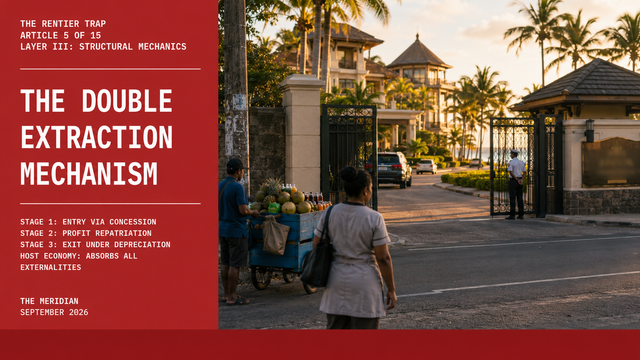
Foreign investment in a rent economy does not take value once. It takes it three times: at entry through the concession that makes the investment attractive, at operation through the profit repatriation that removes the return from the host economy, and at exit through the currency conversion that amplifies the dollar value of what leaves as the rupee depreciates. The host economy absorbs the infrastructure cost, the environmental externality, and the fiscal burden of all three stages. The Meridian names the mechanism and quantifies it for Mauritius.
The standard account of foreign direct investment presents it as a net benefit to the host economy: capital comes in, employment is created, technology is transferred, tax revenue is generated. This account is not wrong about the first stage. When an EPZ manufacturer arrived in Mauritius in 1975, capital did come in, employment was created, and some tax revenue was generated. The account becomes incomplete at the second stage, when the profits generated by the investment left Mauritius. It becomes seriously misleading at the third stage, when the exit of capital under a depreciating rupee transferred additional value to the departing investor at the expense of the residual economy. The Double Extraction Mechanism is the name The Meridian gives to the full three-stage process that the standard account describes incompletely.
Every major category of foreign investment in Mauritius has been structured around an entry concession: a fiscal, regulatory, or legal advantage that makes the investment economically attractive to the foreign investor by transferring a cost from the investor to the Mauritian state or the Mauritian household. The Export Processing Zone, established in 1970, offered full exemption from corporate tax for the first ten years of operation, 50 per cent exemption for years eleven to fifteen, and 25 per cent exemption for years sixteen to twenty, as recorded in analyses of the period citing Meade report implementation. The fiscal cost of these exemptions was borne by the Mauritian public budget, which foregone the revenue that a taxed enterprise would have generated.
The Integrated Resort Scheme, established in the early 2000s under the Investment Promotion Act, offered foreign nationals the right to purchase property and obtain Mauritian residency at a minimum investment threshold that placed the asset class beyond domestic buyers. The threshold itself is the concession: it creates a property market segment dominated by foreign currency buyers who pay in dollars or euros, converting rupee-denominated land into dollar-denominated capital at whatever exchange rate the market produces at the moment of transaction. The offshore financial sector operates under a treaty network that provides access to double taxation avoidance arrangements that are not available to domestic enterprises at the same terms. The concession at entry in each case transfers fiscal value from the state to the investor. The investment is structured to be attractive precisely because the entry cost has been partially socialised.
The return on foreign investment in Mauritius does not remain in Mauritius. Tourism hotels operated by international chains remit management fees, franchise royalties, and net operating profit to their parent companies abroad. The legacy EPZ textile manufacturers, whose operations have largely wound down, repatriated their profits to Hong Kong, Taiwan, and Singapore throughout the decades of their presence. The offshore financial sector, by its structural nature, channels fees and asset management returns to parent entities and beneficial owners in the jurisdictions whose capital it manages. The IMF's data, retrieved from the Federal Reserve Bank of St. Louis FRED database for the Sub-Saharan Africa Regional Economic Outlook, records the net lending and borrowing position from direct investment for Mauritius at negative 20.94 per cent of GDP in 2025: capital is leaving through the direct investment channel at a rate that significantly exceeds what is arriving. In 2023 it was negative 12.61 per cent of GDP. In 2025 the outflow accelerated.
The Bank of Mauritius records total foreign direct investment received in the most recent available period at MUR 24,814 million, while the external debt figure stands at MUR 98,826 million as of December 2025. The current account deficit reached MUR 21,166 million in the fourth quarter of 2025. The current account is the sum of the trade balance, the net income from foreign investment, and the net transfer payments. A persistent current account deficit in a country receiving significant FDI indicates that the income flowing out of the country on existing investments exceeds the capital flowing in as new investment. The second extraction, profit repatriation, is measurable in the current account as the primary income deficit: the systematic excess of income payments to foreign investors over income received from Mauritian investments abroad.
The third stage of the mechanism operates through the exchange rate. The rupee has been in structural decline against major currencies since 1986, the last year Mauritius recorded a trade surplus. The Bank of Mauritius interbank sell rate reached Rs 47.36 per US dollar in August 2026, a record low. When foreign capital exits Mauritius, it converts rupee-denominated proceeds into foreign currency at whatever rate the market produces at the moment of exit. A foreign investor who entered Mauritius when the rupee was stronger, held an asset that appreciated in rupee terms, and exits when the rupee is weaker, captures three distinct value accretions: the original rupee appreciation of the asset, the currency gain from converting weaker rupees into stronger dollars, and the entry concession that made the original investment attractive. The Mauritian economy, which absorbs the infrastructure cost of making the investment possible, the fiscal cost of the tax concession that made it attractive, and the environmental cost of the land use change that enabled it, receives the employment and the headline FDI figure. The full value chain runs in the opposite direction.
The Integrated Resort Scheme is the instrument in which all three stages of the Double Extraction Mechanism are most visibly combined. The Economic Development Board of Mauritius records Rs 152 billion in foreign real estate investment channelled through the IRS and successor schemes since 2006. Mauritian nationals account for 9 per cent of acquisitions: the scheme was designed for foreign buyers and has functioned as designed. Property prices in Mauritius rose approximately 80 per cent over the two decades of the scheme's primary operation. Wages rose approximately 20 per cent over the same period. The divergence is not incidental. It is the price mechanism recording the consequence of opening a segment of the Mauritian property market to foreign currency buyers with structurally higher purchasing power than rupee-earning residents.
The scheme's structure makes all three extraction stages legible. At entry, the foreign buyer receives Mauritian residency rights, access to the island's healthcare and infrastructure, and legal title to coastal land, in exchange for a minimum investment that is set to attract high-net-worth foreign nationals rather than to reflect the productive value of the land to the Mauritian economy. The entry concession is the residency right and the infrastructure access that accompanies it. At operation, the property is held, maintained by local labour at rupee wages, and appreciated in rupee terms while generating no productive economic output for the host economy. The holder of a luxury IRS villa is not an economic actor in Mauritius in any productive sense. They are a rent recipient, collecting capital appreciation on an asset whose value was created by Mauritius's geography, climate, and infrastructure, not by the investor's productive contribution. At exit, whether through resale to another foreign buyer or through eventual repatriation of proceeds, the capital converts out at a rupee rate that has been depreciating since the scheme began. The dollar or euro proceeds of a 2026 exit are worth more relative to the original dollar or euro entry cost than the nominal rupee appreciation alone would suggest, because the rupee has weakened against the currencies in which the investor thinks about wealth.
The mechanism is not a failure of the investment. From the investor's perspective, it has worked perfectly. Entry was subsidised, returns were repatriated, and depreciation amplified the dollar value of the exit. The host economy absorbed the infrastructure cost of all three stages and received 9 per cent of the property acquisitions it made possible.
The Double Extraction Mechanism distributes costs to actors who did not participate in the investment decision and are not party to the returns. The EPZ tax holidays that made the investment attractive were financed by the Mauritian public budget, which means they were financed by Mauritian taxpayers who were not shareholders in the EPZ enterprises and received no share of their profits. The IRS property appreciation that rewarded the foreign buyer was financed by the exclusion of Mauritian buyers from a segment of the coastal property market, raising prices for domestic buyers throughout the adjacent market segments. The rupee depreciation that amplified the dollar value of the foreign investor's exit was borne by every Mauritian household that imports food and fuel in foreign currency and earns wages in the domestic one.
The Bank of Mauritius data on the net direct investment position going to negative 20.94 per cent of GDP in 2025 captures the aggregate consequence. Capital is not accumulating in Mauritius through the FDI channel. It is transiting through Mauritius, extracting rents at each stage, and exiting at a rate that exceeds what is arriving. The FDI figure that appears in the headline data, MUR 48.04 billion in 2025, of which approximately 44.5 per cent was directed to real estate rather than to productive enterprise, describes the gross inflow. The net position describes the direction of the flow. The flow is outward.
Stage One: Entry via Concession. The investment is made attractive by transferring part of its cost from the investor to the host economy. EPZ: tax holiday of up to 100% for ten years, socialised through the public budget. IRS: residency rights and infrastructure access in exchange for minimum investment threshold; land priced in rupees, purchased in foreign currency, coastal location generated by Mauritius's geography. The concession reduces the investor's cost. The cost does not disappear. It is absorbed by the state and the taxpayer.
Stage Two: Profit Repatriation. The return on the investment leaves the host economy. Tourism profits remitted to parent chains. EPZ profits repatriated to Asian manufacturers. Offshore management fees paid to parent entities. The IMF records the net direct investment position for Mauritius at negative 20.94 per cent of GDP in 2025: more capital leaving through the direct investment channel than arriving. The employment and the infrastructure remain. The profit does not.
Stage Three: Exit Under Depreciation. When capital exits, it converts rupee proceeds into foreign currency at a rupee rate that has been structurally declining since 1986. The depreciation amplifies the dollar value of the exit beyond the nominal rupee appreciation of the asset. The Mauritian household that earns rupees and buys imported goods absorbs the depreciation as higher prices. The departing investor captures it as a currency gain. The mechanism is not a conspiracy. It is the arithmetic of holding rupee-denominated assets in a structurally depreciating currency and exiting in a structurally appreciating one.
The Double Extraction Mechanism is not a normative argument against foreign investment. It is a structural description of how foreign investment operates in a rent economy where the host has no productive base to retain value, no exchange rate stability to protect against the depreciation amplifier, and no regulatory architecture to capture a share of the return for the public budget beyond the fiscal concessions that made the investment attractive in the first place.
The 44.5 per cent of Mauritius's FDI directed to real estate in 2025, rather than to manufacturing, technology, or productive enterprise, is the market's verdict on what Mauritius offers foreign capital: not a productive platform but a rent asset. A villa on the coast of a depreciating-currency small island, purchased with residency rights attached, generating no productive output but appreciating in rupee terms and converting to dollars on exit, is a near-perfect extraction instrument. It is also, viewed from the host economy, the clearest possible illustration of the gap between the headline FDI figure and the direction of the underlying value flow.
The flow is outward. The net direct investment position at negative 20.94 per cent of GDP in 2025 is the number that the FDI headline does not show. That number is the Double Extraction Mechanism, quantified.
Add comment
Comments