Dubai: The Trap That Worked / How a Rentier State Engineered Its Own Exit and What It Cost
In 1985, a United States Geological Survey assessment of Dubai's oil position recorded that at the prevailing rate of production, the emirate's reserves would be exhausted within a decade. The ruler of Dubai had read the same arithmetic six years earlier and had already begun building what would replace the oil. The infrastructure was completed. The oil ran out. Dubai survived. This article examines what the mechanism was, who paid for it, and why the states that study the model cannot replicate it.
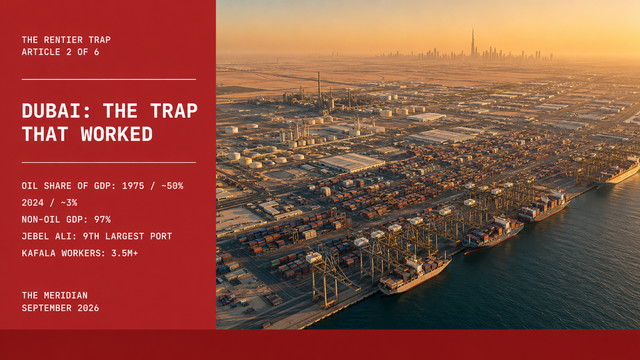
On 26 February 1979, the British royal yacht HMY Britannia, with Queen Elizabeth II on board, entered a new deep-sea port 40 kilometres south of Dubai to inaugurate it. The port, Jebel Ali, was the largest man-made harbour in the world, visible from space, and it had been built at the instruction of Sheikh Rashid bin Saeed Al Maktoum, the ruler of Dubai, who had taken the decision to construct it in 1975. At the time of that decision, Dubai's petroleum industry contributed over 65 per cent of the UAE's gross domestic product, according to data recorded by the United States Geological Survey in its 1978 assessment of the UAE's mineral industry. Sheikh Rashid understood two things simultaneously: that Dubai was located at the precise geographic intersection of Europe, Asia, and Africa, and that the oil financing the port would not last long enough to be taken for granted. He built the port with the oil money before the oil was gone. That decision is the entire Dubai model, compressed into a single act of infrastructure policy.
The sequencing of Dubai's economic transformation is not accidental. It is the result of a series of deliberate infrastructure decisions made before the oil revenue that financed them was depleted. Jebel Ali Port opened in 1979. The Jebel Ali Free Zone (JAFZA) was established in 1985, creating the industrial and logistics infrastructure around the port. Emirates airline was founded in 1985, with seed capital from the Dubai government, to build the aviation connectivity that would make the emirate a viable global hub. The Dubai International Financial Centre (DIFC) was established in 2004, adding the financial architecture to the logistics and aviation base already in place.
Each of these decisions preceded the revenue streams they were designed to generate. Jebel Ali was built before container shipping had established the trade volumes that would justify it. Emirates was founded before Dubai International Airport was the global hub it would become. The DIFC was established before Dubai had the financial services depth that now makes it a regional capital market. The model is one of anticipatory infrastructure: the asset is built in advance of the demand it will serve, financed by a resource rent that the builder knows is finite.
The result of four decades of this strategy is recorded in the data published by the UAE's Federal Competitiveness and Statistics Centre. In the first quarter of 2025, non-oil GDP reached a historic high of 77.3 per cent of total UAE output, with oil-related activities accounting for 22.7 per cent. In 2024, the non-oil economy grew by 5 per cent to reach AED 1.342 trillion. The leading contributors to non-oil GDP were trade at 16.5 per cent, manufacturing at 15 per cent, and financial and insurance activities at 12.5 per cent: precisely the sectors that Jebel Ali, the free zone, and the DIFC were designed to generate. The arithmetic of the transformation is not disputed. The oil accounted for more than 65 per cent of GDP in 1978. It accounts for less than a quarter today, and the trajectory is downward.
The construction of Jebel Ali, the expansion of Dubai International Airport, the building of the hotel and commercial infrastructure that made the emirate a global destination, and the staffing of the logistics, hospitality, and financial services economy that now generates the non-oil GDP: all of it was built and is maintained by a migrant labour force that accounts for approximately 89 per cent of the UAE's total population. UAE nationals constitute approximately 11 per cent of the country's residents, according to government census data. The remaining population is composed of migrant workers operating under the kafala sponsorship system, a legal architecture that ties a worker's residency status to their employer, restricts their ability to change jobs without employer consent, and provides no pathway to citizenship regardless of the duration of employment.
The International Labour Organization has documented the kafala system extensively as a structural labour control mechanism that creates conditions of dependency incompatible with freely negotiated labour contracts. Under kafala, the employer holds the worker's residency documents. Departure from the country requires employer consent. A worker who leaves an employer without consent becomes undocumented. The system was not incidental to Dubai's transformation. It was the mechanism that made the transformation affordable. Construction labour, hospitality labour, logistics labour, and domestic labour were available at costs that a freely negotiated market would not have produced, because the workers were not in a position to negotiate freely.
Dubai did not escape rent dependency. It escaped oil dependency. The rents were replaced with logistics rents, finance rents, tourism rents, and real estate rents. The political economy that made the transition possible is not separable from the transition itself.
The development economics literature on Dubai asks whether the diversification succeeded. By the metric of reducing oil dependency, it unambiguously did. The more demanding question is whether Dubai replaced oil rents with non-rent productive capacity, or merely replaced oil rents with a different and more durable portfolio of rents. The evidence supports the latter conclusion. Jebel Ali generates revenue because it is the most efficient container port between Asia and Europe, which is a function of its geographic location: a rent of position, not a rent of production. Emirates generates revenue because Dubai sits at the intersection of intercontinental flight paths, which is again a geographic rent. The DIFC generates revenue because Dubai's regulatory architecture and geographic positioning make it an efficient interface between Gulf capital and global financial markets: a rent of institutional positioning. Dubai's tourism generates revenue because it has built the infrastructure to capture the discretionary spending of high-income travellers: a discretionary service rent. None of these rents are oil. None of them will be depleted in a decade. But they are rents.
What Dubai built, at an accuracy the model's admirers rarely acknowledge, was a more durable and diversified rent portfolio, financed by a finite resource rent, constructed by a captive labour force, and maintained by an autocratic political economy that could allocate capital toward long-horizon infrastructure without the constraint of democratic deliberation or electoral cycles. The emirate was not starting from zero. It had Abu Dhabi behind it: a federal partner with hydrocarbon reserves large enough to backstop Dubai's credit when the 2008-09 financial crisis threatened the debt-financed expansion of the boom years. Without the Abu Dhabi intervention, the model's trajectory would have been substantially different.
1. A finite but substantial oil resource. Dubai's oil was enough to finance the infrastructure transition but not enough to sustain indefinite rent extraction. The finitude created the urgency. The scale provided the capital. Both were necessary.
2. Geographic positioning on global trade routes. Dubai sits at the intersection of the Europe-Asia shipping lane, intercontinental aviation paths, and the Gulf's capital flows. The ports, airports, and financial centres built there generate rents of position that cannot be replicated by states without the same geographic endowment.
3. The kafala labour system. The construction and maintenance of Dubai's infrastructure was financed partly by suppressing the labour costs of the workforce that built it. The kafala system is not a peripheral feature of the Dubai model. It is structural to the cost arithmetic that made the model viable.
4. The Abu Dhabi capital backstop. When Dubai's debt-financed expansion reached its limit in 2009, Abu Dhabi provided a $10 billion bailout. The Dubai model is not a standalone achievement. It is the achievement of a federal entity with access to one of the world's largest sovereign wealth fund reserves.
The Dubai model proves that a rentier state can engineer a transition away from dependence on a single depleting resource, provided it acts early enough, has sufficient capital to finance anticipatory infrastructure, possesses or can create the geographic conditions for alternative rent generation, and operates a political economy capable of making long-horizon capital allocation decisions without the friction of democratic contestation. These conditions are not widely distributed. They are not present in most of the states that cite Dubai as a model.
The states of the Global South that study Dubai are, in the majority, neither autocracies with sovereign wealth fund backstops, nor geographically positioned at the intersection of global trade routes, nor in possession of enough oil revenue to finance a decade of anticipatory infrastructure construction before the oil runs out. The features of the Dubai model that made it work are precisely the features that are structurally absent in the states that are asked to replicate it. Citing Dubai as proof that diversification is possible is analytically correct. Citing it as a template for how diversification should be pursued by states operating under different conditions is a category error that the model's admirers have never adequately addressed.
Dubai is the success case of this edition's comparative analysis because the oil dependency was genuinely reduced. The transition from over 65 per cent of GDP in oil revenue in 1978 to 22.7 per cent in 2025 is a documented, primary-source-verified fact, not an assertion. The port was built before the oil ran out. The airline was founded before the hub was established. The financial centre was created before the financial depth existed to justify it. These are real achievements of foresight and institutional capacity.
What the celebration of the model consistently omits is the population that built it: the 89 per cent of the UAE's residents who are not citizens, whose labour costs were suppressed by a legal architecture that restricted their ability to negotiate freely, who have no pathway to citizenship regardless of how long they remain, and who will be required to leave when the economy no longer needs their specific category of labour. The kafala system is not incidental to the Dubai success story. It is the mechanism through which the labour cost of the transition was kept low enough to make the transition financeable. Acknowledging it does not diminish the infrastructure achievement. It completes the account of how the achievement was made.
Dubai escaped the oil trap. It remains inside the rent trap. And the workers who built the exit paid a price that does not appear in any GDP table.
Add comment
Comments