Iran: The Curse Without the Crown / When the Rentier Model Fails on Its Own Terms
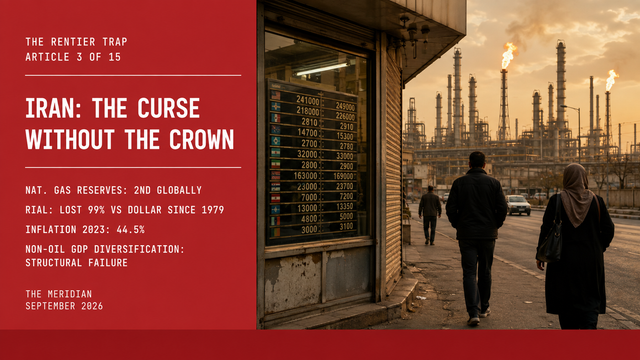
Iran holds the world's second largest proven natural gas reserves after Russia, representing 15.9 per cent of the global total, and ranks among the top four in proven oil deposits. Its nominal GDP per capita in 2024, recorded by the World Bank at $5,778, remains below the $7,422 recorded in 1976, before the revolution that was supposed to return the nation's resources to its people. The oil was always there. The trap closed anyway. This article examines how, and why sanctions are the wrong explanation.
The standard account of Iran's economic failure assigns primary causation to international sanctions. It is not wrong that sanctions have damaged the Iranian economy. The US Energy Information Administration has documented sustained reductions in Iranian oil export volumes following successive rounds of sanctions. The IMF has projected negative or near-zero growth for Iran in multiple years since 2012 as a direct consequence of oil revenue compression. The rial, which traded at approximately 70 to the US dollar at the time of the 1979 revolution, reached 1.4 million to the dollar on the open market in early 2026, according to Gulf News market data, a depreciation of approximately 20,000 times over four decades. The scale of the economic deterioration is not in dispute. What is in dispute is the causal account. The rentier trap in Iran did not close because of sanctions. The sanctions accelerated the closure of a trap whose internal architecture had been under construction since 1979.
The hydrocarbon endowment of the Islamic Republic of Iran is, by any measure, extraordinary. According to the Iran Petroleum Ministry, confirmed by the US Energy Information Administration, Iran's proven natural gas reserves stand at approximately 1,201 trillion cubic feet, representing 15.9 per cent of the world's total and ranking second globally after Russia. Iran's proven oil reserves are estimated at approximately 150 billion barrels, representing roughly 10 per cent of global proven petroleum reserves, ranking third or fourth depending on the treatment of Canadian unconventional deposits. The South Pars gas field in the Persian Gulf, shared with Qatar, is the world's largest single gas field. At 2024 rates of production, Iran's gas reserves have approximately 122 years of supply remaining.
This is not a country without resources. It is one of the most hydrocarbon-rich territories on earth. The comparison with Dubai is instructive in reverse: Dubai built its exit infrastructure because it knew the oil would run out. Iran's oil and gas are not running out. The structural failure of the Iranian economy cannot be attributed to resource depletion. It must be attributed to what happened to the resource revenue after it was collected.
The 1979 Islamic Revolution produced a specific institutional architecture for managing the oil revenue. The bonyad system, a network of quasi-governmental foundations operating outside the normal state budget, was established in the immediate aftermath of the revolution to manage assets expropriated from the Shah's regime and from political dissidents, religious minorities, and private capital holders who fled the country. Bonyad Mostazafan, the largest of these foundations, was sanctioned by the US Treasury Department in 2019 and described in the Treasury's press release as an organisation that "controls large swaths of the Iranian economy" and is "estimated to account for over one percent of Iran's gross domestic product" independently, with total bonyad assets constituting a far larger share. The Treasury noted that bonyads "receive benefits from the Iranian government, including tax exemptions, but are not required to have their budgets publicly approved."
The Islamic Revolutionary Guard Corps developed a parallel economic empire alongside the bonyad system. According to a joint US Treasury Department press release on the designation of Bonyad Mostazafan, EIKO, and Astan Quds Razavi, these entities alongside the IRGC's Khatam al-Anbiya engineering firm "are said to control more than half of the Iranian economy." The Clingendael Institute's analysis, cited in reporting by Fortune magazine in 2026, estimated that IRGC-affiliated foundations alone accounted for more than half of Iran's GDP by 2013. The IRGC's economic activities span oil, construction, banking, telecommunications, ports, and real estate. These entities operate with structural advantages over private competitors: access to state contracts, exemptions from the tariff and regulatory framework that constrains ordinary business, and the political protection of the Supreme Leader's office.
The consequence of this institutional architecture is a non-oil economy that cannot function competitively. Private sector firms operating in sectors where IRGC affiliates are present face structural disadvantages that no market mechanism can correct, because the advantages of the IRGC enterprises are political rather than productive. Import tariffs that apply at 50 to 100 per cent for private businesses are waived for IRGC-affiliated importers, as the Carnegie Endowment for International Peace documented in testimony to the US Congress. The result is that the non-oil private sector in Iran operates in a permanently distorted environment where the price of political connection is a structural prerequisite for survival. Productive investment yields lower returns than rent-seeking within the system. The system therefore generates rent-seekers, not producers.
The depreciation of the Iranian rial is the most legible record of the structural failure, and its timeline contradicts the sanctions-as-primary-cause account. The rial began depreciating immediately after the 1979 revolution, well before the nuclear-related sanctions that post-2012 analysis focuses on. The Iran-Iraq war of 1980 to 1988, financed substantially by oil revenue, produced inflation and monetary instability that the central bank could not contain because the fiscal demands of the state were incompatible with monetary discipline. The rial lost the majority of its value in the 1980s and 1990s, during periods of sanctions that were limited in scope and in many cases not consistently enforced.
By the time the most stringent sanctions came into effect after 2012, they landed on an economy whose monetary system had already been structurally compromised by four decades of fiscal dominance: the subordination of monetary policy to the revenue requirements of the state and the IRGC's parallel economy. The parallel exchange rate system that the IMF noted in its 2014 Article IV consultation, where the official rate stood at 42,000 rials to the dollar while the black market rate was approximately 144,000, is not a creation of external pressure. It is the institutional expression of a state that cannot maintain currency credibility because its economic institutions are designed to transfer rents to political insiders rather than to generate productive value.
Iran's GDP per capita in 2024 remains below the level recorded in 1976, before the revolution that was supposed to return the nation's resources to its people. The oil was always there. The institutional architecture that replaced the Shah's rentier model built a more durable version of the same trap.
The World Bank's assessment of Iran's economic trajectory, cited in multiple analyses of the IRGC's economic role, describes Iran as having "suffered from a lost decade of economic growth" driven by the ongoing focus on oil and the sanctions regime. The World Bank's data shows that between 2011 and 2020, the share of Iranians living below the international poverty line increased from 20 per cent to 28.1 per cent. A further 40 per cent of the population was assessed as vulnerable to falling into poverty. These are the social consequences of the structural failure.
But the World Bank's timeline is instructive. The deterioration measured between 2011 and 2020 begins at the point of maximum sanctions pressure. What the analysis cannot account for is the period from 1979 to 2011, during which the bonyad system and IRGC economic empire were constructed and consolidated, during which the rial underwent the majority of its structural depreciation, and during which the non-oil economy was systematically crowded out by politically connected institutions that could not be competed with. The sanctions did not create the structural conditions for the economic failure. They removed the oil revenue that had been masking it.
1. Rent capture without productive conversion. Oil revenue was captured by the state and channelled into subsidies (food, fuel, utilities) that maintained political consent without building productive capacity. The subsidies created fiscal dependence on oil revenue without generating the economic diversification that would reduce that dependence. Each round of subsidy reform attempted since the 1990s has been constrained by the political risk of removing consumption benefits from a population whose incomes had not grown sufficiently to absorb the price adjustment.
2. Institutional displacement of the private sector. The bonyad and IRGC economic empires, estimated by the US Treasury and independent analysts to control more than half the Iranian economy, operate with structural advantages that private competitors cannot match. The non-oil private sector is therefore permanently constrained in the sectors it can profitably enter. Productive investment is depressed relative to rent-seeking within the political system.
3. Monetary subordination to fiscal demands. The central bank's inability to maintain currency credibility reflects the fiscal dominance of a state whose revenue requirements are determined by political commitments rather than productive capacity. The parallel exchange rate system, the 42.2 per cent annual inflation recorded in December 2025, and the rial's depreciation from 70 to 1.4 million per dollar are the monetary expression of an economy whose institutional architecture cannot generate the productive base needed to support the claims made upon it.
Iran's rentier trap is not the product of external pressure. It is the product of an internal institutional architecture that was constructed deliberately, in the years immediately following the 1979 revolution, to distribute the oil rent among politically privileged actors rather than to convert it into productive capacity. The bonyad system and the IRGC economic empire are not pathologies that emerged despite the revolution's intentions. They are the institutional expression of a political economy in which the capture of rents was the primary objective and the allocation of productive investment was secondary.
The sanctions that intensified after 2012 compressed the oil revenue that had been financing the subsidies and the IRGC's operations. They did not create the structural conditions for the trap. Those conditions were already in place. What the sanctions did was remove the revenue that had been masking the structural failure from public view. When the oil money contracted, the consequences of four decades of institutional rent-capture became visible as inflation, currency collapse, and poverty. The trap had been closing since 1979. The sanctions only determined when it became impossible to ignore.
Iran's GDP per capita in 2024 remains below its 1976 level. The second largest natural gas reserves in the world did not prevent this. They were never going to, given what was built to manage them.
Add comment
Comments