The Import Dependency Trap: How Mauritius Lost the Power to Set Its Own Price Level
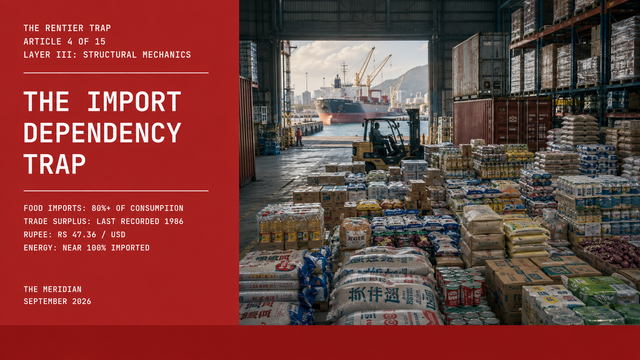
In February 2026, the Bank of Mauritius held its key repo rate at 4.5 per cent for the fourth consecutive meeting. The Monetary Policy Committee described its stance as cautious and appropriate for anchoring inflation expectations. The problem is that the inflation Mauritius faces is not the kind that repo rate adjustments are designed to address. The price level of the Mauritian household is set in Rotterdam, Dubai, and Johannesburg. The Bank of Mauritius can raise or lower the cost of borrowing. It cannot change where the food and the fuel come from.
The standard textbook account of how depreciation corrects a trade deficit proceeds as follows. When a currency weakens, the domestic price of exports falls in foreign currency terms. Foreign buyers purchase more. Export revenue rises. The trade balance improves and the currency finds a floor. The mechanism depends entirely on one condition: the existence of an export manufacturing sector whose output becomes cheaper and more competitive when the currency moves. Mauritius has not recorded a trade surplus since 1986, according to Statistics Mauritius and Bank of Mauritius data. The rupee reached Rs 47.36 per US dollar at the Bank of Mauritius interbank sell rate in August 2026, a record low. The mechanism is not working. It is not working because the condition on which it depends does not exist. There is no significant export manufacturing sector to stimulate. The rupee's depreciation raises the cost of what Mauritius imports. It does not lower the price of what Mauritius sells, because what Mauritius sells are services, not manufactured goods, and the price of services is not primarily determined by the exchange rate.
The United States Department of Commerce Country Commercial Guide for Mauritius, updated in 2024, records that 90.9 per cent of Mauritius's primary energy requirement is sourced from imports: 61.1 per cent from petroleum products and 29.8 per cent from coal. The Central Electricity Board, established under the CEB Act of 1963 and responsible for generation, transmission, and distribution of electricity across the island, generates approximately 47 per cent of the country's electricity through its thermal and hydroelectric plants. The remaining 53 per cent is sourced from Independent Power Producers, which rely primarily on imported coal outside the sugarcane harvesting season and bagasse during it. The electricity price that Mauritius pays is therefore substantially determined by the price of imported coal and petroleum, which is denominated in US dollars and paid in rupees. When the rupee weakens, the rupee cost of every unit of electricity generated from imported fuel rises. The Central Electricity Board raised tariffs by 15 per cent in May 2026. The underlying cause was the currency.
The food position is equivalent. More than 80 per cent of Mauritius's food consumption is sourced from imports, a figure confirmed by the Ministry of Agro-Industry's own baseline assessments and by Statistics Mauritius trade data. In a single month, May 2026, Mauritius imported goods worth Rs 31.64 billion while exporting Rs 9.28 billion, generating a trade deficit of Rs 22.36 billion in thirty days. Fuel alone accounted for Rs 11.31 billion of that month's import bill: the single largest line item, at 35.7 per cent of total imports. Both the food and the fuel are priced in foreign currency. Both are purchased with rupees. Every depreciation of the rupee is therefore a direct and immediate increase in the cost of living, before any other economic mechanism has time to operate.
The Bank of Mauritius operates under a monetary policy framework with a medium-term inflation target of 3.5 per cent. The primary instrument available to the Monetary Policy Committee is the repo rate: the rate at which the central bank lends to commercial banks overnight, which anchors the cost of borrowing across the economy. When the MPC raises the repo rate, it raises the cost of credit, which suppresses consumer spending and investment, which reduces demand-pull pressure on prices. This instrument was designed for an economy where inflation is primarily caused by excess domestic demand: too much money chasing too few goods. It is not primarily designed for an economy where inflation is caused by the rising rupee cost of goods that must be imported regardless of the domestic interest rate.
In Mauritius, the producer price index rose by 7.70 per cent in February 2026, according to Statistics Mauritius data. The core inflation rate, which strips out volatile food and energy prices to reveal underlying price pressure, stood at 5.50 per cent in the same month, projected to reach 6.70 per cent by the end of the quarter. The headline rate was 3.50 per cent. The divergence between headline and core, and between consumer and producer prices, is a structural signal. The producers, who buy imported inputs to make or distribute goods for the domestic market, are absorbing cost increases faster than the consumer price index is registering them. The pressure is moving up the supply chain from import costs to production costs to consumer prices. Raising the repo rate from 4.5 per cent to 5 per cent would not change the price of a barrel of petroleum delivered to Port Louis. It would make borrowing more expensive for a Mauritian household or business that is already absorbing higher energy and food costs.
The Bank of Mauritius itself acknowledged the structural dimension in its February 2026 Monetary Policy Committee statement, noting that the inflation outlook carries "upside risks both domestically and externally, including global supply chain disruptions, climate-related events, and high imported inflation." The phrase "high imported inflation" is the institutional admission that the instrument in use does not address the primary source of the price pressure. The MPC can anchor inflation expectations. It cannot anchor the price of petroleum at the Rotterdam spot market, which is where the fuel that Mauritius burns is priced, in a currency that Mauritius does not print.
The Price Sovereignty Theorem, as articulated in The Meridian's analytical framework for this edition, holds that a state that cannot set prices in its own currency for its essential goods does not possess meaningful economic sovereignty, regardless of its formal political independence. Mauritius has formal monetary sovereignty: it has a central bank, a domestic currency, and a monetary policy framework. But the goods that are essential to the Mauritian household, food and energy, are priced externally in foreign currency, purchased in rupees at whatever exchange rate the market produces. The STC, the State Trading Corporation, is the sole importer of petroleum products for the domestic market. It sets fuel prices administratively in rupees. But the rupee price it sets is determined by the dollar price of the petroleum it imports and the rupee value of the dollar at the moment of purchase. The STC does not set the price of oil. It translates the dollar price of oil into rupees and passes the translation on to the consumer.
The consequence of this structure for monetary policy is precise and limiting. The Bank of Mauritius monetary policy framework is calibrated to an economy where domestic price pressures are a significant determinant of the consumer price index. In Mauritius, a disproportionate share of consumer price pressure originates from the import channel: the rupee cost of goods whose dollar price is set abroad. A central bank that raises rates in this environment imposes a cost on domestic borrowers, suppresses domestic demand, and slows the local economy. It does not reduce the price of imported petroleum. The instrument inflicts collateral damage on the domestic economy in pursuit of a goal it was not designed to achieve, because the goal, reducing the rupee price of imported essentials, is not achievable through domestic interest rate policy.
The Bank of Mauritius can raise or lower the cost of borrowing. It cannot change the dollar price of petroleum or the exchange rate at which rupees purchase it. A central bank whose primary inflation source is imported is holding an instrument designed for a different problem.
The import dependency trap is a structural condition, not a policy failure. It was not produced by a bad decision at the Bank of Mauritius or the Ministry of Finance. It is the arithmetic consequence of building an economy on rents from external buyers without simultaneously building the productive capacity in food and energy that would reduce the dependence on external suppliers. Every rent transition examined in this series, sugar, EPZ textiles, tourism, offshore finance, required importing the inputs that the domestic economy did not produce. The EPZ imported fabric and components from Asia and re-exported garments. Tourism imports food and equipment for the hotels. Offshore finance imports the human capital it cannot source domestically. The current account deficit, which the Ministry of Finance projects at 5.9 per cent of GDP for fiscal year 2025/26, is the running total of what the economy imports above what it exports. It has been running continuously since 1986.
The exchange rate depreciation that follows from a persistent current account deficit is not a policy mistake. It is the price mechanism communicating that the currency is overvalued relative to the productive capacity of the economy. But in an economy where more than 80 per cent of food and 90.9 per cent of primary energy are imported, the depreciation does not trigger the export-led correction that the price mechanism is supposed to produce. It produces inflation. The central bank then faces a structural dilemma: it can tighten policy to anchor expectations and accept slower growth, or it can ease policy to support growth and accept higher inflation. Neither option addresses the structural condition that produces the dilemma. That condition is the absence of the productive base that would make the exchange rate work as theory predicts.
1. The exchange rate channel is blocked. Standard theory holds that currency depreciation stimulates exports. In Mauritius, the export base consists primarily of tourism services and offshore financial services, neither of which is primarily price-sensitive in the way that manufactured goods are. The rupee can depreciate without triggering the export-led correction mechanism. What depreciation does produce is higher rupee costs for imported food, fuel, and capital goods.
2. The monetary policy instrument is mismatched to the inflation source. The Bank of Mauritius repo rate (4.5 per cent as of February 2026) is designed to address demand-pull inflation. Core inflation at 5.50 per cent and producer price inflation at 7.70 per cent in February 2026 indicate that cost-push pressure from imported inputs is the primary driver. Rate increases suppress domestic demand without addressing the import cost channel. The MPC has acknowledged "high imported inflation" as the primary upside risk to its own forecasts.
3. The fiscal position amplifies the vulnerability. With public debt at 88.3 per cent of GDP and the current account deficit at 5.9 per cent of GDP, the government's capacity to absorb import cost shocks through fiscal transfers is constrained. The STC fuel subsidy, the CEB tariff structure, and the food price support mechanisms all require fiscal resources that are under sustained pressure from the debt service burden. The structural vulnerability cannot be addressed by fiscal means alone because the fiscal position is itself a product of the same structural dependency.
The Import Dependency Trap is the structural condition that connects every other analysis in this edition. The Rentier Trap, as diagnosed in the editor's letter and the lead article, produced an economy that generates revenue from external rents rather than from domestic productive capacity. The Import Dependency Trap is the monetary expression of that structural choice: an economy that does not produce what it consumes must import it, and an economy that imports its essentials in foreign currency does not control its own price level.
The Bank of Mauritius is an institution staffed by capable economists operating within a well-designed formal framework. The problem is not the institution. The problem is that the institution's primary instrument, the repo rate, was designed for an economy whose inflation is generated by excess domestic demand. Mauritius's inflation is generated substantially by the rupee cost of imported goods whose dollar price is set in markets the central bank cannot influence. This is not a criticism of the Bank of Mauritius. It is a description of the structural position in which the Bank of Mauritius operates.
A state that imports its price level cannot conduct sovereign monetary policy. This is not a normative claim. It is a structural description of what the instrument can and cannot do when 90.9 per cent of primary energy and more than 80 per cent of food consumption are priced in foreign currency and purchased with rupees at a rate the market sets.
Add comment
Comments