Mauritius at the Threshold: The Diagnosis
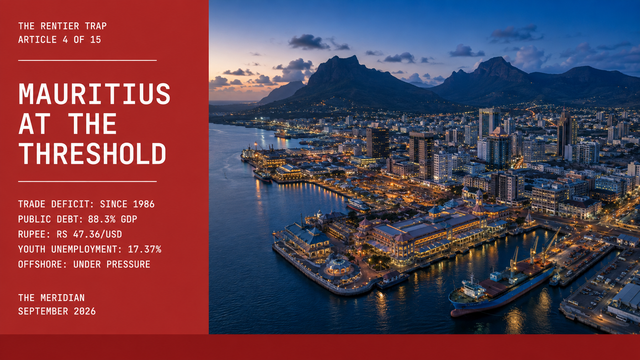
This article contains no government press releases, no ministry briefings, and no institutional projections that cannot be verified against a named primary source. It contains the numbers that describe where Mauritius stands in September 2026, assembled from Statistics Mauritius, the Bank of Mauritius, the Ministry of Finance, the IMF's Article IV consultation, the Financial Services Commission, and the United States Department of Commerce. The numbers are the argument. They are also the diagnosis.
Nine months ago, Mauritius produced a 60-0 electoral result: every seat in the National Assembly taken by a single coalition, on a mandate to reform the structural conditions that had produced rising inequality, currency weakness, and institutional stagnation. The macroeconomic data assembled for this article does not assess the political performance of the government that mandate produced. It records the structural indicators that any government inherits when it takes office with this economy and that any government must navigate regardless of its political programme. The data is the context. The context is the threshold. This is what the threshold looks like, measured precisely.
The Ministry of Finance projects public sector debt at 88.3 per cent of GDP for the fiscal year 2025/26, having peaked at approximately 90 per cent in FY 2024/25, according to Ministry of Finance budget documents confirmed by the IMF's July 2026 Article IV mission, which independently estimates general government debt at approximately 88 per cent of GDP as of June 2026. The statutory target under the Public Debt Management Act is an eventual reduction to 60 per cent of GDP. The current position is 47 per cent above the statutory target, and the trajectory has been upward for five consecutive fiscal years. The Ministry of Finance projects the merchandise trade deficit at 10.7 per cent of GDP for FY 2025/26. The current account deficit, which incorporates services, income flows, and transfers alongside the goods trade balance, stands at 5.9 per cent of GDP according to Ministry of Finance projections for FY 2025/26, with the Bank of Mauritius projecting 5.3 per cent for the 2026 calendar year in its August 2026 monetary policy statement.
The external debt position, as recorded by the Bank of Mauritius, reached MUR 98,826 million in December 2025. The fiscal position is not in crisis. It is in sustained structural deterioration that has been masked by growth, by the post-pandemic tourism recovery, and by the offshore sector's continued revenue generation under increasing international pressure. The question the fiscal data poses is not whether Mauritius can service its current obligations. It can. The question is what the fiscal trajectory looks like if the two primary revenue pillars, tourism and offshore financial services, simultaneously face the structural pressures documented later in this article.
Mauritius has not recorded a trade surplus since 1986, a fact confirmed by Statistics Mauritius and Bank of Mauritius historical series. In May 2026, Statistics Mauritius recorded total imports of Rs 31.64 billion against exports of Rs 9.28 billion, producing a single-month merchandise trade deficit of Rs 22.36 billion. Fuel imports alone accounted for Rs 11.31 billion of May's import bill, representing 35.7 per cent of total monthly imports. The Bank of Mauritius records the rupee at an interbank sell rate of Rs 47.36 per US dollar in August 2026, a record low. The rupee's depreciation is structural rather than episodic: the exchange rate has been weakening against the dollar and the euro for the full period since Mauritius last recorded a trade surplus, because the current account deficit that the trade balance generates requires a continuous transfer of foreign exchange to service it, which exerts persistent downward pressure on the currency.
Tourism generated gross earnings of Rs 93,574 million in 2024, according to the Statistics Mauritius Handbook of Statistical Data on Tourism 2024. Tourist arrivals grew to 1,436,250 in 2025, a 3.9 per cent increase from 1,382,177 in 2024, according to the Statistics Mauritius International Travel and Tourism Year 2025 publication. The 2025 figure exceeds the previous all-time high of approximately 1,431,000 recorded in 2018. Arrivals by air grew 4.7 per cent to 1,411,791. The average length of stay recorded in the 2024 handbook was 11.4 nights. On the volume measure, tourism is performing above its historical peak.
The structural fragility of the tourism pillar does not reside in arrival volumes. It resides in the cost architecture that makes those arrivals possible and the external conditions that determine whether they continue. The aviation fuel price spike of mid-2026, which The Meridian documented in August, produced a single-month decline in tourist arrivals from 115,165 in May 2026 to 89,098 in June 2026, a fall of 22.6 per cent in thirty days, according to Trading Economics data sourced from Statistics Mauritius. The cost of reaching Mauritius is not set in Mauritius. The prices charged by the airlines that connect it to its source markets, predominantly Europe, are set by fuel markets, airline yield management systems, and competitive dynamics that the Mauritius Tourism Promotion Authority cannot influence. The tourism model is structurally dependent on external conditions over which the island has no leverage.
The offshore financial services sector contributes 5.8 per cent of GDP, according to the Financial Services Commission's 2023/24 data. The sector's structural trajectory is under pressure from three directions simultaneously. The OECD's Base Erosion and Profit Shifting framework, specifically Actions 5 and 6 addressing harmful tax practices and treaty abuse, has required Mauritius to reform the substantive conditions under which entities qualify for treaty benefits. The India-Mauritius Double Taxation Avoidance Agreement, revised by Protocol in May 2016, eliminated the capital gains tax exemption on equity shares acquired after 1 April 2017, removing the routing advantage that had made Mauritius the dominant conduit for foreign direct investment into India. The OECD's Pillar Two Global Minimum Tax, which establishes a 15 per cent minimum corporate tax rate for large multinationals with revenues above EUR 750 million, was incorporated into Mauritius law through the Finance Act 2024 via the Qualified Domestic Minimum Top-up Tax. These are not future risks. They are present structural changes to the conditions that made the offshore model viable at its peak.
The overall unemployment rate stood at 5.4 per cent in the fourth quarter of 2025, according to Statistics Mauritius, with 32,800 persons unemployed from a total labour force of approximately 556,400 employed persons. The youth unemployment rate for ages 15 to 24 was recorded at 17.37 per cent in 2025, according to the World Bank World Development Indicators derived from ILO modelled estimates, having peaked at 25.37 per cent in 2021. In the first quarter of 2026, Statistics Mauritius recorded 12,100 unemployed youth aged 16 to 24, representing 36 per cent of the total unemployed population of 33,300. Average monthly wages stood at Rs 43,488 in December 2024, according to Statistics Mauritius. Against the background of a rupee at Rs 47.36 per dollar and food and fuel prices substantially determined by import costs in foreign currency, the relationship between wages and the cost of living is structurally adverse for the lower and middle segments of the Mauritian labour market.
The Bank of Mauritius has maintained its key repo rate at 4.5 per cent since February 2025, holding it steady through four consecutive Monetary Policy Committee meetings. Core inflation stood at 5.50 per cent in February 2026, according to Statistics Mauritius, with producer price inflation at 7.70 per cent in the same period. The Bank of Mauritius projects headline inflation at 5.0 per cent for the full 2026 calendar year, according to its August 2026 monetary policy statement. The MPC's own statement acknowledged that "high imported inflation" represents the primary upside risk to its inflation forecasts. This is the monetary bind: the instrument available to the Bank of Mauritius, the repo rate, suppresses domestic demand but cannot address the cost-push inflation generated by the rupee cost of imported food and energy. GDP growth is projected at 3.0 per cent for 2026 by Statistics Mauritius and at 2.8 per cent by the IMF. Growth is present. But it is occurring against a background of structural inflation that the monetary framework cannot fully address and a fiscal position that is 47 per cent above its own statutory target.
The data does not predict collapse. It describes a structural position in which the two primary rent pillars are under simultaneous external pressure, the fiscal space to absorb shocks is constrained, and the monetary instruments available to manage inflation do not address its primary source. This is what a threshold looks like, measured.
Taken individually, each of the indicators assembled in this article can be explained, contextualised, or offset against a positive countervailing data point. Public debt at 88.3 per cent of GDP is high but below several peer economies. Tourist arrivals at 1,436,250 in 2025 exceed the historical peak. GDP growth at 3.2 per cent in 2025 is above the global average. Youth unemployment at 17.37 per cent is elevated but below several comparator small island developing states. Each of these contextual observations is accurate.
Taken together, the indicators describe something specific. The fiscal position is deteriorating because the economy imports far more than it exports, has not recorded a trade surplus in four decades, and services a current account deficit through capital inflows that are themselves generated by the two rent pillars. Those rent pillars, tourism and offshore finance, are each simultaneously under pressure from external conditions they cannot control: aviation cost shocks for tourism, OECD treaty reform and India's treaty renegotiation for offshore. The monetary framework is managing cost-push inflation generated by import dependency with instruments designed for demand-pull conditions. The labour market is producing graduates faster than the economy's mid-tier professional structure can absorb them, generating a sustained emigration of human capital funded by public education investment. The rupee is at a record low, raising the rupee cost of every import while failing to stimulate export manufacturing that does not exist.
None of these conditions is individually catastrophic. In combination, they describe a structural position that requires simultaneous reform of the fiscal trajectory, the external account, the rent pillar vulnerabilities, the labour market architecture, and the monetary framework. The political system produced a 60-0 mandate nine months ago. The data assembled here is the full account of what that mandate must address.
1. Fiscal trajectory above statutory target. Public debt at 88.3% of GDP against a statutory target of 60%. The gap is 47% above the legal ceiling. The trajectory has been upward for five consecutive years.
2. Two rent pillars under external pressure simultaneously. Tourism: volume above historical peak but structurally dependent on aviation fuel costs, airlift, and European discretionary income. Offshore: 5.8% of GDP, India treaty revised 2016, OECD minimum tax enacted 2024, substantive conditions reform required. Neither pillar is collapsing. Both are structurally constrained.
3. Monetary policy mismatched to inflation source. Core inflation at 5.50%, producer prices at 7.70%, repo rate at 4.5%. Bank of Mauritius acknowledges "high imported inflation" as primary upside risk. The instrument suppresses demand. The inflation is cost-push from import dependency. The instrument does not fit the problem.
4. Labour market displacement generating sustained emigration. Youth unemployment at 17.37%, 63,000 foreign workers employed simultaneously, 3,500 Mauritians emigrating annually. The economy imports the workers it needs for the base and exports the graduates it cannot employ at the level they were trained to occupy.
5. Exchange rate in structural depreciation with no export manufacturing base to stimulate. Rupee at Rs 47.36 per dollar, record low. Depreciation raises import costs without triggering the export-led correction that the price mechanism is designed to produce, because the manufacturing base that would respond to a cheaper currency does not exist.
The diagnosis assembled in this article does not rely on a political position. It relies on the figures published by Statistics Mauritius, the Bank of Mauritius, the Ministry of Finance, the IMF, the Financial Services Commission, the United States Department of Commerce, the World Bank, and Statistics Mauritius's own tourism handbook. Every number in this article has a named primary source. None of the numbers are invented. None of them are government talking points. They are the output of the statistical systems that Mauritius has built and maintained, which are among the most reliable in the African region.
What those numbers describe, in aggregate, is a structural position that is neither stable nor catastrophic. It is a threshold. The fiscal trajectory is deteriorating. The two primary rent pillars are under simultaneous external pressure. The monetary framework is mismatched to the inflation it is managing. The labour market is displacing the graduates it produces. The exchange rate is depreciating without triggering the export correction it is supposed to produce. Each of these conditions has a structural cause examined in other articles in this edition. None of them resolves automatically. Each of them worsens incrementally in the absence of structural reform.
The data does not predict when the threshold becomes a crossing. It describes, with precision, where the threshold is. September 2026 is where Mauritius stands. The numbers say so.
Add comment
Comments