The Double Extraction Mechanism: The Subsidy Architecture
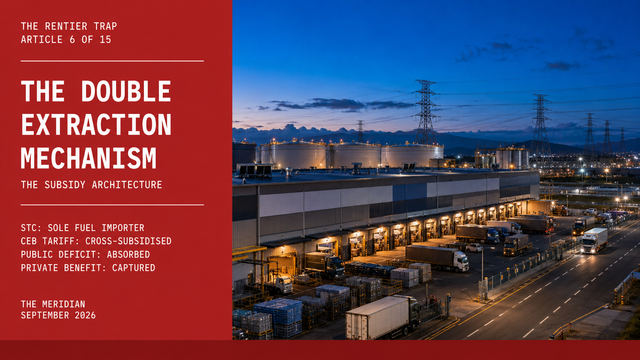
On 14 August 2026, the Petroleum Pricing Committee of Mauritius raised the retail price of Mogas from Rs 64.25 per litre to Rs 70.65 per litre and noted in its press release that the Price Stabilisation Account carried an estimated deficit of Rs 3.50 billion. The deficit is what the State Trading Corporation absorbed rather than pass to consumers when world prices rose. The public budget will absorb it. The largest commercial consumers of fuel and electricity in Mauritius consumed at below-cost prices while the deficit accumulated. This is the subsidy architecture of the Double Extraction Mechanism: public money transferred to private consumption at scale, through administered pricing designed to protect the population, but structured in a way that delivers proportionally greater benefit to those who consume the most.
The State Trading Corporation was established by Act of Parliament on 24 October 1982 to regulate and rationalise trade in essential commodities. It became operational in January 1983. According to its own institutional description, confirmed on its official website, the STC is "solely responsible for the importation and supply of Petroleum Products to meet the country's inland requirements," covering fuel for public transport, industrial and commercial activities, private motor vehicles, the operation of turbines by the Central Electricity Board to generate electricity, and aircraft refuelling at SSR International Airport. The STC's total annual imports of petroleum products have exceeded 1.1 million metric tons. All its selling prices are fixed by the government. The STC operates its domestic lines of business strictly on a cost basis with no profit mark-up. This is the foundation of the mechanism: a state entity with monopoly import rights, selling at prices set by government decree, with the fiscal consequence of any gap between cost and price absorbed by the state.
The Petroleum Pricing Committee is established under Government Notice and is responsible for determining retail fuel prices. According to its own press release of 14 August 2026, the PPC met to assess retail prices in accordance with Regulation 8 of the Consumer Protection (Control of Price of Petroleum Products) Regulations 2011, as amended. The committee reviewed the evolution of world prices and assessed the estimated deficit of Rs 3.50 billion in the Price Stabilisation Account before recommending the Mogas price increase. The Price Stabilisation Account is the mechanism by which the gap between world prices and administered retail prices is tracked and eventually reconciled. When world prices rise faster than the PPC raises retail prices, the PSA accumulates a deficit. That deficit represents the cumulative amount by which consumers were charged below the landed cost of fuel. The Rs 3.50 billion figure is the accumulated deferred cost as of 14 August 2026.
The STC's own FAQ documentation states that taxes, levies, and contributions including subsidies on staple food and LPG represent 40 to 55 per cent of the retail price at which consumers buy petrol and diesel. The same documentation records that subsidies on ration rice, wheat flour, and LPG cost the STC more than Rs 1.2 billion, a figure from the 2019/20 period when the annual report recorded a deficit of MUR 917.2 million attributable to subsidy payments. The subsidy architecture therefore operates on two levels simultaneously: the administered retail price is held below world cost (creating the PSA deficit), and a portion of the taxes embedded in the retail price cross-subsidises food and LPG for the population. The fiscal cost flows in both directions: from the public budget to the STC when the PSA deficit is settled, and from fuel consumers to food and LPG subsidy recipients through the embedded levy structure.
When petroleum products arrive at Port Louis, they are discharged through pipelines into the shore tanks of four Local Oil Companies and the Central Electricity Board, all located within the port area. The four LOCs are the retail distribution entities: they purchase from the STC at government-fixed prices and sell to filling stations and direct commercial customers at government-fixed margins. The CEB purchases fuel directly from STC to run its thermal generation turbines, which according to the US Department of Commerce Country Commercial Guide for Mauritius produce approximately 47 per cent of the country's electricity. The remaining 53 per cent comes from Independent Power Producers, which also rely substantially on imported fossil fuels outside the sugarcane harvesting season. The electricity that Mauritian commercial and industrial entities consume is therefore substantially generated from petroleum products and coal imported at world market prices, sold to the CEB and IPPs at government-administered or market-negotiated rates, and priced to end consumers through the CEB tariff structure. When the STC holds fuel prices below cost, the CEB's input cost is also affected, as a portion of its fuel is sourced through the STC at administered prices.
The administered pricing mechanism is designed to protect the population from world market volatility. It achieves this by holding retail prices below landed cost when markets spike, with the PSA deficit recording the accumulated gap. The protection is available to all consumers: the household, the small business, the large commercial operation, and the industrial entity. The mechanism does not discriminate by consumer category. It is therefore neutral in its design and asymmetric in its effect.
The asymmetry arises from the relationship between the value of below-cost pricing and the volume of consumption. A household that purchases thirty litres of petrol per month captures approximately Rs 190 of below-cost benefit when the administered price is held Rs 6.40 per litre below the market-justified level, the gap implied by the Mogas adjustment of 14 August 2026. A commercial logistics operation, a hotel complex, a food distribution network, or an industrial facility that consumes 30,000 litres per month captures Rs 192,000 of the same benefit per month. The mechanism is identical for both. The value captured is proportional to the volume consumed. The entities that consume at the greatest volume capture the greatest absolute value from the subsidy. The public budget absorbs the cost for all of them equally.
The conglomerate sector of Mauritius, as disclosed on the Stock Exchange of Mauritius, is the segment of the economy that operates at the consumption scale where administered pricing delivers material fiscal benefit. The major listed conglomerates, IBL Group (Ireland Blyth Limited), Rogers Group, CIEL Group, ENL Group, and Harel Mallac, operate collectively across logistics and distribution networks, hotel and hospitality complexes, food manufacturing and retail chains, agricultural operations, and industrial facilities. These operations are large consumers of diesel fuel, industrial fuel oil, and electricity. They are not exceptional consumers in any pejorative sense: their consumption is proportional to their industrial and commercial scale, which is substantial. IBL Group, for example, encompasses among its disclosed portfolio: logistics and port operations, food manufacturing and distribution, healthcare infrastructure, and retail chains. Each of these verticals requires significant fuel and electricity inputs at commercial volume.
The structural point is precise and limited. When the Price Stabilisation Account accumulates a deficit of Rs 3.50 billion because retail fuel prices have been held below cost, that deficit represents a transfer of value from the public budget to all fuel consumers in proportion to their consumption. The household that filled its tank receives a small share of that transfer. The conglomerate operating a distribution fleet, a hotel complex, and a manufacturing facility receives a large share of the same transfer. Neither is acting improperly. The mechanism delivers what it is designed to deliver: below-cost fuel to all consumers. The structural consequence, that the entities with the greatest consumption capacity capture the greatest absolute value from the subsidy, is not a design flaw. It is the arithmetic of a universal price support applied to a market with highly unequal consumption volumes.
The subsidy is paid by the public. The benefit is captured in proportion to consumption. In a market where consumption is highly concentrated among a small number of large commercial entities, the subsidy architecture is a mechanism for transferring public resources to private operations at scale. This is the Double Extraction Mechanism applied to the domestic economy.
1. The STC Price Stabilisation Account. The STC holds retail fuel prices below landed cost when world markets spike. The accumulated gap is recorded in the PSA. The estimated deficit as of 14 August 2026 is Rs 3.50 billion, confirmed by the Petroleum Pricing Committee press release. This deficit will be settled from the public budget or absorbed through future price adjustments. All fuel consumers benefit. Large commercial consumers benefit most in absolute terms.
2. The cross-subsidy within the retail fuel price. Taxes and levies of 40 to 55 per cent are embedded in the retail petrol and diesel price, according to the STC's own FAQ. These fund, among other things, subsidies on ration rice, wheat flour, and LPG. A portion of every litre of fuel purchased by a commercial consumer funds the social subsidy programme. The commercial consumer pays this levy in proportion to their consumption. At scale, this is a non-trivial fiscal contribution. But it does not offset the below-cost pricing benefit when the PSA is in deficit, because the levy is a fixed percentage of the administered retail price, not of the world market price.
3. The CEB electricity tariff structure. The Central Electricity Board raised tariffs 15 per cent in May 2026. Prior to that adjustment, the electricity price paid by commercial and industrial consumers reflected input fuel costs that had not been fully passed through. The 15 per cent adjustment represents the correction of a below-cost pricing position that accumulated while fuel input costs rose. Large commercial and industrial electricity consumers captured the benefit of the below-cost period in proportion to their consumption, precisely as with the STC fuel mechanism.
The subsidy architecture described in this article was not designed to transfer public money to private conglomerates. It was designed to protect the population from the volatility of world fuel prices. The STC's mandate is social: affordable essential commodities for the Mauritian household. The Petroleum Pricing Committee's regulatory function is genuine and its published methodology is transparent. The CEB's tariff structure serves legitimate distribution objectives. None of the mechanisms described in this article represent misconduct by the entities that operate them or benefit from them.
What this article documents is the structural consequence of applying universal price support to a market where consumption is highly concentrated. When the public budget absorbs Rs 3.50 billion of accumulated below-cost fuel pricing, it does so on behalf of all consumers. The household that benefited from Rs 190 per month of below-cost petrol also benefited. But the concentration of commercial and industrial consumption in the conglomerate sector means that a disproportionate share of the Rs 3.50 billion was consumed at scale by entities for whom the benefit is material, not marginal. The public budget does not distinguish. The market does.
This is the Double Extraction Mechanism applied domestically: a subsidy designed for the population, structured in a way that delivers proportionally greater benefit to those who already consume at scale. The Rs 3.50 billion PSA deficit is the number that makes this visible. It is a public number, published by a public body, in a public press release. The Meridian is simply reading it.
Add comment
Comments