Three Major Economies Set Interest Rates This Week. America and Japan Raised. Britain Did Not. Here Is Why.
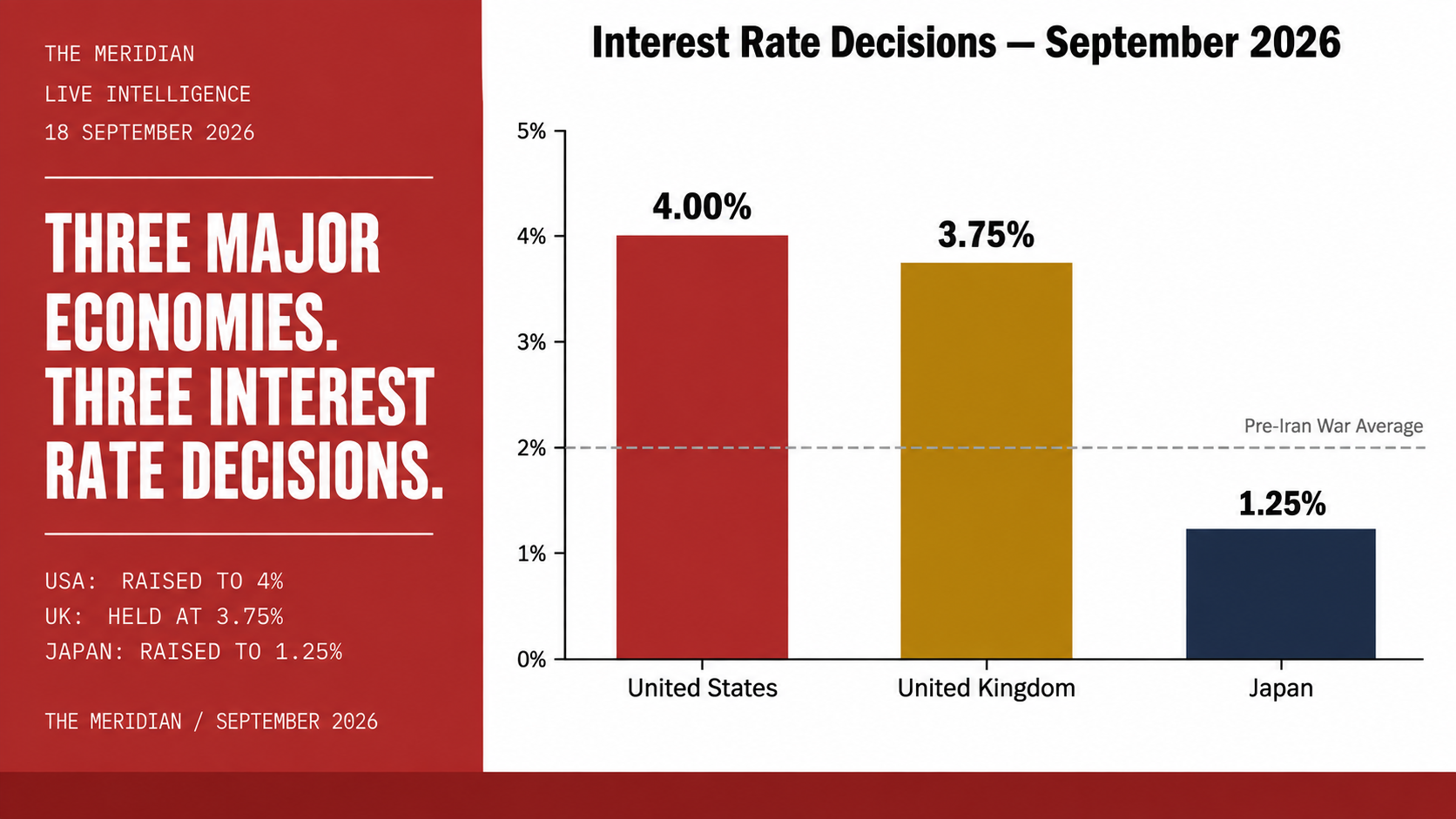
Between 16 and 18 September 2026, the three most watched central banks in the world all made decisions about interest rates. The Federal Reserve in America raised them. The Bank of England in Britain held them. The Bank of Japan raised them. All three faced the same underlying problem: a war in the Middle East had pushed energy prices higher and inflation was climbing. They reached three completely different conclusions about what to do. This article explains why, and what their disagreement means for ordinary borrowers, savers, and economies around the world.
An interest rate decision is one of the most consequential things a central bank does. When a central bank raises rates, borrowing becomes more expensive for everyone in that country: mortgages cost more, business loans cost more, credit card debt costs more. When it holds rates steady, it is choosing to leave that pressure where it already is. When it cuts, it makes borrowing cheaper and tries to stimulate spending and growth. These decisions ripple outward from the central bank's meeting room into the daily financial lives of millions of people. This week, three of the world's most powerful central banks made three different decisions about the same problem and their disagreement reveals something important about how the global economy is working right now.
All three central banks were grappling with the same underlying issue. In February 2026, following strikes on Iranian nuclear facilities, Iran launched retaliatory missile attacks on Gulf states. The conflict disrupted energy supply from one of the world's most important oil-producing regions. Global energy prices rose sharply. When energy prices go up, the cost of almost everything else follows: fuel costs rise, transport costs rise, and businesses pass those increases on to customers in higher prices. The technical term for this is inflation, and all three countries were experiencing it above their official targets of around 2%.
The question each central bank faced was the same: do we raise interest rates to fight this inflation, or do we hold steady? The answers they gave were different, and the reasons behind those answers reveal three distinct theories of what central banks can and cannot actually do.
The Federal Reserve, which sets interest rates in America, raised its benchmark rate to a range of 3.75% to 4% on 16 September. It was the first increase since 2023 and the vote to raise was unanimous, meaning every single member of the rate-setting committee agreed. The Fed's reasoning was straightforward: US inflation, measured by the Personal Consumption Expenditures index, was running at 3.7%, well above the 2% target. Fed Chairman Kevin Warsh concluded that the energy price rises from the Iran war were no longer a temporary blip that could safely be ignored. They were feeding into broader prices across the economy, and if left unchecked, people and businesses would start expecting high inflation to continue indefinitely, making it much harder to bring down. Acting now, even at the cost of making borrowing more expensive, was judged to be less painful than letting the inflation become embedded.
The Bank of England, which sets rates in Britain, decided the following day to leave them exactly where they were at 3.75%. The vote was not unanimous. Three of the nine members of the Monetary Policy Committee voted to raise rates to 4%, arguing Britain's inflation, at 3.1%, was already too high and rising. But six members voted to hold. Bank of England Governor Andrew Bailey explained the majority's thinking in a phrase that cuts to the heart of the disagreement: monetary policy cannot affect global energy prices. Raising interest rates in London will not make Iranian oil cheaper. What it will do is make British mortgages more expensive and slow an economy that is already under pressure. The Bank of England concluded that when the cause of inflation is a war on the other side of the world rather than excessive spending at home, higher rates cause pain without solving the problem. It chose to wait and see whether the energy price shock would fade before acting.
Raising interest rates in London will not make Iranian oil cheaper. What it will do is make British mortgages more expensive. Bank of England, September 2026
Japan's central bank raised its interest rate to 1.25% on 18 September, but for reasons that are quite different from America's. To understand Japan's decision, it helps to know that Japan kept its interest rates at zero or even below zero for nearly thirty years, from the mid-1990s through to 2024. This was an extraordinary and unprecedented experiment designed to rescue an economy that had fallen into a long slump. Now Japan is gradually returning rates to normal levels, a process called normalisation. The Iran war and its effect on energy prices added another reason to act: inflation in Japan has been running above the 2% target, and the Bank of Japan wanted to get ahead of any risk that rising energy costs would push it higher still. Japan's rate rise is therefore partly about the same Iran war inflation problem as America's, and partly about the end of an era of nearly free money that shaped global financial markets for a generation.
Japan's decision matters for reasons that go well beyond Japan's own economy. For thirty years, investors around the world could borrow money from Japanese banks at almost no cost, take that money, and invest it in countries where returns were much higher. An investor borrowing in Japan at 0.1% and investing in assets paying 6% anywhere else in the world was earning a risk-free profit of nearly 6% on someone else's money. This practice, known as the yen carry trade, channelled enormous amounts of capital into emerging markets, developing economies, and risk assets across Asia, Africa, and Latin America. Some of the investment that built infrastructure, funded government borrowing, and supported economic activity across the developing world was, ultimately, made possible by Japan's three decades of near-zero interest rates.
As Japan raises rates, that equation changes. Borrowing in Japan becomes more expensive. The profit from investing that borrowed money elsewhere shrinks. Gradually, investors who have been using this strategy are closing their positions, selling the foreign assets they bought, and repaying their Japanese loans. This is a slow withdrawal of capital from the countries that benefited from it. For the Global South economies that have been quietly supported by this flow of money, Japan's rate rises represent a structural tightening of the financial conditions they operate in, with no direct connection to anything they have done themselves.
If you have a mortgage, a business loan, or a credit card balance in America or Japan, this week's decisions make your debt more expensive. American mortgage rates, already above 7%, will edge higher still. Japanese companies and households accustomed to borrowing at near-zero rates face a genuine adjustment. British borrowers are spared for now, but three members of the Bank of England's rate-setting committee already want to raise, and December's meeting is widely expected to be the moment the UK follows America's lead.
For savers, higher rates are welcome news. Money sitting in bank accounts finally earns a meaningful return after years of near-zero deposit rates. American savers can now earn around 4% in a standard savings account, the best return in over a decade. Japanese savers, accustomed to earning effectively nothing on their deposits, are beginning to see the first meaningful interest on their savings in a generation.
For developing countries that borrowed in US dollars, this week's decision has an immediate and painful consequence. When the Federal Reserve raises rates, the dollar typically strengthens against other currencies. A country that borrowed in dollars now needs to find more of its own currency to buy the dollars required to make each debt payment. Its debt has not grown in dollar terms. But in local currency terms, it has become more expensive overnight. This dollar tax, as it can be called, falls hardest on the countries least responsible for the inflation that caused America to raise rates in the first place.
The most important thing this week's three decisions reveal is not what each central bank chose to do. It is why they disagreed. America believes that inflation, even when caused by an external shock like a war, must be confronted directly with higher rates before it becomes a permanent feature of the economy. Britain believes that when the cause of inflation is something a central bank cannot control, like the price of oil set by conflict in the Middle East, the damage of higher rates to its own borrowers is not worth bearing. Japan is doing something different again, gradually returning to normal after three decades of an extraordinary monetary experiment that shaped global financial markets in ways most people never noticed.
All three positions are defensible. None of them is obviously wrong. They reflect different judgements about risk, timing, and what central banks are actually capable of achieving. The disagreement itself is the story. A world in which the three most influential central banks cannot agree on the correct response to the same problem is a world in which the financial conditions people live under depend heavily on which country they happen to be in, and on which theory their central bank happens to hold.
For the countries that were not in any of those three meeting rooms, that had no vote, and whose economies will nonetheless be shaped by what was decided, the divergence is not an abstract policy debate. It is the difference between a mortgage that rises, a currency that falls, and a debt that quietly becomes harder to repay.
Add comment
Comments