The Meridian Scorecard 2027
Fifty forecasts for the year ahead. Each one carries a number, a date, a probability and the evidence that would prove it wrong. We will publish them again next December with the result of each beside it.
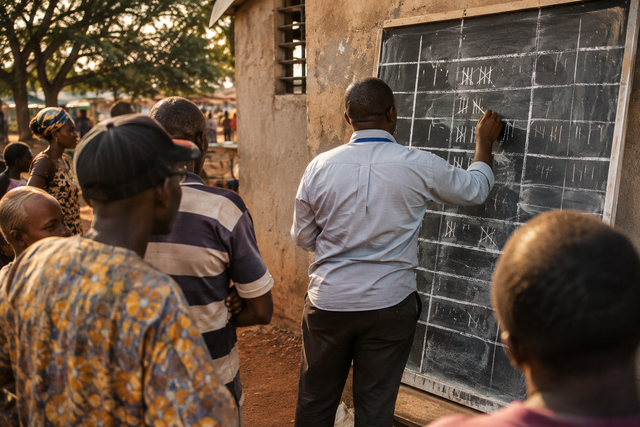
A forecast that nobody checks is not a forecast. It is an atmosphere. The annual outlook industry has understood this for a long time and has built its product accordingly: observations hedged until they cannot fail, risks that could go either way, a tone of authority unaccompanied by any claim specific enough to be scored. Publications have been producing that document every December for four decades, and almost none of them return the following December to see how it did.
What follows is the opposite arrangement. Fifty numbered calls. Every one of them states what we expect, attaches a probability, names the date by which it becomes checkable, and sets out in plain terms the evidence that would prove it wrong. In December 2027 this page will be republished with the outcome of each call printed beside it, including the ones we lose, and the post-mortem will concentrate on the calls where the reasoning failed rather than merely the ones where the outcome went against us.
A call with a stated falsifier is a call that can be lost in public. That is the point of writing it down.
The probability attached to each call is our own estimate, not a model output and not a market price. It expresses how confident we are, and it should be read as such. A call at sixty per cent is one we expect to happen while fully accepting that it may not, and we would expect roughly four in ten of our sixty per cent calls to fail. If they all come in, we were too cautious. If very few do, the estimate was wrong rather than the world.
The factual premises behind these calls are verified against primary sources. The calls themselves are editorial judgements, which is what a forecast is. Where a call depends on a figure we could not verify to primary-source standard, we have either rewritten it so that it does not, or dropped it.
Three features of this ledger are worth noticing before you read it, because each is a weakness as much as a description.
The first is concentration. Twelve of the fifty calls sit in a single section, on elections and the borrowing that surrounds them, because that is where the year has the most dated, checkable events in it. The Verdict section carries five. That imbalance is honest rather than ideal: it reflects where the calendar gives us something to be specific about.
The second is confidence. Mean stated confidence across the fifty is 70.9 per cent, and sixteen calls sit at eighty per cent or higher. A ledger weighted towards high confidence looks impressive in December and proves very little the following year, because calls that were close to certain were never really forecasts. We have kept those sixteen because several of them, such as the French second round or the persistence of El Nino into March, are load-bearing for other articles in this edition and need stating. But a reader is entitled to discount them, and we would rather point that out ourselves than have it pointed out for us.
The third is timing, and it is the most uncomfortable of the three. Only eight of the fifty calls resolve before October. The rest cluster at the end of the year or later still, because that is when the statistics arrive. This is a genuine limitation of an annual ledger rather than a presentational one: it means that for most of 2027 we will not know whether our account of the year is holding, and neither will you. The eight early calls, five of which resolve in the first quarter, are therefore worth watching closely. If Nigeria slips, or the Pacific turns earlier than NOAA expects, a good deal of what follows will need revisiting in public.
With that said, here is the ledger.
At least one month of 2027 records a FAO Food Price Index reading above every monthly reading of 2026.
Wrong if: Every 2027 monthly reading sits at or below the highest 2026 reading.
Five or more national governments introduce or expand food subsidies, price caps or strategic grain releases in response to food inflation.
Wrong if: Fewer than five such measures are announced.
Three or more countries see sustained multi-day public protest in which food, fuel or transport costs are a stated grievance.
Wrong if: Fewer than three, counting only protests lasting more than two consecutive days.
Across low and lower-middle income economies with published series, a majority show real wages still below their 2019 level at the end of 2027.
Wrong if: A majority have recovered to or above the 2019 level.
Youth unemployment across Sub-Saharan Africa does not fall below its 2026 rate on World Bank or ILO modelled estimates.
Wrong if: The regional rate prints below the 2026 figure.
At least one G20 government formally opens a legislative process, commission or white paper specifically addressing labour displacement by artificial intelligence.
Wrong if: No such process is opened by any G20 member.
Nigeria records a full calendar year as a net exporter of refined petroleum products.
Wrong if: Official trade data show net imports of refined products for the year.
Two or more African states announce new refining or fuel processing capacity of at least fifty thousand barrels per day.
Wrong if: Fewer than two such announcements, counting signed commitments rather than expressions of interest.
Three or more African countries report increased outward migration of registered health professionals compared with 2026.
Wrong if: Fewer than three, on national registry or receiving-country registration data.
Nigeria holds its presidential election on 16 January 2027 without postponement.
Wrong if: INEC moves the date, for any reason, by more than seven days.
The Nigerian presidential result is formally challenged before the Presidential Election Petition Court.
Wrong if: No petition is filed within the statutory window.
The naira trades weaker against the US dollar thirty days after the Nigerian election than on the day before it.
Wrong if: The official rate is stronger or unchanged at the thirty-day mark.
Kyrgyzstan's presidential election produces no change in the governing orientation of the executive.
Wrong if: An opposition candidate takes office.
The French presidential election goes to a second round.
Wrong if: A candidate wins outright in the first round.
No member state formally exits the CFA franc zone during 2027.
Wrong if: Any member announces and initiates exit.
The eco does not enter circulation as a single West African currency during 2027.
Wrong if: The eco is issued and circulating in any ECOWAS member.
Kenya holds its general election on 10 August 2027 without postponement.
Wrong if: The IEBC moves the date by more than seven days.
The Kenyan presidential result is challenged before the Supreme Court.
Wrong if: No petition is filed within the constitutional window.
Argentina enters a new IMF arrangement or a formal modification of an existing one during 2027.
Wrong if: No new arrangement or programme modification is agreed.
Two or more low or middle income sovereigns default or complete a distressed debt exchange.
Wrong if: Fewer than two, counting rating agency default designations and completed exchanges.
The G20 Common Framework completes fewer than three new treatments during the year.
Wrong if: Three or more cases reach completed treatment.
A formal ceasefire or armistice agreement in Ukraine is signed by both parties.
Wrong if: No signed agreement by 31 December.
Even in the event of a ceasefire, no broad relief of Western sanctions on Russian energy exports takes effect during 2027.
Wrong if: Broad sectoral energy sanctions relief enters force.
At least one commercial vessel is attacked in the Red Sea or Bab el-Mandeb corridor.
Wrong if: No attack on commercial shipping is recorded in the corridor.
Asia to Europe container freight rates spend at least one month above their 2026 monthly average.
Wrong if: No month exceeds the 2026 average on a recognised index.
The Strait of Hormuz is not closed to commercial traffic for more than seventy-two consecutive hours.
Wrong if: A closure exceeding seventy-two hours occurs.
No state that left ECOWAS rejoins during 2027.
Wrong if: Any departed member formally rejoins.
At least one new foreign military basing agreement is announced in the Sahel or the Horn of Africa.
Wrong if: No new basing agreement is announced by any external power.
At least one G7 government announces a further reduction to its overseas development assistance budget.
Wrong if: No G7 member announces a cut.
Two or more producing states announce new export restrictions or domestic processing mandates on critical minerals.
Wrong if: Fewer than two such measures are announced.
2027 is declared the warmest calendar year on record by at least one of NASA GISS, NOAA, Berkeley Earth or Copernicus.
Wrong if: No major dataset ranks 2027 first.
NOAA assesses El Nino conditions as persisting through at least March 2027.
Wrong if: CPC declares a transition to neutral or La Nina before March ends.
The 2026 to 2027 event is recorded with a peak Oceanic Nino Index of at least plus two degrees Celsius.
Wrong if: The final peak ONI prints below plus two.
The peak Relative Oceanic Nino Index for the event is at least half a degree Celsius below the peak Oceanic Nino Index.
Wrong if: The gap between the two peaks is under half a degree.
At least one national government explicitly cites El Nino in declaring a disaster, emergency or drought response.
Wrong if: No government cites it explicitly in a formal declaration.
East Africa records above-average rainfall in at least one of its two 2027 rainy seasons.
Wrong if: Both seasons print at or below average.
Southern Africa records below-average rainfall across the 2026 to 2027 season.
Wrong if: The season prints at or above average.
At least one major cereal exporter imposes an export restriction, levy or quota.
Wrong if: No major exporter imposes a restriction.
A United Nations humanitarian appeal for food insecurity in the Horn of Africa or southern Africa is launched at a higher value than its 2026 equivalent.
Wrong if: No appeal exceeds its prior-year value.
Mauritius remains dependent on imports for more than seventy per cent of food consumption.
Wrong if: Official data show import dependence at or below seventy per cent.
At least one Indian Ocean small island state requests IMF financing or a programme review.
Wrong if: No such request is made.
No small island developing state receives a loss and damage fund disbursement exceeding fifty million US dollars.
Wrong if: Any single SIDS receives more than fifty million in disbursed funds.
At least one major reinsurer announces withdrawal from, or material repricing of, a climate-exposed coastal property market.
Wrong if: No such announcement is made.
Tourist arrivals to Mauritius in 2027 do not exceed the 2025 total by more than five per cent.
Wrong if: Arrivals exceed the 2025 figure by more than five per cent.
No Indian Ocean island state defaults on sovereign debt during 2027.
Wrong if: Any such state is designated in default.
Global growth for 2027 is estimated below three per cent in the IMF's first full-year assessment.
Wrong if: The estimate prints at or above three per cent.
The US Federal Reserve does not raise its policy rate above the 2026 peak at any point in 2027.
Wrong if: The target range exceeds the 2026 high.
At least one emerging market central bank conducts foreign exchange intervention reported as record or near-record in scale.
Wrong if: No such intervention is reported.
Combined artificial intelligence capital expenditure by the five largest United States hyperscalers grows more slowly in 2027 than in 2026.
Wrong if: Growth matches or exceeds the 2026 rate.
We mark at least five of these fifty calls as wrong in the December 2027 audit.
Wrong if: Fewer than five are marked wrong, which would mean we did not take enough risk.
In December 2027 this page returns with a result printed against every line: correct, wrong, or unresolved where the data did not arrive. The unresolved category will be counted as a failure of construction rather than of judgement, because a call we cannot score is a call we should not have written in this form.
The audit will go further than a tally. For every call we lose, we will say whether the outcome surprised us or the reasoning was faulty, and those are different admissions. A forecast that fails because an unforeseeable event intervened tells you very little. A forecast that fails because we misread a mechanism tells you a great deal, and it is the second category that should change how much weight you give this publication in 2028.
Call fifty commits us to getting at least five of these wrong. If we do not, we were not forecasting. We were describing.
One final note on what this ledger is not. It is not a prediction of the year in the sense of claiming to know it. Fifty calls at an average of seventy-one per cent confidence amounts to an expectation that roughly fourteen of them fail. That is not a hedge. It is arithmetic, stated in advance so that nobody has to argue about it afterwards.
Data notes: Pacific sea surface readings and persistence probabilities from the United States National Oceanic and Atmospheric Administration, Climate Prediction Center, ENSO update of 2 November 2026. Election dates from the Independent National Electoral Commission of Nigeria, the Central Electoral Commission of the Kyrgyz Republic, the Independent Electoral and Boundaries Commission of Kenya, and the Camara Nacional Electoral of Argentina. The French presidential date is set by the Conseil constitutionnel and had not been formally fixed at the time of publication. Probabilities are the assessment of The Meridian Intelligence Desk and are not derived from a model or from market pricing.
Content Protected
This article is the original work of The Meridian and is protected by copyright. Please link to it rather than reproducing it.