Nigeria Built Africa's Biggest Refinery. Will Fuel Get Cheaper?
In September more refined fuel left Nigeria than was delivered into it. The plant is not failing. It is doing exactly what its own prospectus says it was built to do, and that is a different thing from lowering the price at the pump.
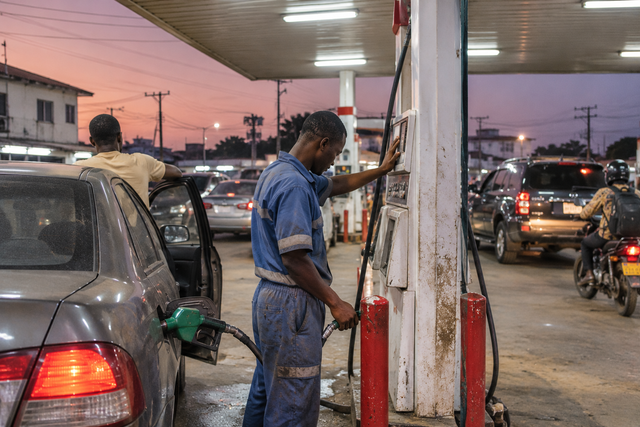
For decades Nigeria lived with an absurdity that everybody could see and nobody could fix. It is one of the largest crude oil producers in Africa, and it imported almost every litre of the petrol, diesel and jet fuel made from that oil. Crude left. Fuel came back. The difference in price between those two cargoes was paid in dollars the country had to find somewhere else.
The answer, when it came, was the largest single industrial bet ever placed on the continent: a refinery of roughly 650,000 barrels a day on the coast at Lekki, built to end the round trip.
The plant works. In September 2026 it produced 97.67 million litres of petrol, diesel and jet fuel a day. In that same month, more of that fuel left Nigeria than was delivered into it.
This article is about why, and about what the answer means for the price a Nigerian pays at the pump in 2027. The short version is that the refinery solved the problem it was built to solve and the pump price was never that problem.
At around 85 per cent of capacity the refinery requires something in the order of 550,000 barrels a day, which translates into thirteen to fifteen crude cargoes a month. In June 2026 it was receiving between five and seven.
Deliveries under the Domestic Crude Supply Obligation, the mechanism meant to guarantee feedstock to local refiners, ran at approximately 46 per cent of allocated volumes in the most recent quarter reviewed, a figure reported by Reuters. Nigeria produced around 1.56 million barrels a day in June 2026. The refinery at full tilt would take roughly a third of national output, leaving around a million barrels a day for everybody else. On the arithmetic of production alone, the oil exists.
What the refinery has done instead is buy its crude abroad. It has taken American cargoes, with Aliko Dangote stating publicly that imports of US oil would continue. It has turned to Libyan crude as Nigerian supply slowed. In June 2026 it took its first ever United Arab Emirates cargo of around two million barrels. Across May and June the feedstock blend ran at 78 per cent Nigerian and 22 per cent imported.
A refinery built to stop Nigeria importing fuel is importing crude. The substitution happened. It simply moved one step up the chain.
The explanation is not geology, and it is not sabotage, and it is not incompetence at the loading terminal. It is on the balance sheet of the state oil company, and it is disclosed in its own audited accounts.
NNPC Limited's 2025 audited financial statements, reported by THISDAY and the Guardian, show more than 186,000 barrels per day committed to servicing crude-backed debt. These are forward sale agreements: lenders advance dollars up front, and physical cargoes are lifted later by designated traders and sold offshore, with the proceeds sweeping into debt service before they reach Nigeria.
Project Gazelle · 90,000 bpd. A five year forward sale from December 2023. Facility of 5.10 trillion naira, 4.90 trillion drawn, 2.81 trillion outstanding.
Project Leopard II · 61,250 bpd. Facility of 3.03 trillion naira, fully drawn by the end of 2025, no principal repaid, repayment beginning June 2026.
Project Leopard · 3.05 trillion naira, fully drawn by February 2025. Its daily barrel commitment is not separately disclosed; the balance to the stated total is shown here.
Project Gazelle alone accounts for 90,000 barrels a day over five years from December 2023. Project Leopard II accounts for a further 61,250. The Guardian reports forward crude sale liabilities of 8.2 trillion naira. Across crude forward sales, gas supply agreements and upstream funding obligations, NNPC's commitments total 12.083 trillion naira, of which 2.886 trillion had been settled, leaving roughly 9.8 trillion outstanding.
A barrel pledged to a lender has to be sold offshore for dollars. It cannot be delivered to a domestic refinery in naira, because the lender is not owed naira. Every forward sale therefore shrinks the pool of unencumbered crude available to the Naira-for-Crude arrangement under which NNPC supplies the refinery in local currency. The policy and the debt are competing for the same barrels, and the debt has first claim.
There is a further constraint, and it runs through the exchange rate rather than through the oil.
Nigeria arranged a five billion dollar facility with First Abu Dhabi Bank, structured as a total return swap in which the government pledges naira-denominated government securities at roughly 133 per cent of the amount financed. The federal government drew 1.5 billion dollars of it in June. By October, FAB was seeking to syndicate part of the exposure to other international banks.
The structure matters because of what it does under pressure. Collateral posted in naira against a dollar obligation has to be topped up if the naira weakens. A currency move therefore converts directly into a demand for hard currency at precisely the moment hard currency is scarce, which gives the authorities a powerful incentive to defend the exchange rate and a correspondingly strong reason not to release dollar-earning cargoes for naira settlement.
The refinery was supposed to save dollars. The arrangements financing the state are built so that dollars must keep arriving. Those two objectives pull on the same cargo.
The policy has worked in one respect, and the figures are not in dispute. Nigeria's gross external reserves reached roughly 55 billion dollars, with net reserves at a record 46 billion, levels not seen in well over a decade. Removing fuel imports from the foreign exchange market was a substantial part of that. Whatever else is true, the refinery has changed Nigeria's external position.
Until now this argument has rested on inference. It no longer has to. The downstream regulator, the Nigerian Midstream and Downstream Petroleum Regulatory Authority, publishes a monthly fact sheet recording what the refinery produces and where it goes, and the September 2026 edition records a reversal.
In August, domestic receipts of petrol, diesel and jet fuel came to 51.31 million litres a day against exports of 39.78 million. In September, exports rose to 54.63 million litres a day while domestic receipts fell to 39.98 million. For the first time, more refined product left the country than was delivered into it.
The shift happened while output was rising, not falling. Combined production of the three fuels went from 84.43 million litres a day in August to 97.67 million in September. The refinery made more and Nigeria received less.
The reversal is not evenly spread across products, and the breakdown matters more than the headline.
Jet fuel is 87 per cent exported. Diesel crossed over in September, going from 12.37 million litres delivered domestically in August against 8.75 exported, to 8.14 delivered against 15.91 exported. Petrol remains majority domestic at 28.50 million litres against 15.47 exported, though the exported share rose from 21 per cent to 35 per cent in a single month.
Before concluding that fuel is being taken away from Nigerians, the structural position has to be stated fairly, because for two of the three products it is not a choice.
Regulatory data cited by Argus Media for the April to August 2026 average shows the refinery producing roughly 136,000 barrels a day of jet fuel against Nigerian consumption of about 16,000. That is more than eight times domestic demand. Diesel output of around 130,000 barrels a day runs against consumption of about 98,000. Petrol is the exception and runs the other way: output of around 258,000 barrels a day against consumption of about 279,000.
A refinery is not a tap that can be set to produce only what the local market wants. The crude goes in and a slate of products comes out in proportions set by chemistry and configuration. If the plant is sized to run at 650,000 barrels a day, the jet fuel arrives whether Nigeria needs it or not, and the choice is to export it or to leave it in a tank.
Petrol is where the argument is genuinely contested, because there the country is short and the product is still being exported. The explanation offered by Argus, citing regulatory data, is that independent marketers imported roughly 78,000 barrels a day of petrol over the same April to August period, under import permits issued by the regulator. Imported fuel displaced domestic offtake, and the refinery sold the displaced volume abroad.
Nigeria imported petrol while its own refinery exported petrol. Both cargoes crossed the same water in opposite directions.
The refinery's own prospectus, published ahead of its public offering in September 2026, is unusually direct about why the export orientation exists. It states that the issuer's functional and reporting currency is the US dollar, reflecting the export-oriented nature of its operations as a licensed Free Zone Enterprise, and describes an import-parity pricing approach for domestic sales.
Two things follow from that sentence, and neither is hidden.
The first is that the company's accounts, obligations and dividends are denominated in dollars, so dollar revenue is not an opportunistic preference but a structural requirement. The second is import-parity pricing, which means the domestic price is set by reference to what imported fuel would cost rather than to what the fuel cost to make in Lekki. A refinery pricing at import parity does not pass its cost advantage to the domestic consumer. It captures it.
The prospectus also records that the export share of total revenue rose from 14.5 per cent in the 2024 financial year to 40.0 per cent in 2025, which is the trend the September figures continue.
Management has offered its own account. The refinery's chief executive told Reuters in June that the plant had built a large surplus of jet fuel and could supply global markets, and in September that it needed to be able to land product in any market at any time of year. Dangote Industries told Argus that increased petrol exports in April were aimed at supporting neighbouring countries through the geopolitical crisis. Argus reported in the same piece that sources attributed the shift to exports being more profitable. Both explanations are on the record and they are not reconciled here.
On this evidence, not much, and the reasons are now documented rather than inferred.
Three mechanisms set the pump price and the plant controls only one of them.
The first is feedstock currency. A refinery buying a substantial share of its crude in dollars, from America, Libya and the Gulf, has a cost base in a currency its domestic customers do not earn. The more imported the barrel, the more the pump price is an exchange rate question rather than a refining question.
The second is pricing policy, and it is the decisive one. Import-parity pricing means the domestic price tracks the cost of the imported alternative. Under that rule, building a refinery next door does not lower the price. It changes who collects the difference.
The third is the subsidy, and it is the one most often misattributed. Nigeria removed its fuel subsidy and brought the refinery online in the same broad period, and the pump price moved. Crediting the refinery for a change driven by withdrawing a subsidy is bad analysis dressed as good news.
So the honest answer to the question in the headline is no, not materially, and not because the refinery failed. It removed an enormous dollar drain and helped rebuild the country's reserves to roughly 55 billion dollars gross and a record 46 billion net. Those are real achievements. What it did not do, and was never structured to do, was make fuel cheaper for Nigerians.
The constraint is contractual, which means it is in principle fixable, and it is being worked on. Barrels come free as forward sales amortise, so the arithmetic improves as Gazelle and the Leopard facilities are repaid rather than rolled. Whether they are rolled is the thing to watch, because refinancing a crude-backed facility with another crude-backed facility keeps the barrels locked while making the balance sheet look serviced.
Beyond that, the options are tightening the Domestic Crude Supply Obligation so that export clearance depends on domestic delivery, replacing deadlocked commercial negotiation with a published pricing formula, and reducing the state oil company's dependence on forward sales in the first place by funding upstream work from revenue rather than from mortgaged output. Each of those is a political decision rather than an engineering one.
The Meridian Scorecard 2027 puts Nigeria recording a full calendar year as a net exporter of refined petroleum products at 45 per cent, the only call in that ledger below even odds. Nothing in this analysis changes the number. The plant is plainly capable of it. The question has never been the plant.
The forecourt attendant will fill the tank at whatever the board says. That number is set less by the refinery two hours up the coast than by financing agreements signed years ago against barrels not yet drilled, and by a pricing rule written into a prospectus that says the domestic price will track the cost of the fuel Nigeria no longer needs to import.
Data notes: Crude-backed debt figures, facility sizes and barrel commitments from NNPC Limited's 2025 Audited Financial Statements as reported by THISDAY on 2 October 2026 and the Guardian Nigeria; figures are as at 31 December 2025. The daily barrel commitment for Project Leopard is not separately disclosed and the residual shown in Chart 2 is derived from the stated total of more than 186,000 bpd. Refinery capacity, cargo requirements, June 2026 deliveries, the 46 per cent Domestic Crude Supply Obligation figure attributed to Reuters, Nigerian production and the May to June feedstock blend are drawn from reporting compiled on Nigeria's 2026 crude supply position. First Abu Dhabi Bank facility structure, collateral ratio and June drawdown as reported by THISDAY citing Bloomberg. External reserve levels from Central Bank of Nigeria figures as reported in November 2026. September and August 2026 evacuation, export and output volumes from the NMDPRA September 2026 Fact Sheet as reported by Nairametrics on 30 October 2026 and The Punch on 1 November 2026; the two reports agree to the decimal. Product output against Nigerian consumption for the April to August 2026 average, and the 78,000 barrels a day of marketer petrol imports, from NMDPRA regulatory data as reported by Argus Media on 5 October 2026. Functional currency, import-parity pricing and the export revenue share from the Dangote Petroleum Refinery and Petrochemicals FZE Initial Public Offering Prospectus dated 7 September 2026. Executive statements as reported by Reuters and Argus Media. Tanker-tracking estimates of export volumes published by Kpler differ substantially between analyst reports for the same month and are not used in this article. The three mechanisms setting the pump price are the assessment of The Meridian.
Content Protected
This article is the original work of The Meridian and is protected by copyright. Please link to it rather than reproducing it.