The IMF Forecasts 3.4% Growth. Will Wages Grow Too?
The IMF expects the world economy to grow by 3.4 per cent in 2027, faster than this year. Wages will rise too, in the numbers on the payslip. Whether they rise faster than prices is a different question, and the last complete global data gives an uncomfortable answer.
There is a particular kind of argument that happens in every country, every year, and never resolves. A minister publishes the growth figure. A newspaper reports it. Somebody in a market or a staff canteen says that it cannot be true, because nothing where they are standing has got any easier. The minister is accused of lying. The minister is not lying. Both statements are accurate, and they are measuring different things.
The International Monetary Fund's October 2026 World Economic Outlook puts global growth at 3.1 per cent this year and 3.4 per cent next. That is not a weak forecast. It is an acceleration, and it is the number that will be quoted in budget speeches from Abuja to Buenos Aires throughout 2027.
The question this article asks is narrow and answerable. When that growth arrives, does it reach a wage?
The figure on a payslip nearly always goes up. Prices go up too, and if they go up faster, the worker is poorer while the number on the slip is larger. This is why wage debates are so often conducted at cross purposes: an employer describing a four per cent increase and an employee describing a pay cut can both be telling the truth in the same room.
The measure that resolves it is the real wage, which is the nominal wage adjusted for consumer prices. It answers the only question a household actually has, which is whether this year's pay buys more or less than last year's did.
On that measure, the most recent complete global data is unflattering, and it is unflattering in a very specific place.
The International Labour Organization's Global Wage Report records global real wage growth of minus 0.9 per cent in 2022, the year the inflation shock landed, followed by a recovery to plus 1.8 per cent in 2023 and a preliminary plus 2.7 per cent in 2024, the strongest gain in more than fifteen years.
That is the global headline, and it is genuinely good news. Underneath it, the regional figures for 2023 move in opposite directions.
Four numbers, one year. Emerging G20 economies posted six per cent real wage growth. The world as a whole managed 1.8 per cent. Advanced G20 economies went slightly backwards at minus 0.5 per cent. Africa fell by 2.4 per cent.
The following year, 2024, Africa's average real wages are estimated to have remained stable while increases elsewhere ranged up to 17.9 per cent in Central and Western Asia and down to 0.3 per cent in Northern America. Stable, after a 2.4 per cent fall, means the ground lost was not recovered.
A regional average that goes backwards in the year the global average recovers is not a slower version of the same story. It is a different story.
This is the mechanism behind the argument in the canteen. The global figure is a weighted average dominated by large economies with strong 2023 wage recoveries. It is an accurate description of the world and a poor description of most places in it.
Three things sit between an economy expanding and a worker being better off, and in much of the Global South all three are working against the worker at once.
The first is composition. Growth concentrated in extractive industries, construction financed from abroad, or a financial services sector employing a few thousand people generates output without generating much wage bill. A country can post a strong growth figure on the back of activity that employs almost nobody.
The second is inflation, and specifically imported inflation. Where the cost increase arrives through the exchange rate on food, fuel and medicine, a nominal pay rise is being measured against a price level set somewhere else entirely. Wage negotiation cannot reach the cause.
The third is bargaining power, and it is the one that is structural rather than cyclical. A workforce that is mostly informal has no mechanism to convert national growth into a pay claim. There is no agreement to reopen and nobody on the other side of the table.
This is the part that is routinely left out of the debate, and it changes how every wage figure above should be read.
Among low-paid wage workers in low and middle income countries, informality runs above 90 per cent. Across all wage employees in those countries, the informal share ranges from 49 to 75 per cent depending on the economy.
A wage statistic is built from recorded employment. Where the great majority of the lowest-paid are not recorded, the published series describes the part of the labour market that is already the most protected. The people whose experience most contradicts the growth headline are also the people least likely to appear in the data that might have proved them right.
The same report measures the share of wage workers earning less than half the median hourly wage in their own country. This is a relative measure, so it is not a poverty line, and it is not affected by exchange rates. It simply asks how many workers sit far below the middle of their own labour market.
Twenty-two per cent in low income countries, seventeen in lower middle income, eleven in upper middle, and three in high income. The poorer the country, the larger the share of its wage earners stranded at the bottom of its own distribution. Growth does not automatically reach that group, and in several of the mechanisms described above it demonstrably does not.
The standard policy response is to raise the statutory minimum, and governments do it. In 2022 close to 60 per cent of 160 countries sampled adjusted their minimum wage. Only about one in four of those adjustments produced a real increase. The rest were overtaken by inflation before they took effect.
In 2023 the picture improved, with 55 per cent of adjustments delivering a real increase, but the report is explicit that these were generally not large enough to offset the losses of the preceding two years.
Three quarters of the minimum wage rises announced in 2022 were worth nothing by the time they arrived. The announcement was real. The increase was not.
There is also the enforcement problem, which the informality figures make unavoidable. A statutory minimum is a floor under the formal sector. Where nine in ten of the lowest-paid are outside it, raising the floor moves a line that most of the affected workers are not standing on.
The IMF's 3.4 per cent is a reasonable central expectation and we do not dispute it. What we expect is that it will be reported as though it settles the question of living standards, and that it will not.
Three things will determine whether 2027 breaks the pattern. The first is imported food and energy prices, which on the evidence of the Pacific are more likely to rise than fall, and which hit real wages directly in net importing countries. The second is the exchange rate in an election year, since several of the currencies concerned face votes in 2027 and currency weakness converts straight into a real wage cut without anybody deciding anything. The third is whether any government moves on informality rather than on the minimum wage, because the first changes who the policy can reach and the second does not.
Our expectation, stated as a call rather than a certainty, is that global real wage growth remains positive in 2027 while African real wage growth once again lags the global average. That is a claim that can be checked against the next Global Wage Report, and it is in the Scorecard where it can be scored.
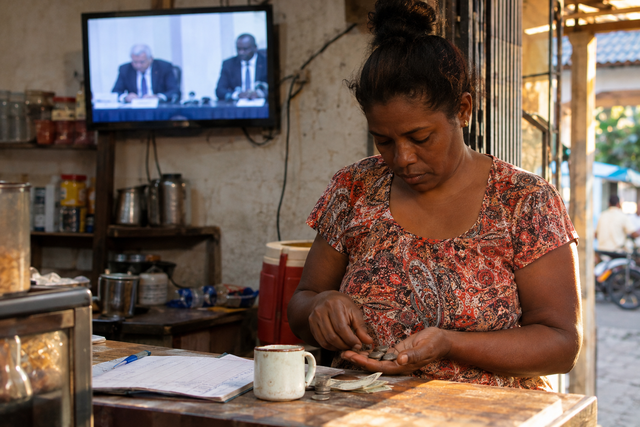
The minister will quote 3.4 per cent. The shopkeeper will count the till. Both will be describing the same year, and the distance between those two accounts is the subject of this entire edition.
Data notes: Growth forecasts from the International Monetary Fund, World Economic Outlook, October 2026. Real wage growth, informality, low-pay shares and minimum wage adjustment figures from the International Labour Organization, Global Wage Report 2024 to 2025, which is the most recent edition of that flagship series; its wage data therefore runs to 2024 and the 2024 global figure is preliminary. Regional groupings are the ILO's own. Real wages are nominal wages adjusted for consumer price inflation.
Content Protected
This article is the original work of The Meridian and is protected by copyright. Please link to it rather than reproducing it.