We Sell the Rock. We Buy It Back as a Product.
Africa grows nearly three quarters of the world's cocoa. Cote d'Ivoire grinds more of it than any country on earth, more than the Netherlands. It has not made the country rich, and understanding why is the difference between an industrial policy that works and one that wastes a decade.
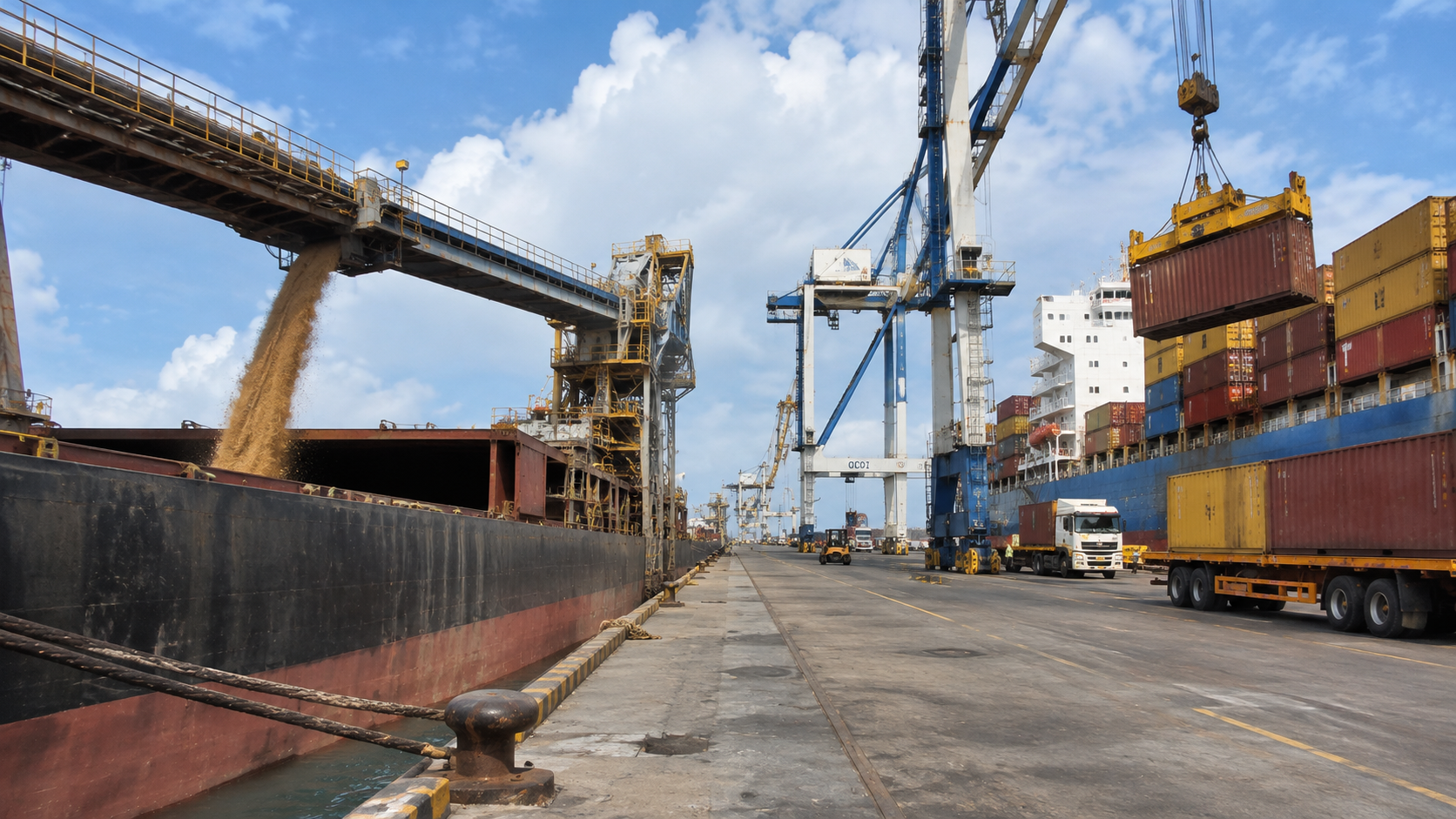
Stand on a working quay in West Africa for a morning and you can watch an entire economic theory play out without anybody explaining it. On one side, a bulk carrier takes on raw material through a conveyor, a pale stream falling into an open hold. On the other, a container ship puts down sealed boxes of finished goods onto flatbed trucks. The same port, the same tide, the same country. One direction is cheap and heavy. The other is expensive and light.
That round trip is the trade deficit, and it is the most durable feature of the economies this publication covers. It is also, in 2027, about to become more expensive to finance, because the gap between the two legs has to be paid for in a currency that nobody in the region issues.
The standard diagnosis is that the Global South exports raw material and fails to process it. The standard prescription is to build processing capacity. The diagnosis is broadly right. The prescription, on the evidence, is not enough, and cocoa is the case that proves it.
In the 2022 to 2023 season, Africa accounted for 73.4 per cent of global cocoa production, according to figures compiled by Afreximbank from the International Cocoa Organization. Cote d'Ivoire alone produced about 44 per cent of the world's cocoa. Ghana produced about 14 per cent.
Cote d'Ivoire: about 44 per cent of world production.
Ghana: about 14 per cent.
The rest of Africa makes up the balance of the 73.4 per cent. The share has slipped from 77 per cent in 2021.
Set against that, the global industrial chocolate market was worth 57.8 billion US dollars in 2022 and is projected to reach 81.8 billion by 2030. Exports of chocolate and other cocoa-containing foods came to 36.7 billion dollars in 2022. The countries that grow almost three quarters of the input are not the countries recording most of that revenue.
So far this is the familiar argument, and the familiar conclusion follows: build the factories. Grind the beans at home. Capture the value.
Here is the problem with it.
In the 2020 to 2021 season, Cote d'Ivoire ground 620,000 tonnes of cocoa, the largest volume of any country in the world. The Netherlands, the historic centre of the global grinding industry, ground 610,000 tonnes.
This single comparison dismantles the simple version of the value addition argument. If processing capacity were the binding constraint, Cote d'Ivoire would by now be capturing a share of the chocolate economy proportionate to the beans it both grows and grinds. It is not.
The country that grinds the most cocoa in the world is a producing country. Grinding, it turns out, is not where the money is.
Grinding converts beans into liquor, butter and powder. It is an industrial process with thin margins, heavy capital requirements and a buyer base of perhaps a dozen global firms. Moving from selling beans to selling butter moves a country one step up a ladder whose remaining steps are the valuable ones: recipe, brand, distribution, shelf position, and the consumer relationship that allows a bar of chocolate to carry a price unrelated to its ingredients.
Those steps are not capital-intensive in the way a grinding plant is. They are intensive in marketing spend, in proximity to the consumer market, in retail negotiating power, and in intellectual property. Those are much harder to relocate than a factory, and they are not addressed by any amount of installed processing capacity.
UNCTAD's State of Commodity Dependence, comparing the 2021 to 2023 period against 2012 to 2014, classifies a country as commodity dependent when commodities exceed 60 per cent of its merchandise export value. On that threshold, 95 of 143 developing economies qualify, roughly two thirds of the developing world.
The regional picture is worse than the global one.
Forty-six of Africa's fifty-four countries are commodity dependent, which is 85 per cent of the continent. In Middle and Western Africa the figure is every single country. In Eastern Africa it is fifteen of eighteen. All twelve South American countries qualify, eleven of them above 80 per cent. All five Central Asian states qualify. Twenty African countries are mining dependent, which is more than 60 per cent of the global total of mining-dependent economies.
These are not the figures of a region that failed to industrialise in one sector. They are the figures of a trading position that has held for a generation and, on UNCTAD's own decade-on-decade comparison, has not meaningfully moved.
Four mechanisms keep the round trip running, and none of them is addressed by building a plant.
The first is tariff escalation. Trade regimes across the advanced economies have long applied low or zero duties to raw inputs and higher duties to the processed version of the same commodity. The effect is to make it cheaper for the importing country to do the processing, which is precisely the outcome the producing country is trying to reverse. This is a policy choice made elsewhere, and no amount of domestic investment overrides it.
The second is standards and certification. Entry to a high-value consumer market requires compliance with food safety, traceability, labelling and increasingly sustainability regimes, each of which carries fixed costs that favour incumbents and large firms.
The third is working capital. Holding processed inventory, extending trade credit and financing a brand's path to market all require capital at a cost that reflects the sovereign's borrowing rate. A producer in a country paying several times the coupon of its competitors is competing on finance before it competes on product.
The fourth is the consumer market itself. Value in the chocolate chain accrues close to the person eating it, and most of those people are in Europe, North America and increasingly East Asia. Capturing that value means operating in those markets, not merely exporting into them.
Tariff escalation is the clearest of the four, because it is the only one written down. It is a deliberate policy, in force, that makes processing at origin more expensive than processing at destination.
Three consequences follow into the year ahead.
The deficit has to be financed, and 2027 is a heavy year for refinancing. A current account gap generated by this structure is covered by borrowing, by reserves, or by currency depreciation. In an election year with elevated borrowing costs, the third option is the one that arrives by default, and it transmits straight into the food and wage arithmetic described elsewhere in this edition.
Commodity prices will do what they do, which is move. The recent run in cocoa prices improved export earnings for producers, and it also demonstrated the vulnerability precisely: a country whose export book is 60 per cent or more one commodity has its fiscal position written by a market it does not control.
And the critical minerals cycle is arriving into exactly this structure. The transition metals that batteries and grids require are concentrated in commodity-dependent economies, and the processing of those minerals is concentrated somewhere else entirely. If the cocoa precedent holds, installing processing capacity will not by itself change the distribution of the value. We return to that in the Wars and the Powers section.
The honest answer is that nothing available inside a single year will. But the cocoa evidence does point at which interventions are worth the money and which are theatre.
Processing capacity is necessary and not sufficient, and a government that builds it while treating it as a solution will be disappointed in roughly a decade. Negotiating tariff escalation is a trade policy question rather than an industrial one, and it is the item most neglected relative to its importance, because it requires coordinated bargaining rather than a ribbon to cut. Regional buyer power, through producer alliances that negotiate as a bloc, is the only lever that addresses a buyer base of a dozen firms. And owning a position in the consumer market, rather than selling into it, is the step almost nobody attempts because it is expensive, slow and unphotogenic.
There is one serious attempt currently running at the largest scale yet tried, in a different commodity, and it will tell us a great deal about which of these constraints actually binds. That is the subject of the next article.
Data notes: Cocoa production and grinding figures from Afreximbank's flashnote on cocoa price hikes and African trade, citing the International Cocoa Organization; production shares are for the 2022 to 2023 season and grinding volumes for 2020 to 2021. Industrial chocolate market value and cocoa-containing food export values are for 2022, from the same source. Commodity dependence figures from UNCTAD, The State of Commodity Dependence 2025, covering 2021 to 2023 and using a threshold of commodities exceeding 60 per cent of merchandise export value. The four mechanisms described in this article are the assessment of The Meridian and are not drawn from a single source.
Content Protected
This article is the original work of The Meridian and is protected by copyright. Please link to it rather than reproducing it.