We Pay to Train Them. Someone Else Hires Them.
Britain saved an estimated 1.1 billion pounds in one year by hiring health workers other countries had already trained. In the same year it spent 232 million pounds helping poorer countries build health systems. The gap between those two numbers is not charity. It is a transfer, and it runs the wrong way.
There is a particular kind of aid statistic that gets quoted at summits. A wealthy country announces a sum committed to strengthening health systems in poorer ones, and the figure is reported as generosity. Nobody puts the other column beside it.
Here is the other column. In the year to June 2025, the number of foreign-trained staff working in the National Health Service rose by 7,719. Researchers at the Center for Global Development calculate that training those people domestically would have cost Britain roughly 1.1 billion pounds. The entire foreign-trained NHS workforce, 218,727 doctors, nurses, health visitors and midwives as of June 2025, represents about 14 billion pounds in training costs that Britain never had to pay.
In the same year, Britain's development assistance for health came to 1.3 billion pounds, of which 232 million went to health systems strengthening. The saving on training in a single year was close to five times what Britain spent helping other countries build the systems that produce health workers in the first place.
On the authors' second method, the ratio is nearer twelve to one. Britain saves about twelve pounds in avoided training costs for every pound it spends on health workforce aid.
This is not a scandal in the sense of a secret. Every figure above is published by a British institution. It is a scandal in the older sense: an arrangement that is plainly visible and that nobody is required to account for, because no accounting framework records it as a transaction at all.
The Nursing and Midwifery Council publishes its register annually. At 31 March 2026 it carried 867,935 professionals, of whom 655,826 were educated in the United Kingdom and 212,109 were educated somewhere else. That is 24.4 per cent, very nearly one in four.
212,109 of the 867,935 professionals on the register were educated outside the United Kingdom.
Among doctors the share is higher still. At the end of 2024 the General Medical Council recorded 138,405 licensed doctors holding a primary medical qualification from outside the UK, about 42 per cent of all licensed doctors.
The countries that trained them are not evenly distributed, and three of the top six appear on a list that exists precisely to discourage this.
The World Health Organization maintains a health workforce support and safeguards list: countries whose health systems are judged too fragile to withstand active international recruitment. The 2023 update carries 55 countries, 37 of them in the WHO African region. The threshold is a density below 49 doctors, nurses and midwives per 10,000 population, combined with a universal health coverage service index below 55.
Britain's own code of practice prohibits active recruitment from those countries, and no bilateral recruitment agreement exists with any of them. Nigeria, Ghana and Zimbabwe are all on the list.
In the year to March 2026, Nigeria supplied 1,614 new joiners to the UK nursing register and Ghana supplied 1,391. They were the second and third largest source countries, behind India. On the register as a whole, Nigeria accounts for 17,092 registrants, Ghana 8,531 and Zimbabwe 4,798.
The mechanism that permits this is the distinction between active recruitment and direct application. An agency may not go to Lagos to recruit. A nurse in Lagos may apply to an advertised vacancy. The prohibition binds the recruiter and not the vacancy, and the flow continues through the gap.
There is a defence of this and it is a serious one. The individual nurse has a right to work where she chooses, and a country that cannot employ its own trained staff has no claim on them. Both things are true, and this article is not an argument against anybody taking a job. The failure is not in the person who leaves. It is in an arrangement that moves an asset across a border and records it on neither side.
Here the numbers become difficult, because the two sides measure differently.
British training costs are published. The Personal Social Services Research Unit puts a five-year medical degree at 304,455 pounds, a doctor through the two-year foundation programme at around 392,000, and a fully qualified general practitioner at around 504,000. A three-year pre-registration nursing degree is put at roughly 67,000 pounds.
African training costs come from two peer-reviewed human capital studies, both now some years old. Kirigia and colleagues, writing for the WHO Regional Office for Africa in 2006, put the cost of producing a doctor in Kenya at 65,997 US dollars and a nurse at 43,180, in 2005 dollars and counting schooling from primary onwards. Mills and colleagues, writing in the BMJ in 2011, put government-subsidised doctor training across nine sub-Saharan countries in a range from 21,000 to 58,698 US dollars.
That chart has to carry a warning, and the warning is in the caption. These are not equivalent measures. The African studies count schooling from the age of five because basic education is a prerequisite public investment in a low-income setting. The British figures start at eighteen. The British doctor figures include salaries paid to trainees who are also working. And the African figures are fifteen and twenty years old.
What survives all those caveats is the direction and the scale. Producing a clinician costs Britain something in the order of six to eighteen times what it costs a sub-Saharan African state. Every such clinician who joins the British register transfers the larger figure as a saving, and removes the smaller one as a loss.
The more important asymmetry is in time.
Kirigia and colleagues made the point by compounding. A doctor leaving Kenya does not cost the country only the 65,997 dollars it spent. It costs the thirty-two working years of output that doctor would have produced, which at a Kenyan commercial deposit rate of 6.65 per cent comes to 517,931 dollars per emigrating doctor, and 338,868 dollars per emigrating nurse.
Mills and colleagues ran the same logic across nine countries and arrived at 2.17 billion dollars of compounded lost investment from emigrating doctors, against 2.7 billion dollars of training costs saved by the United Kingdom alone and 846 million saved by the United States. The destination countries saved more than the source countries lost, which is what happens when a cheap asset is moved into an expensive market.
Both of those studies are over a decade old. That they remain the standard citations is itself a finding: nobody has been required to keep count.
Britain has bilateral health workforce agreements with Kenya, Nepal, the Philippines, India, Malaysia and Sri Lanka. None of them includes a mechanism for reimbursing the source country's treasury, health ministry or universities for the cost of educating the people recruited.
The agreements do real things. Employers pay recruitment fees, visas and relocation rather than charging the worker. There is technical cooperation, clinical fellowships, curriculum support. Those are not nothing. But they are transaction costs and goodwill, and neither is compensation for an asset.
And the countries from which the largest red list flows come, Nigeria, Ghana and Zimbabwe, have no bilateral agreement at all, because active recruitment from them is prohibited. The arrangement with the least reciprocity is the one operating on the countries least able to absorb the loss.
What is visible in health because registers record country of training is invisible in education because nothing comparable is counted. The shape is the same.
Enrolment across the Global South has risen substantially and is quoted constantly. What it conceals is whether anything was learned. The World Bank measures learning poverty, the share of children who cannot read and understand a simple text by the age of ten. In 2019, before the pandemic, that figure was 57 per cent across low and middle income countries and 86 per cent in sub-Saharan Africa. Simulations published in 2022 put the post-pandemic figures at 70 and 89 per cent.
Behind that sits the workforce problem. UNESCO and the Teacher Task Force project that 44 million additional primary and secondary teachers are needed worldwide by 2030, of which 15 million are needed in sub-Saharan Africa, more than a third of the global total. Over half of the global shortfall is simply to replace teachers leaving the profession, and global primary teacher attrition roughly doubled between 2015 and 2022, from 4.62 to 9.06 per cent.
The share of primary teachers in sub-Saharan Africa trained to national standards has fallen from 85 per cent in 2000. Two UNESCO publications give different current figures, 64 per cent in a 2024 report and 69 per cent in an October 2025 release, and we report both rather than choosing.
A system that cannot staff its classrooms produces the learning poverty figures above, and a decade later produces fewer people qualified to enter medical or nursing school. The education failure and the health workforce drain are the same problem at two points in one chain.
The standard rebuttal is that the money comes back. It does, and it is substantial. Nigeria received about 22.8 billion US dollars in personal remittances in 2025, some 7.8 per cent of its GDP. Kenya received about 5.1 billion, Ghana about 2.4 billion, and Zimbabwe about 3.5 billion in 2024, which was 8.5 per cent of its GDP.
Those sums matter enormously to the households that receive them and we do not diminish that. But a remittance and a clinician are not the same kind of economic object. A remittance is income: it is spent, it supports consumption, and it ends. A trained nurse is capital: she produces health outcomes for thirty years, and she trains the next cohort while she does it.
Swapping the second for the first is a bad trade even when the cash figure looks large, and no national accounting framework shows it as a trade at all. The remittance appears in the balance of payments. The nurse who was exported to generate it appears nowhere.
Three things are worth watching, and they do not all point the same way.
Recruitment is slowing, and sharply. International joiners to the UK nursing register fell 47 per cent in the year to March 2026, from 20,669 to 10,961. Indian joiners more than halved. Nigerian joiners fell 31.7 per cent and Ghanaian 22 per cent. Britain is training more of its own again, and the decline may be the single largest change in this landscape in a decade.
Against that, the stock does not fall when the flow slows. The 212,109 internationally educated professionals already on the register remain, and the training saving they represent is already banked.
And the pressure on the source side is rising rather than falling. Aid budgets are contracting across the donor economies, which reduces the health systems spending that was the only counterweight on offer. A year in which recruitment slows and aid also falls is not obviously an improvement for a health ministry in Accra or Harare.
The policy question is narrower than it looks. Nobody is proposing to stop people moving, and nobody should. What is missing is an accounting rule. If a country recruits a clinician trained elsewhere, the training cost it has avoided is a measurable number, and it could be recorded, published, and set against what that country gives in health systems support. At present it is none of those things, which is why the transfer continues to be described as a shortage in one country and generosity in the other.
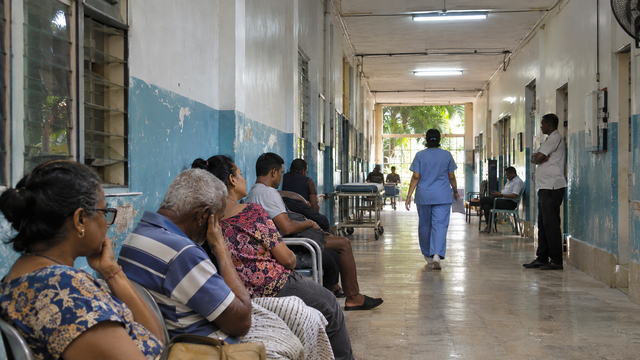
The nurse walking down the corridor towards the exit is not the problem. The problem is that when she reaches the door, two countries will record what happened and neither will write it down as what it was.
Data notes: UK nursing register figures from the Nursing and Midwifery Council, The NMC Register 1 April 2025 to 31 March 2026, published 29 July 2026, and its accompanying data tables; verified against the published report. Doctor figures from the General Medical Council, The state of medical education and practice in the UK: Workforce report 2025, covering the end of 2024. Averted training cost and aid comparison from Anastassia Demeshko and Helen Dempster, Center for Global Development, 16 March 2026, drawing on NHS Workforce Statistics for June 2025, IHME development assistance for health data and OECD Creditor Reporting System figures; their unit cost benchmarks were 22,589 pounds per nurse and 120,693 pounds per doctor, which are lower than the PSSRU figures quoted separately in this article. UK unit training costs from the Personal Social Services Research Unit, Unit Costs of Health and Social Care 2024, as cited by NHS England and the Department of Health and Social Care. African training costs and compounded losses from Kirigia et al., BMC Health Services Research 2006, and Mills et al., BMJ 2011;343:d7031; both are modelled human capital estimates, both are over a decade old, and the two use different costing bases. WHO health workforce support and safeguards list, 2023 update. Learning poverty from The State of Global Learning Poverty 2022 Update; the 2019 figures are observed estimates and the 2022 figures are simulations. Teacher projections from UNESCO and the International Task Force on Teachers for Education 2030, Global Report on Teachers, February 2024; these are projections. Remittance figures from World Bank World Development Indicators, 2026 release, drawing on IMF balance of payments data.
Content Protected
This article is the original work of The Meridian and is protected by copyright. Please link to it rather than reproducing it.