Nigeria Votes on 16 January. The Borrowing Starts Earlier.
Africa's largest economy opens the global election year in better external shape than at any poll since 2014. Reserves are at a record, the currency is stable and inflation is falling. And more than half of every naira the federal government collects goes to paying interest.
On Saturday 16 January 2027, polls open across Nigeria's thirty-six states and the Federal Capital Territory at half past eight in the morning and close at half past two in the afternoon. More than 103 million registered voters will choose a president and a National Assembly across 176,846 polling units. Three weeks later, on 6 February, the governorship and state assembly elections follow.
That is the earliest a Nigerian general election has been held, pulled forward toward the opening of the constitutional window by the Electoral Act 2026, which cut the statutory pre-election timelines. It means the world's eighth most populous country opens the global election year of 2027 before most of the hemisphere has gone back to work.
The conventional thing to write about a Nigerian election is that the naira will suffer. On the record of the last three, that would have been a reasonable call. This time it is probably wrong, and the reason it is wrong is the most interesting thing about this election.
Nigeria has run the same pre-election macroeconomic script three times.
In 2014 and 2015 the authorities drew down the Excess Crude Account and external reserves to defend a peg at 197 naira to the dollar through the March 2015 vote, just as the oil price collapsed. Growth slowed to 2.7 per cent in 2015, the economy entered recession in 2016, and inflation reached 16.5 per cent in 2017 after the post-election devaluations.
Ahead of February 2019, recurrent spending and central bank Ways and Means financing expanded while the central bank ran multiple exchange rate windows, holding the official rate at 306 naira and the investors' window near 360.
The 2023 cycle was the most expensive of the three. The Central Bank of Nigeria's own 2022 annual report names, as a primary domestic shock, "increased spending as the 2023 general elections approach". The petrol subsidy consumed 4.5 trillion naira in forgone oil revenue in 2022, roughly 2.2 per cent of GDP and close to half the general government deficit. The cumulative stock of central bank deficit monetisation through Ways and Means advances rose from 134.8 billion naira in 2012 to over 22.7 trillion by May 2023. Defending the official rate ahead of the February poll pushed the parallel market premium above 60 per cent. External reserves fell to 36.61 billion dollars.
Defend the rate, spend before the vote, monetise the deficit, then devalue once the result is certified. Nigeria has run that sequence three times in twelve years.
The reason to expect something different in January is that the preconditions for that sequence are not present.
Net foreign exchange reserves stood at around 4 billion dollars at the end of 2023. At the end of 2025 they were 34.8 billion. Gross reserves reached 54.9 billion dollars on 25 September 2026 and about 55.1 billion in early November.
The currency reflects it. The official volume-weighted rate traded between 1,346 and 1,352 naira to the dollar through early November, with the parallel market at 1,390 to 1,400. That is a spread of three to four per cent. Before the June 2023 unification it exceeded sixty.
Inflation has fallen for four consecutive months, reaching 14.63 per cent in September 2026, the lowest since October 2020. Food inflation remains high at 19.59 per cent, which matters a great deal to a household and rather less to a bond trader, but the direction is down.
The institutional change underneath those numbers matters more than the numbers. The central bank has moved away from defending an exchange rate target, restricting intervention to smoothing volatility under an integrated policy framework, and in September 2026 it recalibrated its policy rate to 23 per cent and adopted a transaction-based overnight benchmark as part of a formal transition to inflation targeting.
A central bank that has given up defending a peg cannot burn reserves defending one through an election. The most expensive feature of the old script has been legislated out of the orchestra.
All three rating agencies have noticed. S&P upgraded Nigeria to B from B minus in May 2026. Moody's revised its outlook to positive in August while affirming B3. Fitch revised to positive in October while affirming B, and as reported its revision reflected increased confidence that reform momentum would not be disrupted by the election due in early 2027.
Here is the figure that governs everything else in this article.
On IMF projections, federal government interest payments consumed 40.8 per cent of federal revenue in 2024, rose to 53.2 per cent in 2025, reach 53.7 per cent in 2026, and ease only marginally to 52.4 per cent in 2027.
A caution on that chart, because it is the kind of number that gets misquoted. It measures federal interest against federal retained revenue. S&P measures consolidated general government interest against combined federal, state and local revenue, and arrives at an average of 21.4 per cent through 2029. Both are correct; they are answering different questions. The federal figure is the one that describes the room the finance ministry actually has, and it is the one that binds in an election year.
Nigeria's total public debt stood at 166.79 trillion naira at the end of June 2026, about 120.93 billion dollars, up 4.7 per cent in a single quarter and up 90.9 per cent from 87.38 trillion three years earlier.
Of the federal government's 87 trillion naira domestic stock, 22.11 trillion is securitised Ways and Means advances: the central bank financing of earlier deficits, including the pre-2023 election ones, converted into bonds the government now services. The last election cycle is still being paid for during this one.
As of the second week of November 2026, with the election nine weeks away, the 2027 Appropriation Bill had not been laid before the National Assembly. The medium-term expenditure framework was concluded in July 2026 for a planned September submission. The Minister of State for Budget and Economic Planning has since indicated the president intends to present the bill before the end of December.
This is not a scandal in itself; Nigerian budgets are frequently late. It matters because of what it means for sequencing. A government that passes its spending plan in the final days before an election, or in the weeks after it, is a government whose fiscal stance for the year is being set either under maximum political pressure or by an administration that may not be the one implementing it.
The 2026 numbers give an indication of the direction. The executive proposed roughly 58.2 trillion naira in spending. The National Assembly enacted 68.32 trillion, an increase of about ten trillion, signed on 17 April 2026, including 15.8 trillion for debt service.
S&P was explicit about the election in its May upgrade, writing that the fiscal deficit was likely to widen across 2026 and 2027 on looser fiscal policy, and that the approaching election was likely to coincide with a slowdown in the implementation of revenue reforms. An upgrade that names the election as the principal risk to the thing being upgraded is a precise piece of analysis, and it is on the record.
Our reading is that the risk has moved from the currency to the budget, and that most coverage will look in the wrong place.
The naira is unlikely to produce the post-election break that followed 2015 and 2023, because the mechanism that produced those breaks has been dismantled. There is no peg to defend, reserves are at a decade high, the parallel premium is in low single digits, and the current account is in surplus on all three agencies' projections.
The fiscal risk is a different matter and it is live. The deficit is projected to widen in the election year. The budget is late. Interest consumes more than half of federal revenue. And the historical record of what Nigerian governments do with spending in the months before a vote is not ambiguous; it is documented by the country's own central bank.
The second risk is the one that sits outside the spreadsheets. A Nigerian presidential result has been formally challenged before the Presidential Election Petition Court after each of the last several elections, and a petition is close to a routine feature of the process. The economically relevant question is not whether a challenge is filed but how long the resulting uncertainty lasts, because an unresolved result in February and March sits directly on top of a budget that has not been passed.
First, whether the 2027 Appropriation Bill is laid and passed before polling day. A budget enacted in December is a government governing. A budget enacted in March is a government reacting.
Second, the domestic bond market. Marginal stop rates at the October auction ran between 16.99 and 17.29 per cent, having fallen from 18.34 to 18.40 per cent in July. If those rates reverse upward through December and January, domestic investors are pricing election risk, and it will show there before it shows anywhere else.
Third, the parallel market spread. At three to four per cent it is the best evidence that the old script has been abandoned. If it widens materially into January, that judgement is wrong and this article is wrong with it.
Fourth, the Ways and Means ledger. A return to central bank financing of the deficit would be the clearest possible signal that the pre-election pattern has reasserted itself, and it would be visible well before any currency move.
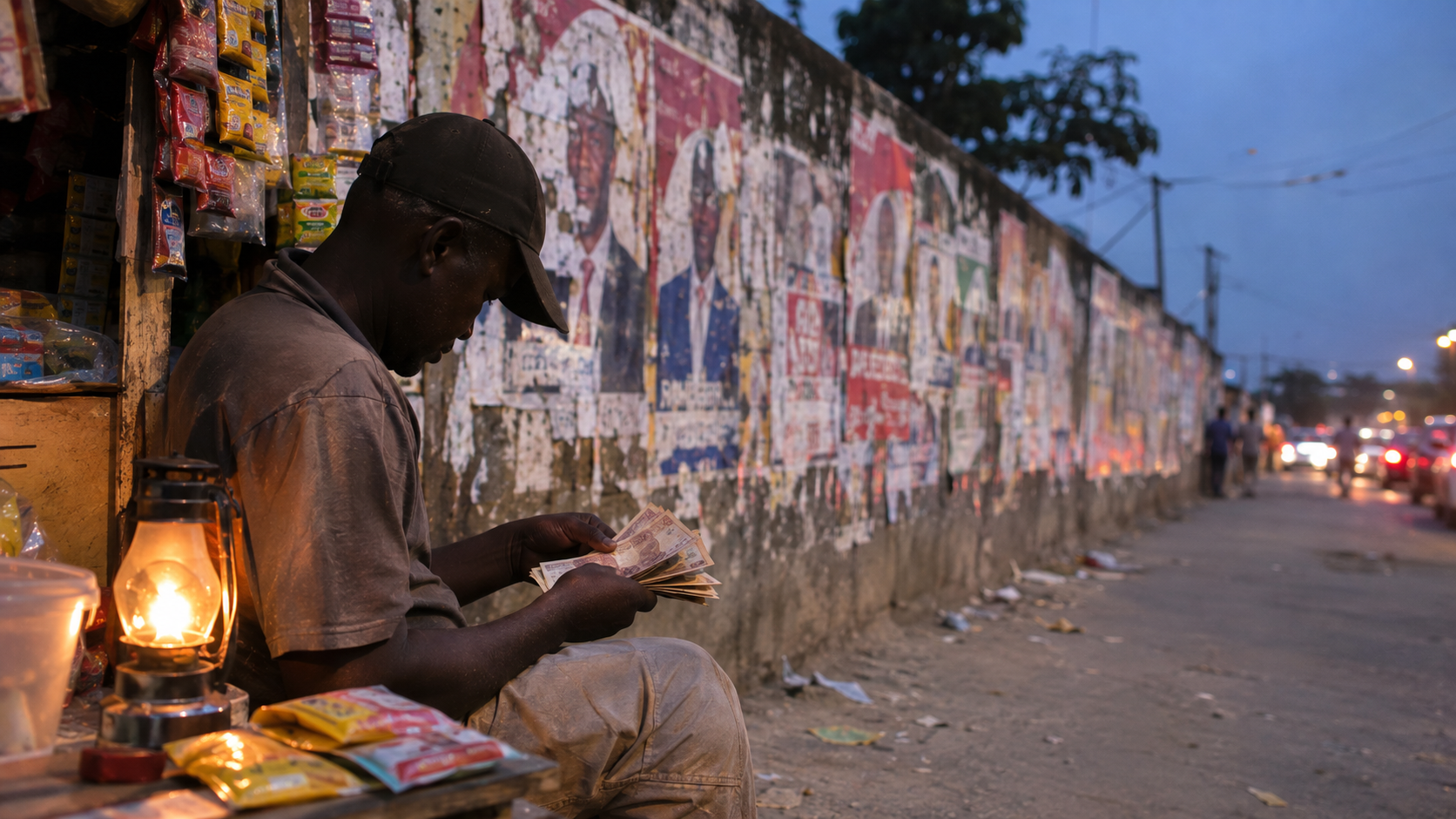
The man counting notes beside the roadside kiosk is not watching any of these. He will experience them as the price of a bag of rice in March. The distance between those four indicators and that bag of rice is roughly the subject of this entire edition, and in Nigeria in 2027 it is unusually short.
Data notes: Election dates, voter registration and polling unit figures from the Independent National Electoral Commission revised timetable of 26 February 2026 and the INEC chairman's address of 5 October 2026. Interest payments as a share of federal revenue, fiscal deficit and GDP projections from the IMF Nigeria 2026 Article IV Consultation Staff Report, Country Report No. 26/125, published 9 June 2026; the 2024 figure is actual, 2025 an estimate, 2026 and 2027 projections. Public debt stock and composition from the Debt Management Office, Nigeria's Total Public Debt as at 30 June 2026, published 25 September 2026. Bond auction stop rates from DMO auction summaries for July to October 2026. Exchange rates from Central Bank of Nigeria NFEM daily rates; parallel market quotes as reported by Reuters. Reserves from the CBN and as cited by Fitch Ratings in October 2026; the IMF notes in its 2026 Article IV report that on the BPM6 definition Nigeria's gross international reserves at end 2025 were 8 billion dollars below the CBN figure. Inflation from the National Bureau of Statistics CPI report for September 2026 on the rebased series. Monetary policy rate from CBN Monetary Policy Communique No. 164 of 22 September 2026. Historical election cycle evidence from the Central Bank of Nigeria 2022 Annual Economic Report, the World Bank Nigeria Development Update of June 2023, and IMF Article IV reports. Rating actions from S&P Global Ratings of 15 May 2026, Moody's of 28 August 2026 and Fitch Ratings of October 2026; the Fitch statement on the election is as reported rather than quoted from the agency's release. This article contains no assessment of the likely outcome of the election.
Content Protected
This article is the original work of The Meridian and is protected by copyright. Please link to it rather than reproducing it.