France Votes in April. Fourteen African Countries Share Its Currency.
Not one voter in the CFA franc zone casts a ballot on 18 April. The familiar account of what that means is now half out of date, because one half of the zone cut the cord in 2019 and the other half did not.
France votes on Sunday 18 April 2027, with a second round on 2 May. The dates have been announced by the interior ministry and sit inside the constitutional window, though the decree formally convoking the electorate had not been published when this edition went to press and is not due until early February.
Fourteen African countries use a currency fixed to the euro at 655.957 to one, guaranteed by the French Treasury. None of their citizens votes in April. That much is unchanged and it is the standard opening for an article of this kind.
The standard article then explains that Paris controls the monetary policy of fourteen countries, and it is now substantially wrong. Not because the arrangement is fair, but because half of it was dismantled six years ago and the other half was not, and almost nobody writes about the two halves separately.
The West African CFA franc is issued by the BCEAO in Dakar for eight countries: Benin, Burkina Faso, Cote d'Ivoire, Guinea-Bissau, Mali, Niger, Senegal and Togo. The Central African CFA franc is issued by the BEAC in Yaounde for six: Cameroon, the Central African Republic, Chad, the Republic of the Congo, Equatorial Guinea and Gabon. Same name, same parity, two separate currencies that are not legal tender in each other's territory.
Under the cooperation agreement signed at Abidjan on 21 December 2019, amended in October 2020 and ratified by the French parliament in March 2021, the West African arrangement was rebuilt. The Central African one was left alone. The Banque de France's own published explainer states the position in a single phrase: cooperation with CEMAC reste inchangee, remains unchanged.
The difference is not cosmetic and it is worth being precise about what it is.
Before 2019, the guarantee operated as an unlimited overdraft on a current account that the central bank was legally required to keep topped up with its own reserves. France was simultaneously the lender of last resort, the custodian of half the reserves, and a voting participant in monetary policy. In West Africa, only the first of those three remains, and it has been converted from a running overdraft into an emergency line that activates after reserves are gone and brings an IMF programme with it.
In Central Africa all three remain.
Fourteen countries use a currency called the CFA franc. Six of them are in the arrangement people describe when they criticise it. Eight are not, and have not been since 2019.
Three things, and they are smaller than the reputation but not nothing.
The first is information. In exchange for guaranteeing a currency without sitting in the room where it is managed, the 2019 agreement requires the BCEAO to report periodically to the French Treasury and the Banque de France on reserve levels, balance of payments dynamics and monetary aggregates. Paris no longer votes. It still reads.
The second is the condition attached to rescue. If the guarantee is ever activated, France may appoint an observer to verify the measures taken, and a sustained drawdown obliges the member states to negotiate an adjustment programme with the IMF. The guarantee is real and it is not free.
The third is the parity itself. Changing the fixed rate against the euro requires consultation and notification running through the EU Council under a 1998 decision, which is why the number has not moved since 1999. The countries can rename the currency without asking. Revaluing it is another matter.
The clearest evidence that the reform was substantive is that the two central banks have stopped moving together, and neither moves with the ECB.
That divergence is possible because both zones enforce strict capital controls, which is the mechanism the IMF identifies as giving them short to medium term policy autonomy despite a hard peg. It is also a reminder that monetary sovereignty and capital account openness are a trade, and the CFA zones have chosen one side of it.
The reserve positions have also diverged sharply.
West African reserves rose from about 14.5 billion dollars in October 2024 to 45.8 billion by February 2026, covering 7.8 months of imports. Central African cover is projected at 4.53 months for end 2026, below the IMF's five month adequacy floor, and the BEAC still keeps half of what it has in Paris.
Inflation tells the same story of divergence. West African prices actually fell year on year in the first quarter of 2026, by 0.2 per cent, before turning positive and reaching a projected 2.1 per cent by October. Central African inflation is running at a projected 2.2 per cent average for 2026. Both are low. Both are well inside the convergence bands. Neither looks like a zone in monetary distress.
Not the peg. On the evidence above, the monetary channel from a French presidential result to a West African household is weaker than it has been at any point since 1945, and in Central Africa it runs through an arrangement that no French government has proposed to change.
The transmission that is real, measurable and already under way is fiscal, and it is in the French budget.
The 2027 finance bill cuts the development assistance mission to 3.17 billion euros, down 11.2 per cent on a 2026 figure that had itself been cut by roughly 700 million. Within that, the Treasury's economic and financial development programme falls 12 per cent and the foreign ministry's solidarity programme falls 18 per cent. Programmed food aid went from 130 million euros in 2025 to 50 million in 2026.
This matters more than the currency because of who receives it. Cote d'Ivoire was the single largest recipient of French bilateral development assistance in 2024, ahead of every other country in the world. France has already suspended bilateral aid entirely to Mali, Niger and Burkina Faso, all three of which remain in the West African monetary union while having left ECOWAS.
And it is happening against a wider contraction. OECD development assistance fell 9 per cent in 2024 and the OECD projects a drop of 16 to 28 per cent in aid to sub-Saharan Africa.
One further thing has changed that puts the monetary question in context, and it happened without most coverage treating it as the end of an era.
France no longer has a permanent military base anywhere in West or Central Africa. Mali in 2022, Burkina Faso in 2023, Niger in 2023, Chad through December 2024 and January 2025, Cote d'Ivoire in early 2025, Gabon converted to a joint training academy, and Senegal's final two installations handed over on 17 July 2025, ending sixty-five years of permanent presence. Djibouti is what remains.
Trade, meanwhile, went the other way. French exports to the West African union rose 10.4 per cent in 2025 to 3.9 billion euros, and imports rose 47 per cent to 2.6 billion. Cote d'Ivoire overtook South Africa as France's largest customer in sub-Saharan Africa.
A relationship in which the bases close, the aid falls and the trade grows is not the relationship the word Francafrique describes. It is something else, and it has not yet been named.
We report positions on the record rather than speculating about a result.
The presidential bloc authored the current doctrine: France as strict financial guarantor, out of the boards, account closed, and formally ready to extend the same reform to Central Africa whenever its heads of state request it. That last point is the one to watch, because the request has not come.
La France Insoumise and the communist group voted against or refused to endorse the 2019 agreement, arguing the reform was cosmetic because the parity and the guarantee survived, and LFI's platform commits to ending the system in consultation with African states.
Les Republicains supported ratification on stability grounds while warning that an unlimited guarantee without a seat on the board exposes the French Treasury to risk it cannot monitor.
The Socialists voted in favour while arguing the future currency should move from a rigid euro peg to a basket including the dollar and the yuan.
The Rassemblement National occupies an unusual position: its leader has publicly criticised the CFA franc as a disadvantage to African countries, while the party's parliamentary activity has concentrated on cutting French budgetary exposure rather than on abrogating the treaties.
Three of those five positions, held together, point at the same outcome by different routes. A government that wants to end the system, a government that worries about fiscal exposure, and a government that wants to cut aid all have reasons to look again at an unlimited guarantee. What none of them has proposed is a change to the parity.
At the ECOWAS summit at Lungi on 19 July 2026, heads of state reconfirmed 2027 as the launch year for the eco, the West African single currency, after target dates in 2003, 2005, 2009, 2015 and 2020 had all passed.
What changed is the method. The launch will now begin with the countries that meet the convergence criteria and are ready, with support for the rest to join later. That is a significant retreat from a single simultaneous launch, and it is also the only version that has ever had a chance of happening.
The practical state of the project is captured by two items in the same communique. The eco trademark has been registered with the African intellectual property organisation. And the presidential task force overseeing the currency had to be reconstituted because only one of its members was still in office.
First, whether the decree convoking the French electorate confirms 18 April and 2 May. It is due by early February and it is the only part of the French timetable that is not yet legally fixed.
Second, the 2027 French development assistance budget as enacted rather than proposed. The 3.17 billion figure is a bill, not a law, and the final number is the one that reaches Abidjan and Dakar.
Third, and most important for the six countries nobody writes about, whether any CEMAC head of state requests the reform that West Africa obtained in 2019. France has stated it is ready. The request has not been made, and the reason it has not been made is a better subject for an investigation than anything happening in Paris in April.
Fourth, the December 2026 ECOWAS summit, where the reconstituted task force is due to report on the exchange rate regime, reserve pooling and the central bank model for the eco. Those three questions are the whole project, and they have been outstanding for twenty-three years.
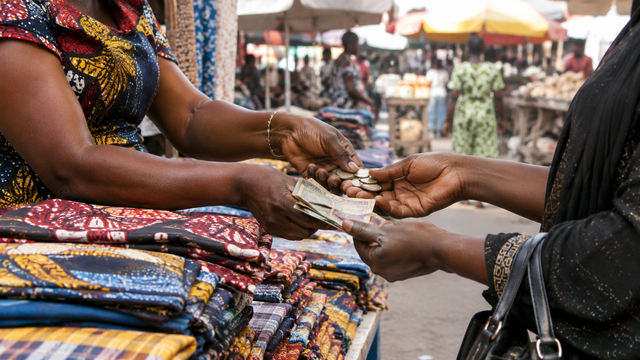
The hands exchanging notes at a market stall in Dakar are using a currency whose value is set in Frankfurt and whose convertibility is underwritten in Paris. That was true in 1999 and it is true today. What has changed is that in Dakar, nobody from Paris is in the room where the decisions are taken, and in Yaounde they still are. Any serious account of the franc zone in 2027 has to begin by saying which of the two it is describing.
Data notes: French election dates from the Ministere de l'Interieur and the government information service, updated 9 November 2026; the decree convoking the electorate had not been published at the time of writing and is due by early February 2027. Institutional architecture from the Banque de France, Les cooperations monetaires Afrique-France, April 2025, which confirms the closure of the BCEAO operations account, the French withdrawal from BCEAO governance bodies, French participation in BEAC governance, and that cooperation with CEMAC remains unchanged; and from the cooperation agreement of 21 December 2019 with the French parliamentary reports on its ratification. The figure of 50 per cent for BEAC reserve deposits is as reported in those parliamentary papers and is not stated in the Banque de France explainer. Policy rates from the ECB decision of 29 October 2026, the BCEAO monetary policy report of September 2026, and the BEAC press release of 28 September 2026. Reserve cover from IMF Country Report 26/154 for WAEMU and the BEAC projection for CEMAC; a separate IMF report gives a different WAEMU figure and both are noted. Inflation from BCEAO and BEAC publications. Development assistance figures from the French 2027 finance bill annual performance plan of October 2026 and the 2026 finance law, with OECD DAC context from July 2025. Trade figures from the French Treasury and customs as reported in September 2026. Military withdrawals from the French government public information service and Public Senat. Party positions from the Assemblee nationale and Senat records of the ratification debates of December 2020 and January 2021 and subsequent published platforms and amendments. Eco status from the ECOWAS final communique of the 69th ordinary session, 19 July 2026. This article contains no assessment of the likely outcome of the French election.
Content Protected
This article is the original work of The Meridian and is protected by copyright. Please link to it rather than reproducing it.