Africa's Peace Missions Are Paid For by Outsiders.
The African Union's own budget decision for 2027 assigns 197.9 million dollars of a 207.9 million dollar peace operations budget to international partners. Its Somalia mission's mandate expires on 31 December, and the United States has told the Union it will fund nothing beyond that date.
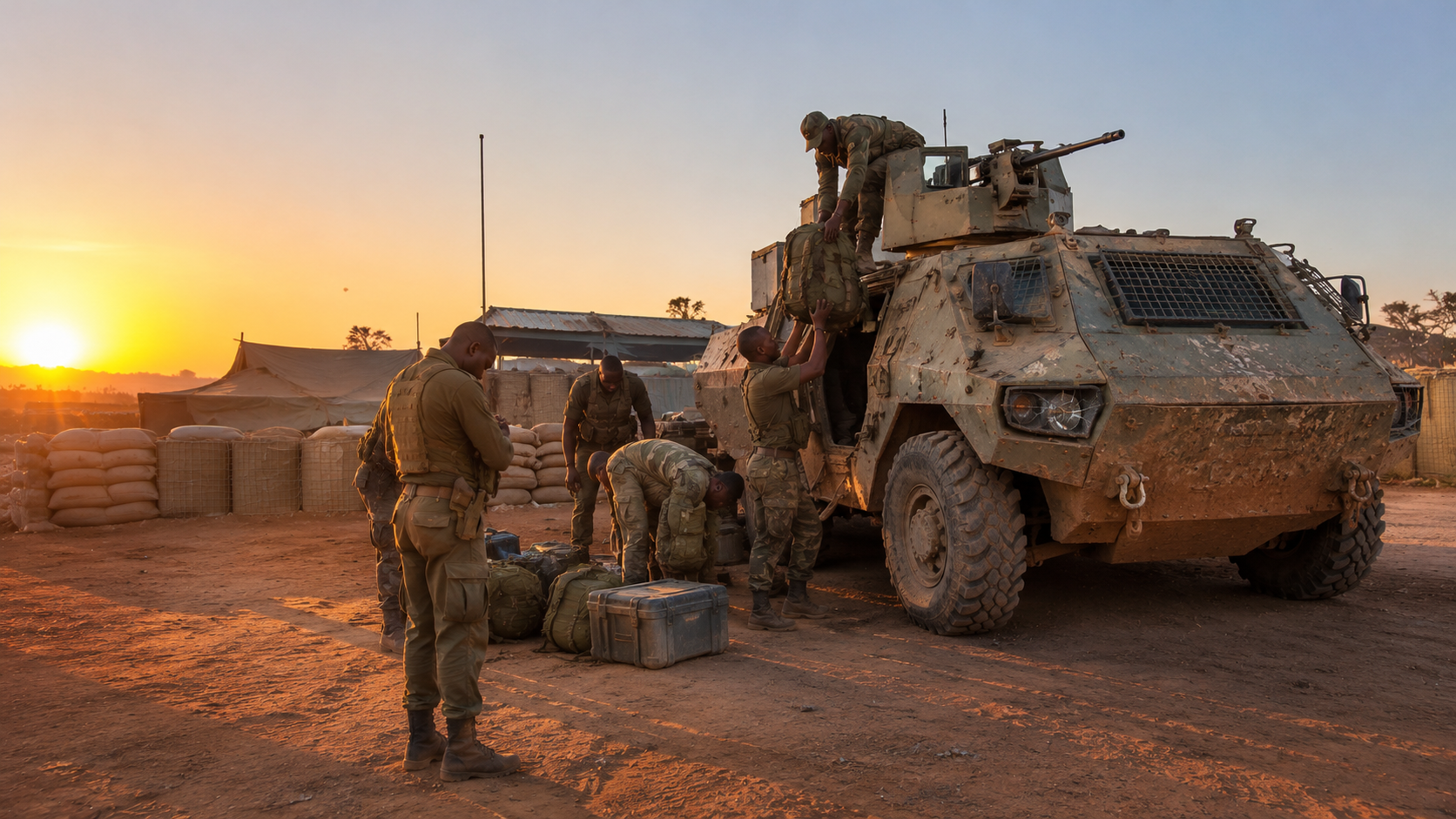
On 13 November the African Union's Executive Council meets in Accra for an extraordinary session on a single subject: how to pay for itself. The Commission's own notice for the meeting, issued on 9 November, says the Union "continues to rely significantly on external partners" for its programmes and its peace and security activities. That is the Union's description of itself, in its own press release, four days before the ministers sit down.
The arithmetic behind that sentence is published and precise. It is set out in Executive Council Decision EX.CL/Dec.1352(XLIX), adopted at the forty-ninth ordinary session in Addis Ababa on 29 July 2026, and it is worth reading rather than summarising.
The Union's total approved budget for 2027 is 800,083,884 dollars. Within that, a regular budget of 707,793,797 dollars divides into three parts: an operational budget of 189,964,492 dollars, which is the Commission itself, salaries and buildings and meetings; a programme budget of 309,938,162 dollars; and a peace support operations budget of 207,891,143 dollars.
Member states are assessed for 200,000,000 dollars. The decision states where it goes: 187,308,355 dollars to the operational budget and 12,691,645 dollars to programmes. Not one dollar of member-state assessment is allocated to peace support operations. International partners are recorded as providing 246,789,343 dollars to programmes and 197,891,143 dollars to peace support operations.
USD m
USD m
USD m
This is not a hostile reading. It is the Union's own table. The money African states put in keeps the institution running. The money that puts soldiers in the field comes from elsewhere.
Not one dollar of member-state assessment is allocated to peace support operations in the 2027 budget.
The 200 million dollar assessment is a ceiling, not a receipt. A companion decision at the same session, EX.CL/Dec.1359(XLIX), records that as at 30 June 2026 member states had paid 132,734,127.53 dollars of the 200,000,000 assessed for that year. Sixty-six per cent, at the halfway point.
Thirteen member states were under the Union's sanctions regime for arrears. Nine carried cautionary sanctions: Chad, South Sudan, Guinea-Bissau, Eswatini, Uganda, Comoros, Liberia, Equatorial Guinea and Malawi. São Tomé and Príncipe carried intermediate sanctions. Burkina Faso, Mali and Niger carried comprehensive sanctions. Somalia, whose arrears stood at 1,722,316.95 dollars on 1 January 2025, had not complied with its restructured payment plan.
The Union has not been passive about this. Ethiopia and Kenya volunteered to move from the second tier of the assessment scale to the first for the 2027 to 2029 cycle, lifting the ceiling by 9,286,000 dollars. And the new scale is deliberately assessed at 104.643 per cent rather than 100, which is an institution budgeting for the fact that some of what it bills will not arrive.
Since 2017 the Peace Fund has received 353,516,629.80 dollars in contributions. The Kigali target was 400 million. Nine years in, it is not there.
The African Union Support and Stabilization Mission in Somalia took over from ATMIS on 1 January 2025. On 23 December 2025 the Security Council renewed its mandate unanimously under Resolution 2809, authorising up to 11,828 uniformed personnel including 680 police, until 31 December 2026.
Resolution 2719, adopted unanimously in December 2023, created a framework under which AU-led operations authorised by the Council could draw up to 75 per cent of their budget from UN assessed contributions. It has never been applied to this mission. When the Council adopted Resolution 2767 in December 2024 the United States abstained and the financing decision was deferred to May 2025. In May 2025 no consensus was reached. Resolution 2809 renewed the mandate without activating 2719.
On 1 July 2026 the United States notified the Union that it would not fund the mission beyond 31 December 2026. Washington said it would not veto renewal of the mandate, but would block UN logistical and operational support, which in practice means the UN Support Office in Somalia that delivers the mission's fuel, rations, water and medical evacuation. The stated reason was the Somali federal government's failure to take ownership of its own security.
Nearly twelve thousand soldiers are deployed under a mandate that expires in seven weeks, funded for less than half of what their pay alone costs, with their logistics provider under notice. The Union's four-phase exit strategy, endorsed in January 2025, envisaged a handover to Somali forces completed on 31 December 2029. That timetable now depends on money nobody has committed.
This is not only an African Union problem, and it helps to see the scale. At the end of 2025 there were 58 multilateral peace operations active in 34 countries, the first time the count has fallen below 60 since 2016. They deployed 78,633 international personnel, the lowest December total in a dataset reaching back to at least 2000, and 49 per cent below the figure for December 2016.
Sub-Saharan Africa carried 55,229 of those personnel, 70 per cent of the global total, down from 69,913 a year earlier. The direction of travel differs sharply by who is doing the deploying.
The bodies with treaties, charters and standing protocols are the ones contracting fastest. The arrangements with none of that are the ones growing.
The Southern African Development Community deployed to eastern Democratic Republic of the Congo on 15 December 2023, with troops from South Africa, Malawi and Tanzania. The target strength was 5,000, to be reached by July 2024.
In late January 2025 M23 took Goma. At least nineteen SADC soldiers were killed, fourteen of them South African. On 13 March 2025 an extraordinary summit terminated the mandate. Withdrawal began on 29 April and the mission closed during the year.
The independent assessment of why is not flattering and not mysterious: slow deployment, no attack helicopters or drones, a regional logistics depot in Botswana not expected to be operational until 2030, a funding gap, a weak national partner army, and troop-contributing countries whose domestic politics turned. Malawi announced its withdrawal in February 2025, before the summit met.
ECOWAS publishes its budget execution, and the 2026 to 2028 community budget document shows what the community levy actually delivers.
The third bar is the one that should trouble the Commission most. Of the money ECOWAS did allocate to peace and security in 2025, fewer than twenty-three cents in every dollar had been spent ten months into the year. The 2026 allocation is lower again, at 19,700,000 units of account.
The consolidated budget fell to 411,724,082 units of account for 2026 from 423,889,851 in 2025, a reduction the Commission attributes to the departure of Burkina Faso, Mali and Niger, whose withdrawal took effect on 29 January 2025. The community now has twelve members, with Guinea-Bissau suspended after the coup of 26 November 2025 and Guinea's suspension lifted on 28 January 2026.
The African Standby Force was created under Article 13 of the 2002 Peace and Security Council Protocol. Five regional brigades, a rapid deployment capability of 2,500 per region intended to move within fourteen days. The Specialised Technical Committee on Defence declared it had reached full operational capability in January 2016, after the Amani Africa II field exercise.
It has never deployed as the African Standby Force. Every peace enforcement operation since has gone out under a regional body's own command, as ECOWAS did in The Gambia in 2017 and SADC did in Mozambique and the Congo, or as a bespoke African Union mission such as the Somalia missions, or as an ad hoc coalition. When the Peace and Security Council authorised a 5,000-strong force for Burundi in December 2015, it never went. In 2020 the Union retrospectively reclassified regional deployments begun in 2017 as standby force operations. As of the Military Staff Committee's thirty-fourth meeting in August 2026, the memorandum of understanding governing command and deployment of the force was still being negotiated.
The reason is not mysterious either. In June 2024 ECOWAS defence and finance ministers meeting in Abuja were given two costed options for a regional counter-terrorism force: 2.6 billion dollars a year for 5,000 troops, or 481 million dollars a year for 1,500.
A force of five thousand costs more than four and a half times the entire annual budget of the organisation that would deploy it, and more than three times the budget of the entire African Union. The standby force has not deployed because nobody has ever been willing to pay for it.
It would be dishonest to leave it there, because the record is not uniform.
ECOWAS removed Yahya Jammeh from power in The Gambia in January 2017 without a combat fatality, by deploying a force while he was still refusing to accept an election result. In 2025 it put troops from Nigeria, Sierra Leone, Côte d'Ivoire and Ghana into Benin within eighteen hours to stop a coup attempt. Both worked.
The Somalia missions, across nineteen years, pushed Al-Shabaab out of Mogadishu in 2011 and out of most major urban centres, and kept a sequence of Somali governments in existence. The independent evaluation by the Effectiveness of Peace Operations Network credits that while also recording the mission as the Union's longest, most expensive and most deadly, fragmented across contributing countries answering to their own capitals, short of aviation, and unable in nineteen years to build a Somali army that could hold what it took.
The pattern that emerges is specific rather than general. These bodies succeed when the operation is short, close to home, politically unanimous and cheap. They fail when it is long, far, contested or expensive. That is not a moral judgement about African institutions. It is what happens to any organisation that must raise money for each operation separately after deciding to mount it.
The African Union's 2027 budget assigns no member-state money to peace support operations and 197.9 million dollars of partner money to them. ECOWAS collects 43 per cent of the levy its members owe and receives 70 per cent of what its partners promise. SADC mounted a mission at a quarter of its intended strength and withdrew it after fifteen months. The continental standby force, declared operational in 2016, has never deployed.
The common factor is not incapacity. It is that the financing of African peace operations is organised as a series of appeals rather than as a budget line, and appeals are answered by whoever is willing that year. In 2026 the answer from Washington was no.
The ministers meeting in Accra on 13 November know this. The question their session has to answer is not whether the Union is externally financed, which its own press release concedes, but whether 55 member states that paid 66 per cent of a 200 million dollar assessment by mid-year are willing to fund the difference themselves. Nothing in the record suggests they are.
First, what the Security Council does about the Somalia mission before 31 December. A mandate renewed without UN logistical support is a mandate without fuel and rations. Watch whether the Council renews it anyway, converts it into a political mission, or hands it to the Eastern Africa Standby Force.
Second, whether the Accra session produces a decision with a number in it. The Union has held financing sessions before. A communiqué that commits members to a specific additional sum, with a date, would be new.
Third, whether Resolution 2719 is ever applied to anything. It has existed for three years and has not been used once. If the Somalia mission ends without it being triggered, it is a framework with no case.
Fourth, whether member-state collection improves against the new 104.643 per cent scale. That figure is the Union's own forecast of its shortfall, written into the assessment. If collection does not rise, the scale will have to rise again.
An institution that cannot fund its own soldiers has a mandate and not an instrument. The African Union has stated the problem with more precision than any of its critics. What it has not yet done is solve it.
Data notes: All African Union budget figures are taken directly from Executive Council Decision EX.CL/Dec.1352(XLIX) and the companion decision EX.CL/Dec.1359(XLIX), adopted at the forty-ninth ordinary session in Addis Ababa on 29 July 2026 and published by the African Union. The stated financing sources in that decision account for 644,680,486 dollars of the 707,793,797 dollar regular budget; the balance is shown in Chart 1 as not attributed, because the portion of the decision text we examined does not assign it a source, and we have not estimated one. The quotation that the Union "continues to rely significantly on external partners" is from the African Union Commission press release of 9 November 2026 announcing the twenty-seventh extraordinary session of the Executive Council in Accra on 13 November 2026. The Peace Fund figure of 353,516,629.80 dollars is contributions since 2017 as recorded in EX.CL/Dec.1359(XLIX); secondary reporting has placed the Fund's balance above 400 million dollars, which may reflect investment returns, and we report the Union's own contribution figure rather than reconcile the two. Somalia mission figures are from Security Council Resolution 2809 of 23 December 2025 as reported by The EastAfrican, and from the Institute for Security Studies, 29 July 2026, for the United States notification of 1 July 2026 and the troop and Somali security force numbers. Peace operation personnel figures and all year-on-year changes are from SIPRI, Developments and Trends in Multilateral Peace Operations 2025, published May 2026. Congo mission figures are from Dzinesa and Rusero, IPI Global Observatory, 31 March 2025, and SIPRI. ECOWAS budget and execution figures are from the ECOWAS Community Budget 2026 to 2028 as published by the ECOWAS Commission, with 2025 actuals stated as at 31 October 2025. The counter-terrorism force costings of 2.6 billion and 481 million dollars were tabled at a meeting of ECOWAS defence and finance ministers in Abuja on 27 June 2024; research supplied to this desk attributed the larger figure to a statement by Commission President Omar Alieu Touray in August 2025 and described it as the cost of the ECOWAS Standby Force, and we have reported the original ministerial costing and its date instead. African Standby Force history is from the African Union Peace and Security Department and from Training for Peace, October 2022. The research supplied to this desk dated the thirteen member states under arrears sanctions to November 2026; the decision itself is dated 29 July 2026 and that date is used here.
Content Protected
This article is the original work of The Meridian and is protected by copyright. Please link to it rather than reproducing it.