Ukraine's Rebuilding Bill Is Larger Than Its Economy.
The joint assessment by Ukraine's government, the World Bank, the European Commission and the United Nations puts recovery at 588 billion dollars over ten years, nearly three times Ukraine's 2025 output. In 2025 Ukraine received more development assistance than all forty-five least developed countries combined. That is the OECD's finding, not ours.
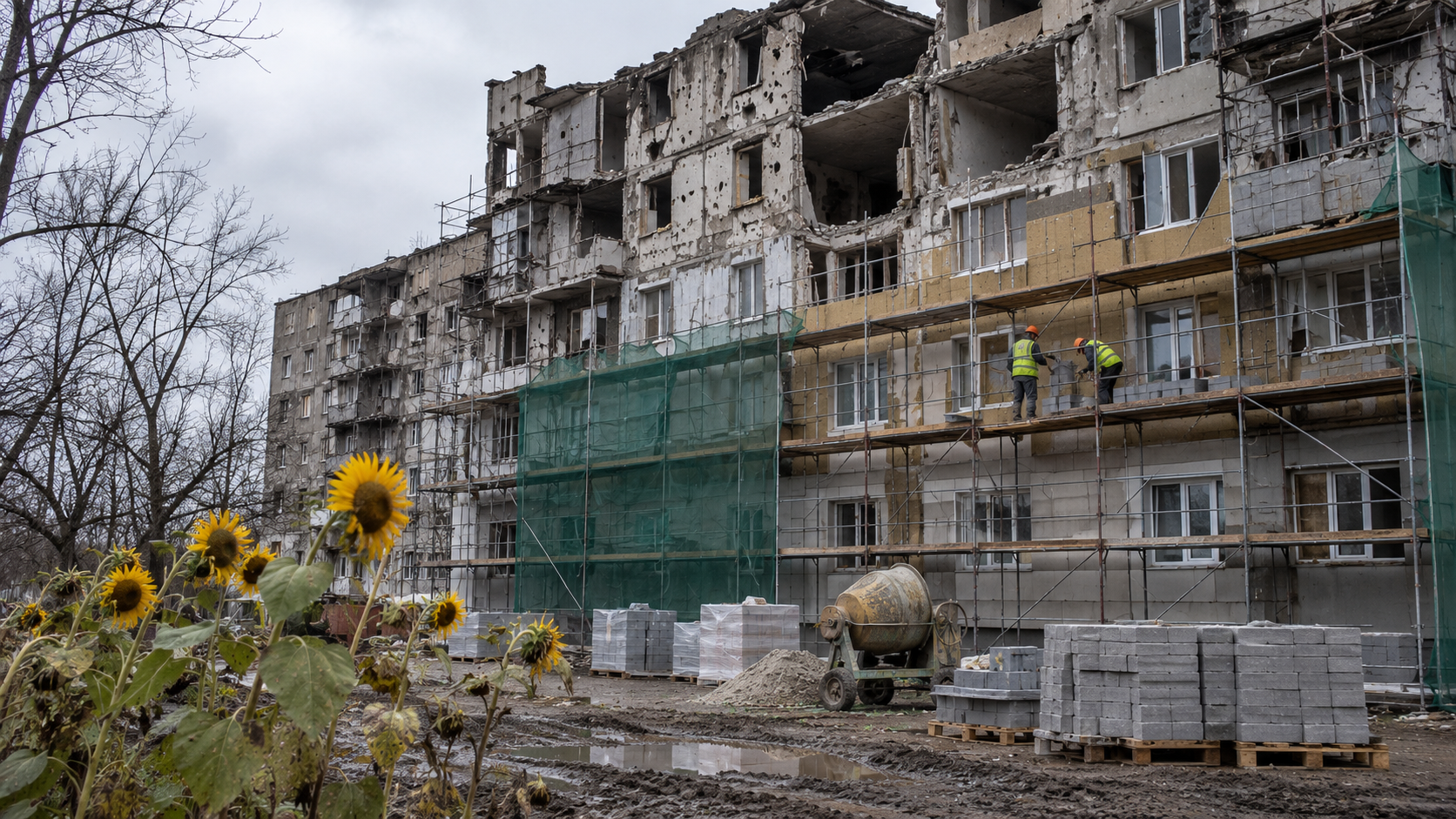
On 23 February 2026 the Government of Ukraine, the World Bank Group, the European Commission and the United Nations published their fifth joint assessment of what the war has cost and what repairing it will cost. Direct physical damage stood at more than 195 billion dollars, up from 176 billion a year earlier. Recovery and reconstruction needs over the following decade came to almost 588 billion dollars, which the publishers themselves described as nearly three times Ukraine's estimated 2025 output.
A settlement in 2027, if one comes, would stop the damage accumulating. It would not touch that number. The borrowing, the write-offs and the claims generated by four years of war are instruments with maturity dates, and the earliest of them falls in 2029.
This article is about who holds those instruments, which budgets the money came out of, and what that has cost countries that were never party to the war.
Ukraine's state and state-guaranteed debt stood at 9,538.34 billion hryvnia at the end of September 2026, about 212.6 billion dollars, of which 76.4 per cent was external. The weighted average interest rate on it had fallen to 4.40 per cent by July, which tells you most of it is not commercial.
It is not. The majority is concessional lending from the European Union, the World Bank, the IMF, the EIB and the EBRD, plus bilateral loans from G7 governments. Restructured commercial Eurobonds account for roughly seven to eight per cent.
Those Eurobonds were restructured in August 2024. Holders of about 20.5 billion dollars of sovereign and guaranteed paper took a 37 per cent nominal haircut, close to 60 per cent in present-value terms, and received about 15.2 billion dollars of new notes. Principal repayments on the largest series do not begin until 1 February 2029. Official bilateral creditors, through the Group of Creditors of Ukraine, have suspended principal since 2022 and extended that standstill in February 2026.
The IMF's published projections have public debt at 107.1 per cent of GDP for 2025, peaking at 111.8 per cent in 2026, and still above 102 per cent in 2030. The Fund's own February 2026 report, using a different treatment of the G7 loans, puts 2026 at 122.6 per cent. Both series are published; they have not been reconciled.
A ceasefire changes the damage figure. It does not change the 2029 maturity.
In October 2024 the G7 finalised 50 billion dollars of what it called Extraordinary Revenue Acceleration lending: 20 billion from the United States, 18.1 billion euros from the European Union, and smaller amounts from Canada, the United Kingdom and Japan.
These are not ordinary sovereign loans. They are serviced from the windfall profits generated by immobilised Russian central bank assets, and they are structured so that Ukraine is not expected to repay them from its own budget. The IMF therefore treats them as contingent liabilities outside baseline debt service. That is why the headline debt ratio and the Fund's alternative series diverge by eleven percentage points.
Roughly 210 billion euros of Russian central bank assets sit immobilised in the European Union, of which something between 183 and 190 billion is held at Euroclear in Brussels. In December 2025 the Commission proposed turning the principal into a reparations loan. Belgium refused, on the grounds that Euroclear and the Belgian state would carry the litigation risk, and the European Council shelved it.
What replaced it is instructive. A 90 billion euro Ukraine Support Loan for 2026 and 2027, 30 billion for budget support and 60 billion for defence procurement, financed by joint EU borrowing against the EU budget rather than by touching the Russian principal. Because three member states refused to take on the liability, it had to be adopted under the enhanced cooperation procedure, only the fifth use of that mechanism in EU history. It was formally adopted on 23 April 2026.
The ten-year figure is the one that gets quoted. The twelve-month figure is the one that matters for 2027.
This is where the story stops being about Ukraine.
In April 2026 the OECD published preliminary figures for development assistance in 2025. Total official development assistance from the thirty-four members of the Development Assistance Committee was 174.3 billion dollars, down 23.1 per cent in real terms. It is the largest annual contraction in the history of the measure. Aid fell to 0.26 per cent of donor national income, and twenty-six of thirty-four members cut.
Within that total, one recipient went up.
The sentence in the OECD's own document reads that Ukraine received more aid from DAC members combined in 2025 than did all least developed countries. Counting EU institutions, it also received more than all of sub-Saharan Africa. No commentary is needed on that, and we are not going to supply any beyond noting that the body which compiles the figures is the body that drew the comparison.
The United Kingdom's own statistics make the mechanism explicit rather than inferred. British aid fell from 0.50 per cent of national income in 2024 to 0.44 per cent in 2025, and the Foreign Office states the reduction to 0.3 per cent by 2027 is being made to fund an increase in defence spending. Ukraine was the single largest country recipient of British bilateral aid for the third consecutive year.
The previous article in this edition established that 95 per cent of the African Union's 2027 peace operations budget is financed by international partners. The largest of those partners is the European Union, and the instrument is the European Peace Facility, which replaced the African Peace Facility in 2021.
That is not an accusation of bad faith. A member-state fund spent most of its money on a war on the member states' own border, which is what one would expect. It is simply the arithmetic that sits underneath Article 14's finding, and it explains why the African Union's peace operations budget depends on decisions taken in Brussels about a different continent.
Development finance that does not arrive concessionally is replaced, where it can be replaced at all, by borrowing at market rates. The World Bank's International Debt Report 2026 puts a number on what that costs.
Five and a half percentage points is the price of the substitution, and it compounds for the life of the instrument. This edition has already reported that African sovereigns pay a premium to borrow and that the IMF's concessional window expects demand of three to five billion in Special Drawing Rights a year against capacity of two and a half to three. This is the same arithmetic seen from the donor end.
Russia is paying for the war out of its own balance sheet, and that balance sheet has changed shape.
The draft 2027 federal budget submitted to the State Duma in late September 2026 allocates 17.1 trillion roubles, about 202.6 billion dollars, to national defence, roughly 27 per cent above the 13.5 trillion originally budgeted. Total 2027 borrowing rises 43 per cent to 7.7 trillion roubles. The 2026 deficit target was raised from 1.6 per cent of GDP to 3.2 per cent, and 2026 spending rose 13.2 per cent to 48.6 trillion roubles, 20.9 per cent of output.
Independent analysis by the Carnegie Endowment and the Kyiv School of Economics puts defence at roughly 35 per cent of 2027 federal spending and debt service at about 9.4 per cent, with liquid reserves in the National Wealth Fund down some 60 per cent from February 2022. Those are estimates from outside the Russian budget process and should be read as such.
The point that both sets of analysts make is the one worth keeping: ending the war is also a fiscal problem for Russia, because military production, enlistment payments and casualty compensation have become significant drivers of household income. A settlement does not return either economy to where it was.
There is a precedent for writing off the debt of a country emerging from war, and it is instructive about the conditions attached.
On 21 November 2004 the Paris Club agreed to cancel 80 per cent of Iraq's pre-1990 sovereign debt to its nineteen bilateral creditors, close to 90 per cent in present-value terms. It was granted in three stages. Thirty per cent on approval of an IMF emergency programme. A further thirty on approval of a standard IMF arrangement. The final twenty only on completing a three-year IMF review, which took until December 2008.
Relief of that depth was conditional on four years of Fund programmes. Anyone arguing for similar treatment of Ukraine should be clear that this is what the precedent involves.
The case for writing it off is that a country carrying debt above 100 per cent of output, with a reconstruction bill near three times output, cannot both service its creditors and rebuild. The case against is that most of Ukraine's debt is already concessional at 4.40 per cent, the commercial portion has already taken a 37 per cent haircut, principal is already suspended, and the G7 loans are already structured so Ukraine is not expected to repay them. On that reading the relief has largely been granted, in instalments, without being called relief.
Ukraine's reconstruction will cost close to three times its annual output and roughly two thirds of this year's priority list is unfunded. The debt itself has been handled with an ingenuity rarely extended elsewhere: haircuts, standstills, non-recourse structures and an 8.1 billion dollar IMF arrangement approved in February 2026 that cancelled and replaced the previous one, anchoring a 136.5 billion dollar package.
That ingenuity is not the complaint. The complaint, if there is one, is that it was not available to Zambia, to Ghana, to Sri Lanka or to Senegal, and that in the year it was extended to Ukraine, global development assistance fell by the largest margin ever recorded and the poorest borrowers paid rates not seen since 1989.
A ceasefire in 2027 would be an unambiguous good. It would not restore the 52 billion dollars that left the development budget in 2025, and it would not lower the coupon on a bond that a least developed country issued at 9.4 per cent because the concessional money had gone somewhere else.
First, the OECD's 2026 preliminary figures, due around April 2027. The organisation has already projected a further decline of about six per cent. Whether aid to Ukraine falls with it, or holds while everything else falls again, is the single most revealing number of the year.
Second, whether the reparations loan returns. Sweden, the Netherlands, Spain and Poland asked the Commission to revive it in August 2026 and Belgium restated its opposition in September. If the 210 billion euros is ever converted, the financing arithmetic changes entirely.
Third, the IMF reviews. The new arrangement runs to 2030 with reviews through 2027, and the Group of Creditors has committed to a definitive debt treatment before the final reviews. The terms of that treatment are the precedent other borrowers will cite.
Fourth, whether the 2026 priority list gets funded. Ten billion dollars unfunded against a fifteen billion dollar list is not an abstraction. It is housing, demining and electricity in a country entering its fifth winter of war.
Wars are financed from the budgets that exist, not from budgets created for the purpose. In this case the budgets that existed were the ones that pay for vaccination, for schools and for concessional lending to countries with no other lender. That transfer has been recorded in detail by the institutions that administer it. It has not, so far, been much discussed by them.
Data notes: Reconstruction figures are from the fifth Rapid Damage and Needs Assessment published jointly by the Government of Ukraine, the World Bank Group, the European Commission and the United Nations on 23 February 2026, covering February 2022 to December 2025, with needs stated over ten years at prices prevailing on 31 December 2025; the characterisation of the total as nearly three times Ukraine's estimated 2025 output is the publishers' own. The 2026 priority need of 15.25 billion dollars and the statement that 34 per cent is secured are from the Government of Ukraine's release of the same assessment; research supplied to this desk gave 38 per cent, and the government's own figure is used. Debt stock figures are from the Ministry of Finance of Ukraine for 30 September 2026 and 31 July 2026. Debt-to-GDP projections are from IMF Country Report 26/188 of 20 July 2026, with the divergent series from Country Report 26/58 of 26 February 2026 reported alongside it rather than reconciled. The 2024 Eurobond restructuring terms are from the Ministry of Finance announcement of 22 July 2024. The new IMF arrangement, its size of SDR 5.9353 billion and 295 per cent of quota, the cancellation of the 2023 arrangement and the 136.5 billion dollar package are from IMF Press Release 26/066 of 26 February 2026. Development assistance figures are from the OECD Development Assistance Committee's preliminary 2025 data, document DCD(2026)8; the comparison between Ukraine and the least developed countries is the OECD's own wording, and the totals including European Union institutions are 44.9 billion dollars for Ukraine, 28.1 billion for the least developed countries and 29.2 billion for sub-Saharan Africa. United Kingdom figures and the stated reason for the reduction are from Statistics on International Development, Final UK ODA Spend 2025, published 17 September 2026. European Peace Facility figures are from the Council of the European Union's own policy page; research supplied to this desk gave approximately 600 million euros allocated to African peace operations between 2022 and 2024, which we could not confirm from the Council's own material and have therefore not stated as a figure. Interest rate and external debt figures are from the World Bank, International Debt Report 2026. Russian budget figures are from the draft 2027 federal budget as reported on 28 September 2026; the shares of federal spending attributed to defence and debt service are independent estimates by the Carnegie Endowment and the Kyiv School of Economics and are attributed as such. The Iraq treatment of 21 November 2004 is from the Paris Club's published record.
Content Protected
This article is the original work of The Meridian and is protected by copyright. Please link to it rather than reproducing it.