Mozambique's LNG Restart 2025: What the Numbers Say About the Fiscal Bet
A $20 billion LNG project resumes after a multi-year suspension, projected to lift growth to 5.5 per cent -- while the state remains at high risk of debt distress and the revenue is years away
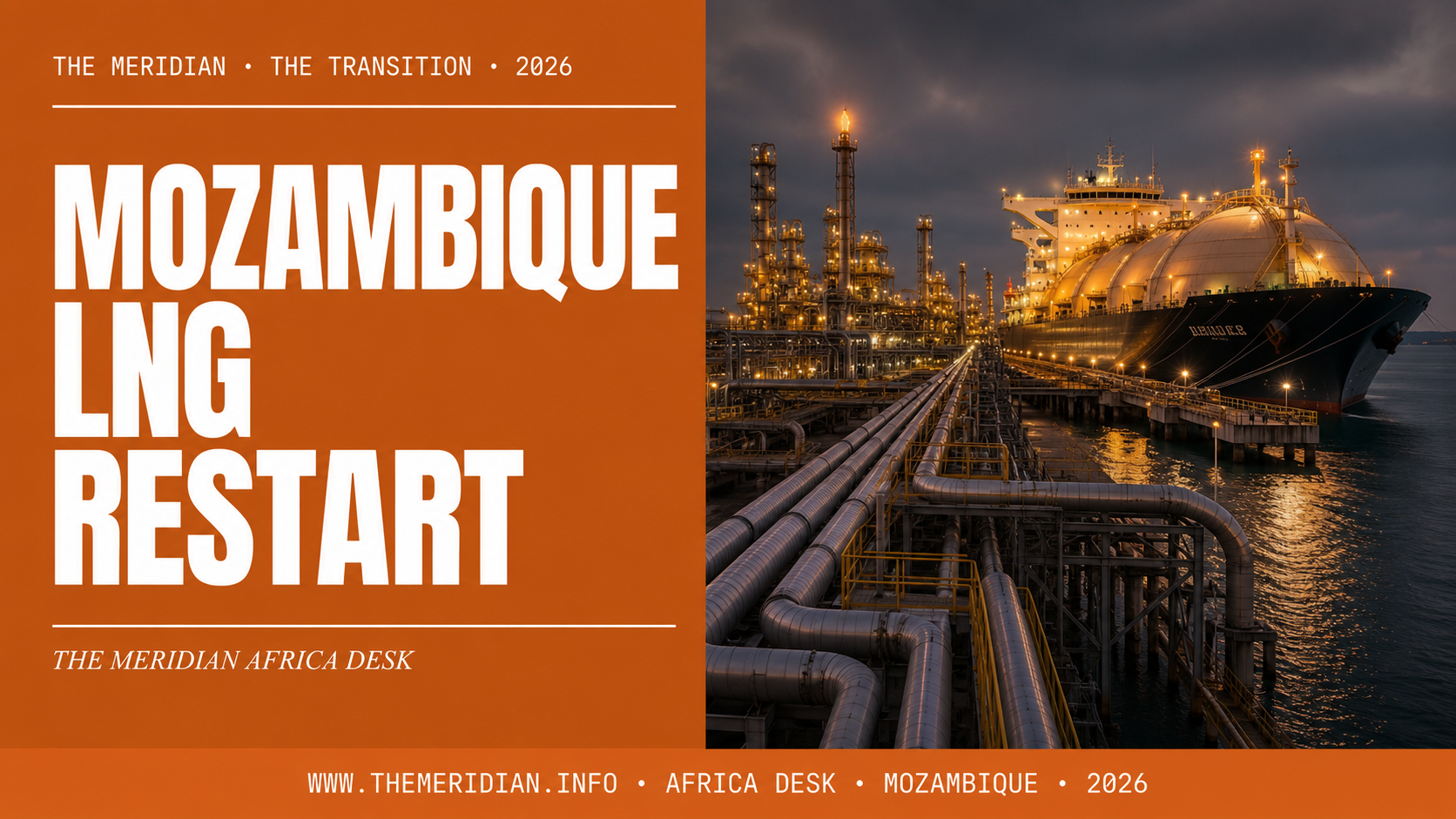
A $20 billion LNG project resumes after a multi-year suspension, projected to lift growth to 5.5 per cent -- while the state remains at high risk of debt distress and the revenue is years away.
A $20 billion capital injection is usually unambiguous good news for a sovereign's growth outlook. Mozambique's case complicates that. According to the International Monetary Fund, the resumption of the country's liquefied natural gas development is projected to elevate long-term economic growth to an average of 5.5 per cent over the medium term. At the same time, the state retains a formally classified high risk of overall debt distress. The mathematical tension between this unprecedented capital injection and the country's fragile macroeconomic baseline defines the national fiscal architecture for the years ahead. The restart initiates a timeline toward eventual hydrocarbon export revenues, but Ministry of Economy and Finance statistics confirm that public debt remains structurally elevated, and debt servicing costs continue to constrain immediate developmental expenditure in the meantime.
The consortium leading the project declared force majeure in 2021 due to localised instability in the Cabo Delgado region, an event that effectively suspended the largest single foreign direct investment on the African continent. The 2025 operational restart reactivates a complex global financing syndicate that had remained legally intact throughout the suspension. This architecture includes approximately $15 billion in senior debt from a consortium of export credit agencies and development finance institutions -- a financing structure that survived years of dormancy, which is itself unusual for a project of this scale. For the administration in office, satisfying the security conditions required to lift the force majeure was a structural prerequisite for unlocking the production-sharing agreements, which are designed to capture tens of billions in projected state revenue over the asset's lifecycle. The financing did not need to be rebuilt. What needed to be rebuilt was the security and insurance environment around it.
The analytical core of this fiscal bet lies in the tension between the project's inflated cost base and the sovereign's immediate liquidity constraints. Following the multi-year suspension, the capital expenditure required to bring the facility to first gas has expanded to incorporate substantial insurance adjustments and permanent operational security premiums. The project's financing structure acts as a temporal bridge, deferring meaningful state revenue while immediate sovereign liabilities compound. Standard cost-recovery mechanisms within the production-sharing agreements permit the consortium to recoup these elevated capital outlays before transferring peak tax and profit-share dividends to the state treasury. The timeline for structural fiscal relief is mechanically deferred by design, not by accident. Mozambique is, in effect, trading near-term macroeconomic vulnerability for a heavily backloaded rent stream -- and the years in between still have to be financed somehow.
Forward-looking assessments from the World Bank emphasise that establishing robust domestic financial mechanisms is critical to preventing the classic resource curse. Under the parameters of its ongoing Extended Credit Facility, the International Monetary Fund has mandated the operationalisation of a sovereign wealth fund to sterilise foreign exchange inflows and decouple the annual operational budget from volatile global commodity cycles. Without this ring-fencing, the sudden influx of dollar-denominated export revenues risks artificially appreciating the local currency, a dynamic that mathematically penalises the competitiveness of non-extractive domestic sectors -- the textbook Dutch disease problem. The long-term solvency of the state depends less on the size of the gas reserves than on whether this concentrated hydrocarbon wealth gets translated into broad-based domestic capital, rather than simply flowing through to service legacy external debt the moment it arrives.
This reliance on heavily capitalised, delayed hydrocarbon infrastructure parallels the fiscal trajectory of the Greater Tortue Ahmeyim project shared by Senegal and Mauritania. According to African Development Bank data, that West African development also experienced significant capital cost inflation and schedule delays, forcing both governments to manage extended periods of heightened debt exposure prior to initial revenue generation. Tanzania's own proposed $30 billion liquefied natural gas facility, by contrast, remains stalled in protracted regulatory and fiscal negotiations and has not reached a comparable construction stage. Mozambique has, against the odds, preserved its complex international financing syndicate through an unprecedented period of operational suspension. Whatever else this restart represents, it gives Mozambique a real temporal advantage over its regional peers in the race to first gas -- though a head start in a race where the state is paid last is still a head start in that race, not a guarantee of how it ends.
| Source | Relevant Point |
|---|---|
| International Monetary Fund | Projects the LNG restart will elevate medium-term growth to an average of 5.5%, while Mozambique retains a formally classified high risk of overall debt distress; mandates a sovereign wealth fund under its Extended Credit Facility to sterilise FX inflows. |
| Ministry of Economy and Finance, Mozambique | Confirms public debt remains structurally elevated, constraining immediate developmental expenditure during the restart period. |
| Project Financing Disclosures (ECA/DFI Consortium) | Approximately $15 billion in senior debt financing remained legally intact through the 2021-2025 force majeure suspension and was reactivated at restart. |
| World Bank | Emphasises the role of domestic financial mechanisms, including the sovereign wealth fund, in preventing the resource curse and currency appreciation effects from concentrated export revenue. |
| African Development Bank | Comparative data on the Greater Tortue Ahmeyim project (Senegal/Mauritania), showing similar capital cost inflation and schedule delays; notes Tanzania's $30 billion LNG project remains stalled in regulatory negotiations. |
Add comment
Comments