Namibia's Green Hydrogen Bet: Who Actually Captures the Value?
A $10 billion project, roughly equal to Namibia's entire GDP, is structured to serve European decarbonisation targets. The state takes a 24 per cent equity stake -- but the energy itself never touches the domestic grid
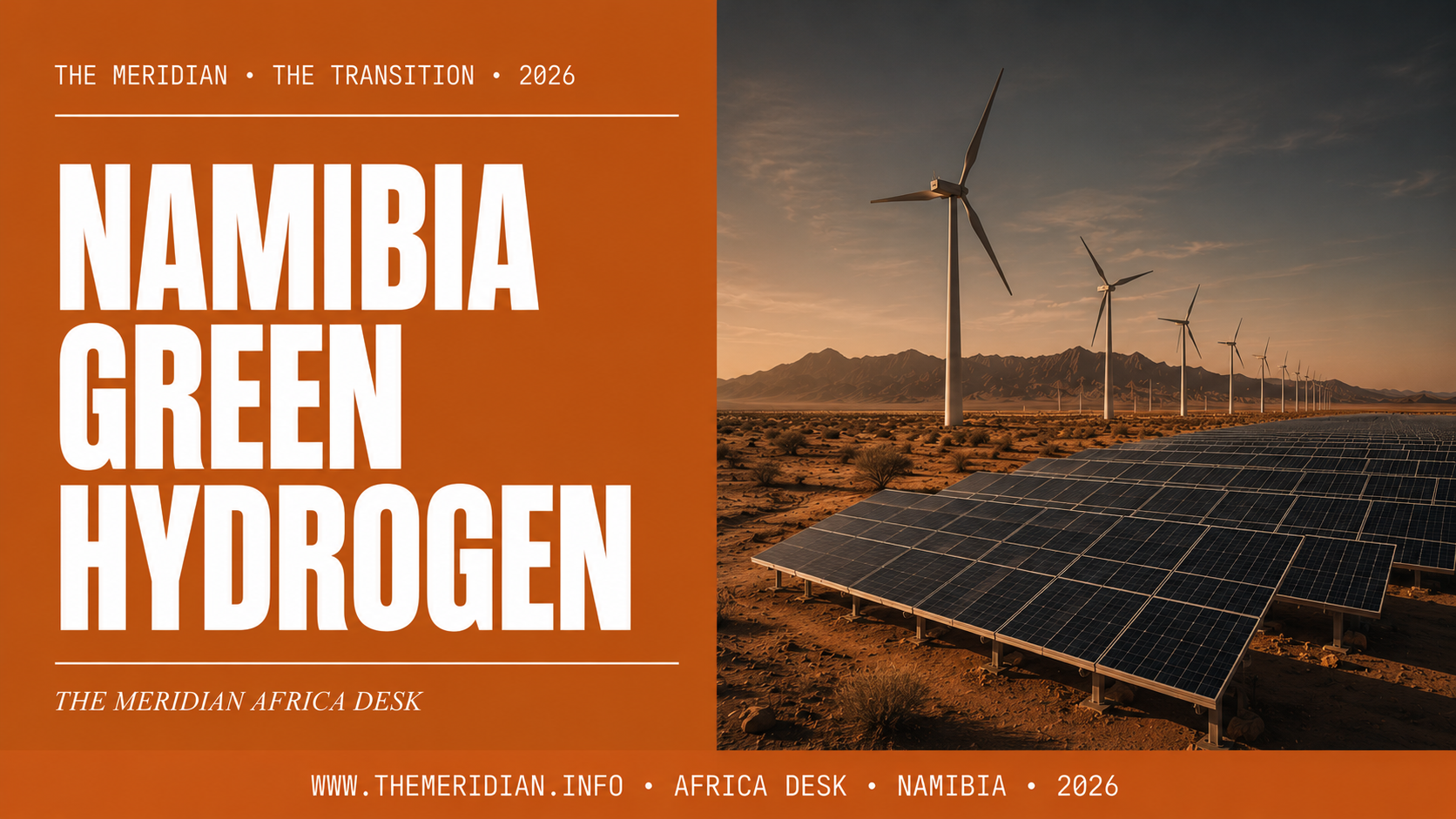
A $10 billion project, roughly equal to Namibia's entire GDP, is structured to serve European decarbonisation targets. The state takes a 24 per cent equity stake -- but the energy itself never touches the domestic grid.
Ten billion dollars is the kind of number that changes a country's growth trajectory. For Namibia, whose entire economy produces roughly that much in a year, it is tempting to read a project of this size as transformational by definition. The data complicates that reading. Valued at approximately $10 billion, the Hyphen Hydrogen Energy development in the Tsau //Khaeb National Park represents a capital commitment roughly equivalent to Namibia's total annual gross domestic product. Yet International Monetary Fund assessments indicate the project is fundamentally structured to service European decarbonisation targets rather than domestic energy deficits. According to project disclosures, the facility is engineered to produce two million tonnes of green ammonia annually at peak capacity. The offtake agreements ensure that these manufactured energy molecules will bypass the constrained Southern African Power Pool entirely, bound instead for industrial markets in the northern hemisphere.
The fiscal architecture underpinning this development reflects a deliberate transfer of capital expenditure risk. To generate hydrogen at this scale, the consortium must construct seven gigawatts of dedicated renewable energy capacity and extensive coastal desalination infrastructure -- an enormous build, by any measure. According to the Ministry of Finance and Public Enterprises, the state is not underwriting this with sovereign debt. Instead, the government has exercised its right to take a 24 per cent equity stake in the project, financed through SDG Namibia One, a blended finance vehicle. By shifting the multi-billion-dollar construction costs onto private developers and export credit agencies, the administration secures projected revenue streams -- land rentals, royalties, corporate taxes -- without exacerbating its baseline debt-to-GDP ratio, which the World Bank tracks at over 65 per cent. On the public balance sheet, this looks almost too good: a stake in a $10 billion project, without the $10 billion of debt.
The analytical core of this arrangement lies in the isolation of its infrastructure, functioning largely as an enclave economy. While the project requires vast amounts of electricity and water, these resources are captive to the electrolysis and ammonia synthesis processes. The European Union's REPowerEU strategy serves as the primary demand anchor, offering the long-term, fixed-price offtake agreements necessary to make the project bankable in the first place. The value captured by Namibia is, as a result, strictly financial rather than physical. The state exchanges the utility of its solar and wind potential for a projected stream of fiscal rent. If global hydrogen prices fluctuate or European industrial demand shifts, the financial viability of this enclave is exposed -- while the host nation is left holding highly specialised, export-dependent infrastructure that cannot easily be repurposed for broad domestic electrification.
Forward-looking employment projections illustrate the concentration of value clearly. Feasibility studies published by Hyphen Hydrogen Energy estimate the creation of 15,000 jobs during the four-year peak construction phase, contracting afterward to 3,000 permanent operational roles. The World Bank notes that capital-intensive industries of this kind inherently limit broad-based labour absorption, and typically demand highly specialised technical skills that necessitate imported expatriate labour, at least in the near term. For the project to deliver sustained domestic benefit at the scale its headline figure implies, the fiscal dividends captured by the sovereign wealth vehicle would need to be aggressively recycled into national health, education, and broader infrastructure -- the standard prescription for avoiding the rentier state dynamic in which a highly concentrated revenue stream never quite reaches the people whose resources generated it.
This export-centric model aligns closely with parallel developments in North Africa, though it contrasts with other regional approaches. Like Namibia, both Egypt and Morocco are leveraging substantial renewable potential and desert land to secure European offtake agreements for their own multi-billion-dollar green hydrogen pipelines -- the same fundamental trade of physical resource for financial rent. South Africa's emerging hydrogen strategy, according to African Development Bank analysis, takes a different approach, focused on integrating production into its existing domestic industrial base and explicitly targeting the decarbonisation of local heavy industry and green steel manufacturing. By operating as a pure-play exporter, Namibia is executing a different macroeconomic calculation from its southern neighbour: betting that the financial yields from servicing Europe's climate targets will, in time, provide the capital required to develop its own domestic economy -- rather than building the domestic industrial linkages first and exporting what is left over.
| Source | Relevant Point |
|---|---|
| International Monetary Fund | Assesses the Hyphen project as structured to serve European decarbonisation targets rather than domestic energy deficits. |
| Hyphen Hydrogen Energy, Project Disclosures | $10 billion project value; 2 million tonnes of green ammonia annual capacity at peak; feasibility studies estimate 15,000 peak construction jobs over four years, contracting to 3,000 permanent operational roles. |
| Ministry of Finance and Public Enterprises, Namibia | Confirms the government's 24% equity stake financed through SDG Namibia One, a blended finance vehicle, without recourse to sovereign debt. |
| World Bank | Tracks Namibia's debt-to-GDP ratio at over 65%; notes capital-intensive industries limit broad-based labour absorption and often require imported technical expertise. |
| African Development Bank | Comparative analysis of Egypt and Morocco's export-oriented green hydrogen pipelines versus South Africa's domestically-integrated hydrogen strategy. |
Add comment
Comments