The Drought Cycle Returns: What the Rainfall Data Actually Says About the Horn of Africa
Drought between 2020 and 2023 killed over 9 million livestock across the Horn of Africa. The financing architecture built to respond remains overwhelmingly reactive -- and arrives, on average, after the damage is already done
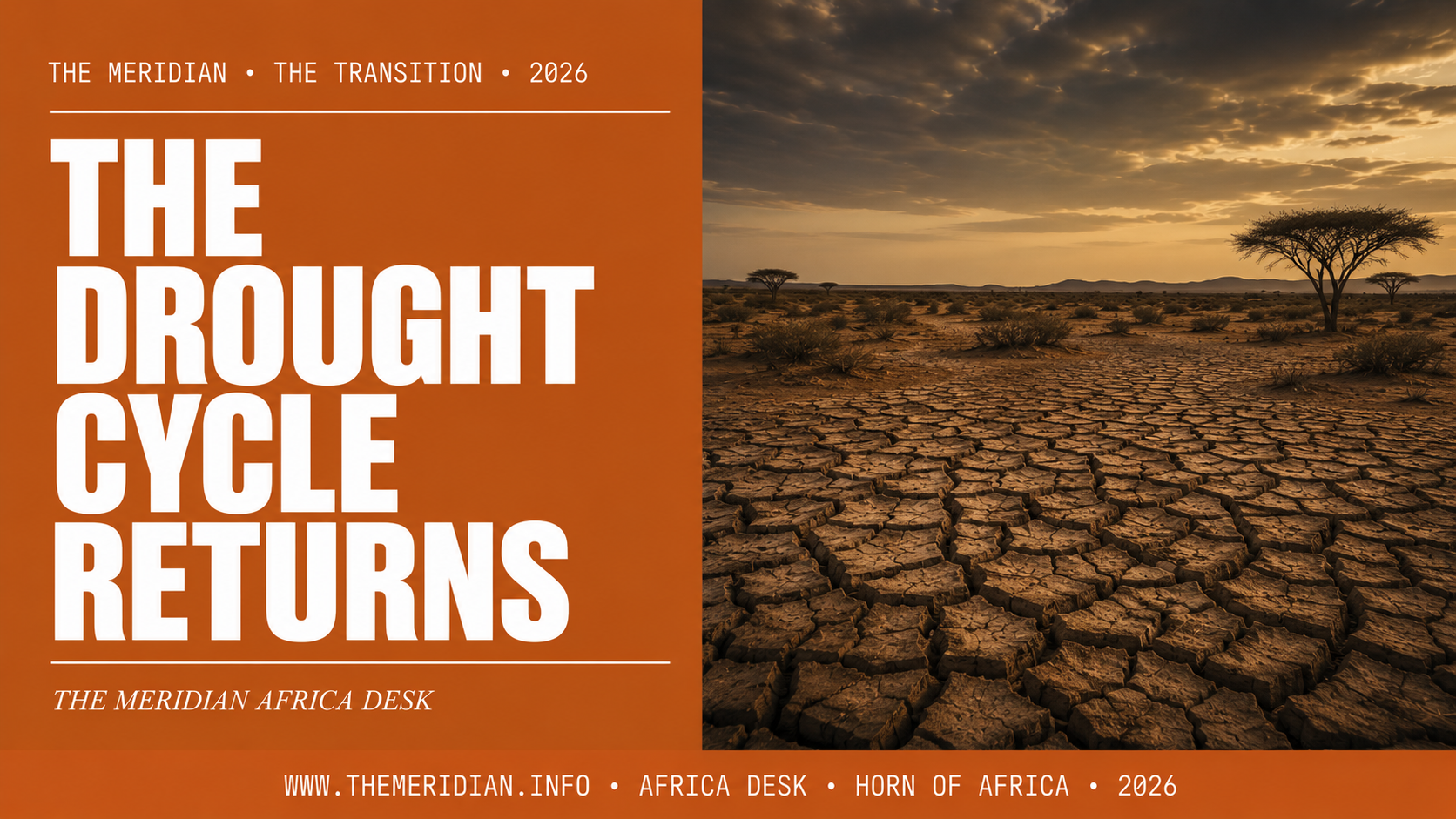
Drought between 2020 and 2023 killed over 9 million livestock across the Horn of Africa. The financing architecture built to respond remains overwhelmingly reactive -- and arrives, on average, after the damage is already done.
Drought in the Horn of Africa is most often described, rightly, in human terms. When rains fail across Ethiopia, Kenya and Somalia, millions of people move toward severe food insecurity, and that fact deserves to stay at the centre of how this story is told. Less visible, but no less consequential for what happens next, is the financial architecture meant to respond once the rains have already failed. According to the Food and Agriculture Organization of the United Nations, the sustained drought cycle across the Horn between 2020 and 2023 eradicated more than 9 million livestock, fundamentally decapitalising the region's pastoral economies. As the Famine Early Warning Systems Network records the return of La Niña conditions and the failure of consecutive rainy seasons, the macroeconomic exposure of Ethiopia, Kenya and Somalia is once again triggering acute liquidity and foreign exchange pressures -- and the architecture tasked with managing this recurring crisis remains overwhelmingly reactive.
For the pastoral communities spanning these borders, livestock serves not merely as a food source but as the primary store of household wealth and a critical export commodity. When drought decimates these herds, it destroys household capital and strips the national treasury of export tax revenue in the same stroke. In Somalia, where the export of live animals to the Arabian Peninsula constitutes a majority of formal export earnings, the loss of millions of head of cattle and sheep degrades the sovereign's balance of payments directly. A herd is a bank account that can die of thirst.
As domestic agricultural yields contract, sovereign administrations are forced to sharply increase food import bills to prevent widespread starvation -- converting a climate shock into a foreign exchange crisis within a single budget cycle. To procure grain on the international market, central banks must deploy scarce dollar reserves, competing directly against the parallel requirement to service external debt. A drought that begins in a field ends, a few months later, in a central bank's reserve account. The two events look unrelated on a news ticker. In the data, they are the same event, observed at different points in the transmission chain.
The analytical core of this vulnerability lies in the regional financing architecture, which remains heavily dependent on emergency humanitarian appeals rather than forecast-based financing. According to the United Nations Office for the Coordination of Humanitarian Affairs, consecutive regional drought appeals have consistently closed with substantial funding gaps, often receiving less than half of their requested capital. Because this capital is raised and deployed only after a crisis has mathematically breached emergency thresholds, it arrives too late to protect the underlying agricultural assets -- functioning as a palliative measure rather than a structural defence.
Parametric insurance tools such as those provided by the African Risk Capacity trigger payouts automatically when regional rainfall data monitored by the IGAD Climate Prediction and Applications Centre falls below a pre-defined threshold. In 2026, the African Risk Capacity distributed a $5.5 million drought insurance payout to Somalia based purely on satellite precipitation deficits -- demonstrating that the mathematical model works. The constraint is not the mechanism itself. While these tools inject liquidity before irreversible asset depletion occurs, the premium costs required to secure meaningful coverage often exceed the fiscal space available to highly indebted regional ministries of finance. Until forecast-based financing comprehensively displaces post-disaster appeals as the primary capital vehicle, the region's treasuries remain structurally exposed to the escalating severity of La Niña cycles.
This reliance on reactive climate financing mirrors the macroeconomic constraints observed across the Sahel. Following successive crop failures, governments in Mali and Burkina Faso similarly faced surging food import bills that rapidly depleted national reserves, according to International Monetary Fund metrics. In both the Horn of Africa and the Sahel, the data points to the same gap: until sovereign states can secure the capital to hedge their agricultural exposure through comprehensive, pre-funded risk pools, recurring drought will continue to dictate domestic fiscal policy and constrain economic expansion -- not because the climate risk is unknown, but because the financing arrives on the climate's timeline rather than the treasury's.
| Source | Relevant Point |
|---|---|
| Food and Agriculture Organization (FAO) | The 2020-2023 drought cycle across the Horn of Africa eradicated more than 9 million livestock. |
| Famine Early Warning Systems Network (FEWS NET) | Records the return of La Niña conditions and the failure of consecutive rainy seasons across the region. |
| World Bank | Agriculture accounts for approximately 60% of GDP in Somalia, 35% in Ethiopia, and 20% in Kenya. |
| UN Office for the Coordination of Humanitarian Affairs (OCHA) | Consecutive regional drought appeals have consistently closed with funding gaps, often receiving less than half of requested capital. |
| African Risk Capacity / IGAD Climate Prediction and Applications Centre | Distributed a $5.5 million parametric drought payout to Somalia in 2026 based on satellite rainfall deficit data against a pre-defined threshold. |
| International Monetary Fund | Comparable food import bill and reserve depletion dynamics following crop failures in Mali and Burkina Faso. |
Add comment
Comments