The Man Who Came from Prison to the Presidency. And the Man He Left Behind.
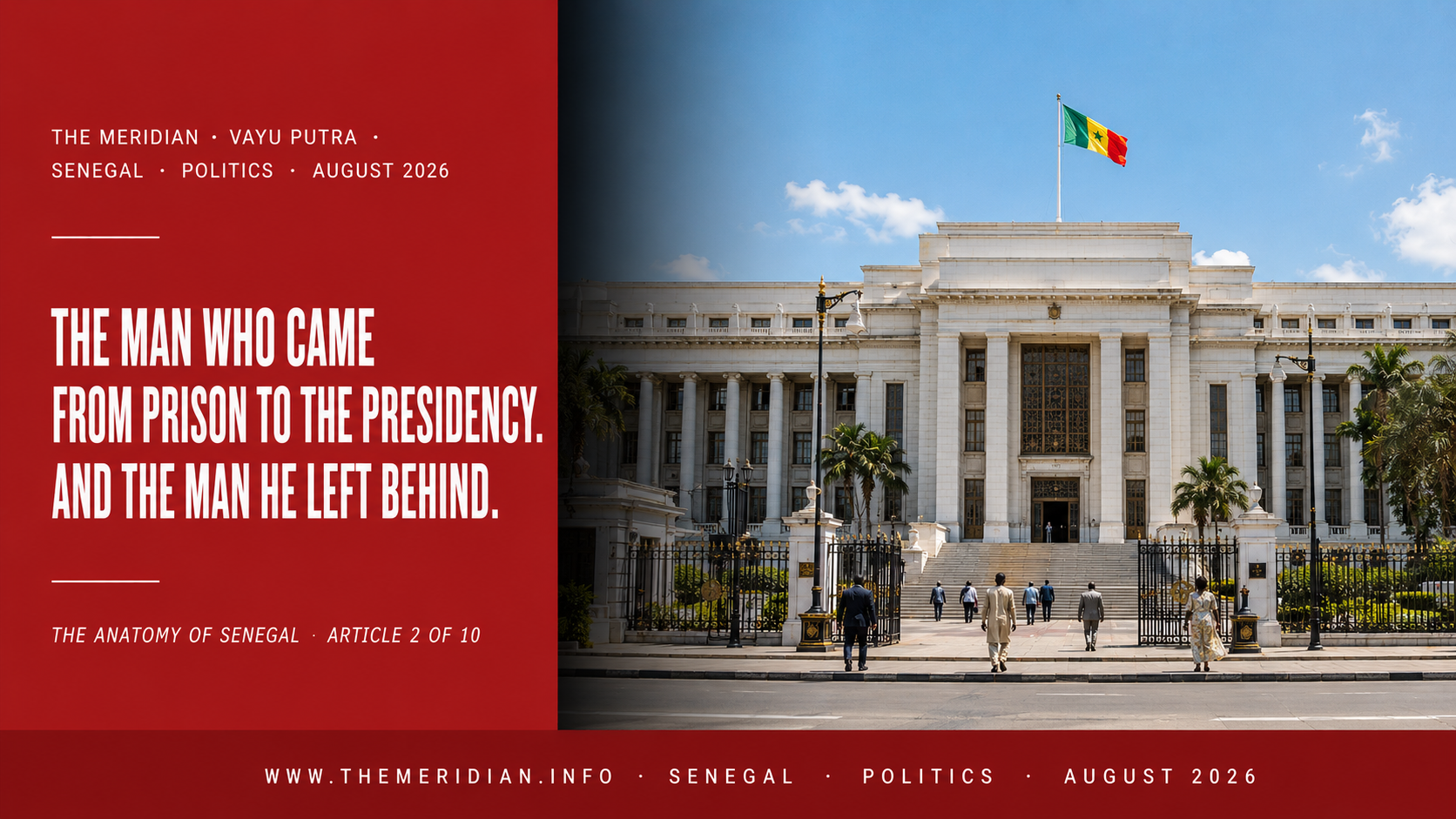
Bassirou Diomaye Faye was born on 25 March 1980 in Ndiaganiao, in the Thiès region of Senegal. He studied law at Cheikh Anta Diop University in Dakar, attended the National School of Administration, and became a tax inspector. On 14 April 2023, he was charged with contempt of court, defamation, and acts likely to compromise public peace following a social media post in which he denounced perceived injustice in the justice system. He was arrested as he exited his tax office on Rue de Thiong in Dakar. He was granted amnesty on 6 March 2024 due to an amnesty law passed by the National Assembly, which granted amnesty to political prisoners for acts committed between 1 February 2021 and 25 February 2024. His release from prison on 14 March 2024, just ten days before the election, invigorated his campaign. He won with 54.28% of the vote in the first round. He appointed Ousmane Sonko as prime minister. On 22 May 2026, President Faye dismissed Sonko and dissolved the cabinet. Sonko's PASTEF retained 130 of 165 parliamentary seats and elected him speaker of the National Assembly. On 26 July 2026, Faye launched his own party, Kiiraay, Republican Patriots, cementing his rupture with the movement that had brought him to power. The two men who came from prison to the presidency together are now governing from opposite sides of the same constitutional architecture. This is the most consequential political rupture in Senegal since Mamadou Dia in 1962. The Meridian examines what happened, why, and what it means for the sovereignty agenda that both men claimed to share.
The story of Faye and Sonko begins not in a prison cell but in a tax office. Both men are trained tax inspectors who graduated from the National School of Administration in Dakar. Both chose public service in the tax and estates department at a moment when the most direct path to power in Senegal ran through the patronage networks of the political parties they would eventually challenge. Their shared professional background is not incidental to their political project. It was in the tax office that both men developed their understanding of how the Senegalese state's fiscal architecture works, who benefits from it, and who bears its cost. The sovereignty agenda that became PASTEF's platform, the renegotiation of resource contracts, the audit of the public finances, the exit from the CFA framework, was not an academic programme imported from economic theory. It was the diagnosis of two insiders who had spent their careers watching how the money moved and where it went.
Ousmane Sonko was born on 15 July 1974 in Thiès. He graduated with a master's degree in juridical science from Gaston Berger University in Saint-Louis and subsequently attended the National School of Administration. He entered electoral politics in 2017, winning a seat in the National Assembly, and came third in the 2019 presidential election with 15.67% of the vote, his first significant national platform. His anti-corruption campaign identified specific individuals, specific contracts, and specific mechanisms through which Senegalese public resources were being misallocated. His naming of the Sall administration's oil and gas contract arrangements by name, with figures, was politically unprecedented in a country where such accusations had previously been made only in opposition press or in exile.
Sonko generated a passionate following among Senegal's disaffected youth. Both Faye and Sonko advocated for the working class and civil servants, groups disproportionately unsatisfied with Sall's policies. Both were outspoken critics of corruption in the Sall administration, particularly concerning oil and gas contracts and management of Senegal's natural resources. The relationship between the two men was that of political mentor and organisational lieutenant: Sonko provided the charisma, the platform, and the popular following; Faye provided the institutional capacity, the party structure, and the administrative discipline. Faye became PASTEF's secretary-general in October 2022, making him responsible for the party machinery that would eventually deliver the 2024 electoral victory.
The slogan that defined the 2024 campaign was coined not by a political consultant but by the grassroots of the movement. Campaign images bearing the slogan "Diomaye moy Sonko," meaning "Diomaye is Sonko" in Wolof, circulated on social media just ahead of the presidential sponsorship period. The slogan was accurate in the sense the movement intended: Faye stood for everything Sonko stood for, and a vote for Faye was a vote for the project Sonko had built. It would prove more accurate than its authors anticipated in another sense: the two men were not separate political identities temporarily merged for electoral convenience. They were the joint leadership of a single project, and the question of whose project it ultimately was would only be answered when they had power to fight over.
The official explanation for the Faye-Sonko split is the IMF. Faye and Sonko's alliance unravelled amid disputes over key policy decisions, including how to approach negotiations with the International Monetary Fund over a loan programme amid a severe debt crisis. While the president negotiates with the IMF, Sonko sees this as a disgrace, citing African sovereignty. The debt crisis revealed by the forensic audit, $28.55 billion in actual obligations against the 74% of GDP the Sall government had reported, required urgent fiscal consolidation and a credible engagement with international creditors. Faye's government chose to negotiate a new IMF programme to manage the adjustment. Sonko, from within the cabinet, called this an unacceptable concession to the same institutions that the sovereignty agenda was designed to challenge.
The IMF dispute is real but it is not the whole story. The deeper tension is structural. Faye is a president with executive authority and a growing understanding that governing requires compromises that campaigning does not. Sonko is a movement leader whose power derives from the purity of his anti-establishment positioning and whose support base is the disaffected Senegalese youth that elected Faye on the expectation that the establishment would be confronted, not negotiated with. These are not merely different temperaments. They are incompatible political logics occupying the same constitutional moment.
Tensions gradually emerged over how the government was run, its economic policy, and the direction of the governing coalition. The relationship deteriorated further as Senegal grappled with the fallout from previously undisclosed public debt, forcing the government to confront difficult economic decisions and renewed engagement with international lenders. The specific trigger of the dismissal has not been publicly disclosed in its full detail. What is documented is that by May 2026, Faye concluded that governing with Sonko as prime minister had become incompatible with the fiscal consolidation and IMF engagement that the inherited debt required, and that Sonko's popularity within PASTEF was sufficient to challenge presidential authority from within the government.
Faye dismissed the man who made him president. Sonko took command of the parliament that his party controls. The president governs without a parliamentary majority. The parliament is led by the man the president dismissed. Senegal has experienced five presidents and five peaceful transfers. It has never experienced this.
The Faye-Sonko split has produced a constitutional configuration that Senegal has not previously experienced. The president is the executive authority. He has dismissed his prime minister and formed a cabinet without PASTEF participation. The National Assembly has 165 seats. PASTEF holds 130. Sonko is the speaker of the National Assembly, presiding over a chamber where his party holds 78.8% of seats and the president's new party has no meaningful representation.
Legally, Faye cannot dissolve the National Assembly until at least November 2026, two years after the last legislative elections, so he cannot shift this dynamic in the short term. Until November 2026 at the earliest, Senegal's president governs without the parliament, and the parliament is led by the man the president dismissed. Every significant legislative initiative the Faye government wants to pass must navigate a chamber controlled by 130 PASTEF members loyal to Sonko. Every budget. Every reform law. Every institutional change. The sovereignty agenda that the two men shared in opposition now requires parliamentary approval from a parliament whose speaker campaigned on a different version of that agenda.
The opposition reacted angrily to Sonko's election as speaker, with Aissata Tall Sall, who heads the main opposition coalition, denouncing an institutional coup prepared under pressure that the majority wants to impose. Sonko's election as speaker was itself constitutionally disputed: opposition parties claimed it was unconstitutional since Sonko was not an elected parliamentary member when first elected speaker. Parliament voted to reinstate him as a member before electing him speaker, in a procedural manoeuvre that the opposition challenged but could not block given PASTEF's majority.
Faye and Sonko, once the twin faces of Senegal's anti-establishment movement, are widely expected to face each other in the 2029 presidential election. This transforms the current constitutional standoff into the opening phase of the next presidential campaign. Every decision Faye makes on the IMF programme, the debt consolidation, the CFA franc, and the port development is simultaneously a governing decision and a 2029 electoral positioning. Every decision Sonko makes from the speaker's chair is simultaneously legislative and pre-electoral.
Faye unveiled his Kiiraay, Republican Patriots party at a gathering in Dakar, describing it as the majority party in this country. Kiiraay means shield in the local Wolof language. The claim that Kiiraay is the majority party is electoral ambition, not current reality. PASTEF holds 130 of 165 parliamentary seats. Faye's new party has no parliamentary representation. The path from the presidential palace to parliamentary majority runs through November 2026 dissolution or the 2029 election. Both require Faye to build a support base that is currently his own person, the presidency, and the officials and former PASTEF members who have crossed to his camp.
The 2029 election is the most significant political contest in Senegal's history because it will be fought between two candidates who share the same sovereignty rhetoric but disagree on what sovereignty requires in practice. Faye's sovereignty is pragmatic: engage the IMF to stabilise the fiscal position, build the institutions that can eventually support monetary independence, and manage the oil revenues through a framework that maximises state capture. Sonko's sovereignty is ideological: reject IMF conditionality as neocolonial, confront the CFA system immediately, and spend the oil revenues on domestic priorities regardless of the fiscal constraint. The electorate that voted for both men in 2024 will be asked in 2029 to choose which version of the sovereignty they wanted.
The Faye-Sonko rupture has produced the most consequential analytical question in the Anatomy of Senegal series: can the sovereignty agenda survive the split between the two men who designed it?
The agenda has three components: fiscal sovereignty (auditing and consolidating the inherited debt, reforming revenue collection, building a transparent public finance system); monetary sovereignty (challenging and eventually exiting the CFA franc); and resource sovereignty (renegotiating oil and gas contracts, building domestic processing capacity, retaining more hydrocarbon revenue within Senegal). Faye's approach to the first is pragmatic IMF engagement. Sonko's approach is domestic confrontation. On monetary sovereignty, both men are aligned in theory but have not yet produced a timetable or mechanism for exit. On resource sovereignty, the renegotiation of contracts has been initiated by the Faye government and is the area of most substantive progress.
The split does not end the sovereignty agenda. It bifurcates it. Faye's version is the version being implemented, because Faye has executive authority. Sonko's version is the version being argued in parliament, in PASTEF's party communications, and in the street politics that built the movement. The gap between the two versions is the IMF: whether Senegal's fiscal consolidation is managed through engagement with international creditors or through domestic resource mobilisation alone. That gap is real, analytically significant, and will not be resolved before the 2029 election.
The Faye-Sonko rupture is not a betrayal story, though it will be narrated as one by both camps. It is a structural story about what happens when a movement built on opposition encounters the constraints of governance. The sovereignty agenda that Faye and Sonko designed as tax inspectors who understood how the money moved was built for opposition, where the correct position is always to demand what the establishment refuses. It was not built for government, where the correct position requires negotiating with the institutions whose refusal was the movement's founding grievance.
Faye has executive authority and a pragmatic approach to the constraints it imposes. Sonko has parliamentary leverage and an ideological commitment to the purity of the original programme. Neither has the institutional power to implement the full sovereignty agenda alone. Faye needs a parliament that will pass his reform laws. Sonko needs an executive that will implement his policy positions. Until November 2026, neither can dissolve the other's power base. Between November 2026 and 2029, both will be building for the election that will determine whose version of the sovereignty agenda Senegal actually wants.
The answer to the article's title question is this. The man who came from prison to the presidency is Bassirou Diomaye Faye, who was a tax inspector, became a party secretary-general, was arrested for defending his mentor, won a presidential election ten days after his release, became the youngest president in Senegal's history, and dismissed the man who made him president when governing with him became incompatible with the fiscal reality the election had not disclosed. The man he left behind is Ousmane Sonko, who built the movement, lost the right to lead it in an election, gave that right to Faye, became prime minister, was dismissed, took command of the parliament, and is preparing to reclaim the presidency in 2029. Both men are still, in their different ways, trying to build the sovereign Senegal that the tax office taught them was possible and that the political class has consistently prevented. The question the next three years will answer is which of them is right about how to get there.
Add comment
Comments