Sudan’s Forgotten War: 12 Million Displaced, Zero Accountability
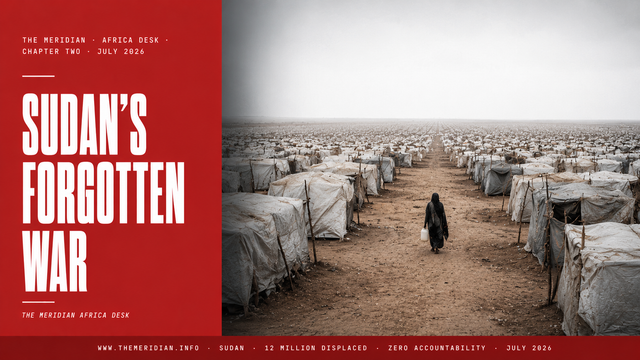
On 15 April 2023, the Sudanese Armed Forces and the Rapid Support Forces began fighting in Khartoum. By July 2026, the conflict had produced the largest displacement crisis on earth -- more than 12 million people forcibly uprooted, more than in Ukraine, with fewer cameras, fewer column inches, fewer sanctions, and zero binding accountability mechanisms activated by the Security Council. The Meridian documents the record and asks who benefits from the silence.
There is a test that the international human rights system applies, in practice if not in principle, to every humanitarian catastrophe that unfolds on earth. The test is not: how many people are suffering? The test is not: how severe are the violations? The test is not even: does the evidence meet the threshold for international legal action? The test is: does this catastrophe involve parties or interests that make accountability politically costly for the states that control the Security Council? If the answer is yes, the machinery of international accountability slows, hedges, and eventually produces a resolution that documents the crisis without addressing it. Sudan is the clearest current example of what that test looks like when it is failed.
The war in Sudan began on 15 April 2023 with fighting between the Sudanese Armed Forces -- the SAF, the national military -- and the Rapid Support Forces -- the RSF, a paramilitary organisation that grew out of the Janjaweed militias responsible for the Darfur genocide of the early 2000s. By July 2026, the conflict had produced more than 12 million internally displaced persons and refugees -- the largest displacement crisis on earth, surpassing Ukraine in scale. Khartoum, a city of six million, had been largely destroyed. El Fasher, the last major city in Darfur not under RSF control, had been under siege for months. Famine had been confirmed in multiple areas. Documented atrocities -- massacres, sexual violence used as a weapon of war, deliberate targeting of civilian infrastructure -- had been reported by the UN, by independent human rights organisations, and by journalists who had managed to reach the conflict zones.
The Security Council had not passed a single binding resolution on Sudan.
The word forgotten is not quite accurate. Sudan is not forgotten in the way that a small story drops off the news cycle because nothing new is happening. Sudan is actively deprioritised -- a catastrophe that the international community is aware of, has documented extensively, and has chosen, through the mechanism of political calculation, not to address with the tools available to it.
The reasons are specific and structural. Russia has significant interests in Sudan -- a naval base agreement negotiated in 2020, gold mining operations run through Wagner-linked entities, and a broader strategic interest in maintaining a presence in the Red Sea corridor. China has significant economic investments in Sudan’s oil sector and a consistent foreign policy position against Security Council resolutions that it regards as interference in the internal affairs of sovereign states. Both have used their veto power, or the threat of it, to prevent binding Security Council action on Sudan.
The Gulf states -- the UAE in particular -- have been credibly reported to have supplied weapons and support to the RSF, the paramilitary force whose documented atrocities in Darfur are the most severe of the conflict. The UAE is a significant economic partner and diplomatic ally of the United States and the United Kingdom. Neither government has imposed sanctions on the UAE in connection with Sudan. The arms continue to flow. The atrocities continue to be documented. The accountability continues not to arrive.
The Rapid Support Forces are not a new organisation. They are the institutional successor to the Janjaweed -- the Arab militias that the Sudanese government armed and deployed in Darfur between 2003 and 2008 in a campaign that the International Criminal Court described as genocide. The RSF was formalised as a paramilitary force under Mohamed Hamdan Dagalo, known as Hemedti, who rose through the Janjaweed ranks and became one of the most powerful figures in Sudan’s post-Omar al-Bashir transitional period.
When the RSF and the SAF went to war in April 2023, the RSF brought to that war the same operational methods it had used in Darfur: targeted ethnic violence, mass sexual violence, looting, and the deliberate destruction of civilian infrastructure. The UN documented massacres in West Darfur in which hundreds of civilians from the Masalit ethnic group were killed. Sexual violence was documented at a scale that led the UN Special Representative on Sexual Violence in Conflict to describe it as a defining feature of the conflict rather than an incidental by-product of it. The targeting of humanitarian workers -- at least a dozen killed in the first year of conflict -- effectively removed international humanitarian presence from the most affected areas.
The RSF is the institutional successor to the Janjaweed. The methods are the same. The victims are the same. The international community’s response is, in its essential architecture, the same. Documentation without accountability. Reports without consequences. Recognition without remedy.
The ICC issued its first arrest warrants related to Darfur in 2007 -- for Omar al-Bashir and for Ahmad Harun. Al-Bashir travelled to multiple countries after the warrants were issued. He was not arrested. The ICC’s warrants remain outstanding. The precedent they set is not that international criminal accountability works. It is that international criminal accountability is available as a political gesture when it costs nothing and unavailable as an enforcement mechanism when it does.
When Russia invaded Ukraine in February 2022, the international response was historic in its speed and scale. The Security Council voted -- with Russia vetoing -- within days. The General Assembly passed an emergency resolution condemning the invasion within a week. Sanctions packages of unprecedented breadth were imposed within months. The ICC opened an investigation and issued arrest warrants for Vladimir Putin within a year. Humanitarian corridors were negotiated. Weapons were supplied. Refugee processing was expedited for millions of Ukrainians across European borders.
Sudan has been at war for longer. Sudan has produced more displaced people. Sudan’s conflict has generated documented atrocities -- ethnic massacres, mass rape, deliberate famine as a weapon of war -- that meet every legal threshold for the most serious crimes under international law. The international response to Sudan has been a fraction of the response to Ukraine in every measurable dimension: sanctions imposed, weapons embargoed, ICC warrants enforced, humanitarian access negotiated, displaced persons processed.
The difference is not the scale of the suffering. The difference is the identity of the victims and the geopolitical interests of the parties responsible for and benefiting from the conflict. This is not a comfortable conclusion. It is the only honest one available from the evidence.
Multiple credible investigations -- by the UN Panel of Experts, by independent researchers, and by investigative journalists -- have documented the supply of weapons and ammunition to the RSF from the United Arab Emirates, routed through Chad and the Central African Republic.
The UAE has denied these reports. The documented evidence has continued to accumulate. The United States and the United Kingdom -- both of which have described the situation in Sudan as genocide or near-genocide in public statements -- have not imposed sanctions on the UAE in connection with its role in the conflict.
The UAE is a significant purchaser of Western weapons systems, a major investor in Western economies, and a key diplomatic partner in Middle East policy. Sudan is none of these things. The accountability gap is not a mystery. It is a price list.
The deliberate obstruction of humanitarian aid is a war crime under international humanitarian law. It is also a consistent feature of the Sudan conflict that both parties -- the SAF and the RSF -- have been documented practising, though the RSF’s obstruction has been more systematic and more severe in the areas under its control.
The Integrated Food Security Phase Classification -- the IPC, the internationally recognised framework for measuring food insecurity -- confirmed famine in Sudan in 2024, the first famine declaration anywhere in the world since South Sudan in 2017. By mid-2026, an estimated 25 million people in Sudan were in acute food insecurity -- approximately half the country’s population. The famine is not a natural disaster. It is the product of a deliberate obstruction of food supply chains, agricultural destruction, and the displacement of farming communities from their land in the planting seasons of 2023 and 2024.
Under the Rome Statute of the International Criminal Court, intentionally using starvation of civilians as a method of warfare is a war crime. The evidence that this crime is being committed in Sudan has been available to the international community for more than two years. The ICC has not issued new arrest warrants specifically related to the current conflict. The Security Council has not referred the Sudan situation to the ICC under the mechanism that would require all parties to cooperate. The famine continues.
Article 3 of the UDHR guarantees the right to life, liberty, and security of person. Article 5 prohibits torture and cruel, inhuman or degrading treatment. Article 14 guarantees the right to seek asylum. Article 25 guarantees the right to an adequate standard of living, including food. Every one of these articles is being violated, at scale, in Sudan. The international human rights system is aware of every violation. It has documented them in reports that run to hundreds of pages. It has passed non-binding resolutions. It has convened conferences. It has issued statements. It has done almost nothing that would require the parties committing the violations, or the parties enabling them, to stop.
The refugees who have crossed into Chad, Egypt, Ethiopia, South Sudan, and the Central African Republic are exercising their right under Article 14 to seek asylum. They are being received by countries that are themselves among the poorest in the world and that have received a fraction of the international humanitarian support that European countries received when processing Ukrainian refugees. The implicit message of the international community’s differential response is not stated in any official document. It does not need to be. It is communicated through the allocation of resources, the speed of processing, the political attention devoted to each crisis, and the accountability mechanisms activated or not activated in response to each conflict.
Sudan has produced the largest displacement crisis on earth. The international community has produced the most extensively documented non-response in the history of the human rights system. Both facts are true simultaneously. The second is what makes the first possible.
The consequences of Sudan’s war are not contained within Sudan’s borders. Chad, which shares a 1,400-kilometre border with Sudan and which was already hosting hundreds of thousands of Sudanese refugees from the Darfur conflict of the 2000s, has received more than 700,000 new arrivals since April 2023. Chad is one of the five poorest countries on earth. Its per capita income is approximately $700 per year. The international humanitarian funding it has received for the Sudan refugee response has been a fraction of what it requires.
Egypt has received hundreds of thousands of Sudanese refugees -- including a significant proportion of Khartoum’s educated middle class, who fled with whatever they could carry when the fighting destroyed their city. South Sudan, which achieved independence from Sudan in 2011 after its own devastating civil war and which remains in a fragile political condition, has received returnees -- South Sudanese who had been living in Sudan -- and Sudanese refugees in numbers that its humanitarian infrastructure cannot absorb.
These countries are paying a price for a conflict they did not cause, a conflict in which third parties with far greater resources and far greater responsibility have chosen not to intervene effectively. This is the geography of accountability in the international human rights system: the consequences fall on the weakest states while the powerful states that could impose accountability choose not to.
Sudan is not forgotten because the world does not know what is happening there. The UN has documented it. The ICC has a historical mandate covering Sudan. Journalists have reported from the conflict zones at significant personal risk. The evidence of atrocities -- ethnic massacres, mass sexual violence, deliberate starvation, destruction of civilian infrastructure -- meets every legal threshold for the most serious crimes under international law.
Sudan is deprioritised because the parties responsible for and enabling the conflict include states whose economic and strategic relationships with the Security Council’s permanent members make accountability politically costly. Russia’s interest in its Sudan naval base. China’s interest in non-interference as a foreign policy principle. The UAE’s interest in continued Western arms purchases and diplomatic cover. These interests outweigh, in the arithmetic of international politics, the rights of 12 million displaced people and 25 million food-insecure Sudanese.
The UDHR guaranteed every human being on earth the right to life, security, food, and asylum in 1948. Sudan’s population has all of those rights on paper. What they do not have is a Security Council that is willing to enforce them. That is not a failure of the Declaration. It is a failure of the people who signed it -- a failure they are committing, with full knowledge, every day that the war continues and the silence holds.
Add comment
Comments