Nigeria’s Watchlist State: Prof Okey Ndibe, the DSS, and Thirteen Years Without Charge
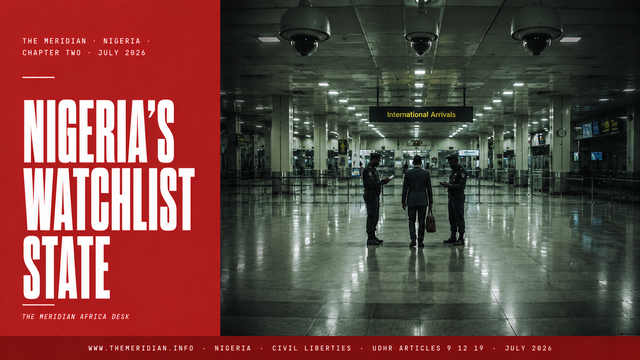
A name placed on a Department of State Services security watchlist in 2013. Five presidential administrations. Zero formal charge filed. Zero evidence presented in any court. Zero conviction recorded. And yet: an airport detention, years of constrained movement, and the permanent anxiety of a man who does not know what the file says about him or when it will next be activated. The Meridian examines Nigeria’s watchlist mechanism as a structural instrument of extra-judicial suppression -- and places it against the UDHR articles it systematically violates.
Prof Okey Ndibe is a novelist, a literary critic, and a political commentator of significant distinction. He is the author of Arrows of Rain and Foreign Gods, Inc. He has taught at institutions including Brown University, Connecticut College, and Trinity College Hartford. He has written for the New York Times, the Guardian, and numerous other publications. He is, by any measure, a public intellectual of international standing whose work has been recognised across the anglophone world.
He is also, as of the most recent available information, a person whose name appears on a Department of State Services security watchlist in Nigeria -- a list on which it has appeared since approximately 2013. He has not been charged with any offence under Nigerian law. No evidence has been presented against him in any court. No legal process has been initiated that would give him the opportunity to contest the basis on which his name was placed on the list or to seek its removal. The list simply exists, maintained by a security agency that operates with limited judicial oversight, producing consequences -- airport detentions, constrained movement, the permanent uncertainty of surveillance -- that are indistinguishable in their practical effect from formal legal persecution, without any of the procedural protections that formal legal persecution would require.
This is Nigeria’s watchlist state. It is not unique to Nigeria. It is a structural feature of security governance across much of Africa and the Global South -- a mechanism through which states suppress dissent, constrain critics, and punish inconvenient voices without the political and legal cost of formal prosecution. The Meridian examines its operation, its legal basis, and the UDHR articles it violates.
The most documented episode in Prof Ndibe’s experience of the DSS watchlist occurred at Murtala Muhammed International Airport in Lagos. He was returning to Nigeria -- a country he describes as home despite his years of academic work abroad -- when DSS officers approached him in the arrivals hall and took him aside for questioning. The questioning lasted for a period that he describes as significantly longer than the DSS’s own account of the incident would suggest. He was eventually released without charge, without explanation, and without any formal record of the encounter being provided to him or to his legal representatives.
What the encounter produced, in addition to its immediate disruption, was confirmation that his name was on a DSS watchlist -- a fact he had suspected but had not previously been able to verify through any formal channel. He was not told what the list said about him. He was not told why his name was on it. He was not told what he would need to do to have it removed. The DSS does not, as a matter of standard practice, inform individuals that their names are on its watchlists, explain the basis for their inclusion, or provide a process for contesting that inclusion.
He has not been charged. He has not been tried. He has not been convicted. His name is on a list that a security agency maintains in secret, that produces real consequences, and that he has no formal mechanism to challenge or remove. This is the watchlist state in operation.
The context for the watchlist placement is not difficult to identify, even if it cannot be formally proven. Prof Ndibe has been a consistent and forensically critical commentator on Nigerian governance -- on corruption, on the abuse of state power, on the failures of successive administrations to deliver basic rights and services to Nigerian citizens. His columns and public statements have been pointed, documented, and unsparing. They are precisely the kind of speech that Article 19 of the UDHR -- which guarantees freedom of opinion and expression including the freedom to impart information and ideas through any media regardless of frontiers -- was written to protect.
The Department of State Services is Nigeria’s domestic intelligence agency, established under the National Security Agencies Act of 1986. Its mandate covers internal security, counter-intelligence, and the protection of the Nigerian state against threats to its constitutional order. It operates under the supervision of the National Security Adviser and, ultimately, the President. It does not operate under the supervision of any independent judicial or parliamentary oversight body with real power to constrain its activities.
The DSS has broad powers to conduct surveillance, to detain individuals for questioning, and to maintain intelligence files on persons it considers relevant to national security. It does not have a publicly available framework governing the criteria for inclusion on its watchlists, the duration of watchlist status, the process for review of watchlist designations, or the rights of individuals whose names appear on those lists. Its operations are, by institutional design, opaque.
This opacity is not incidental. It is the mechanism through which the watchlist functions as an instrument of suppression rather than a legitimate security tool. A security agency that cannot be required to explain why a name is on a list, that cannot be compelled to remove a name through any legal process available to the individual concerned, and that is not subject to independent oversight of its listing decisions is an agency that can maintain a watchlist for any purpose -- including the purpose of suppressing political and intellectual dissent -- without legal accountability for doing so.
Article 9 states that no one shall be subjected to arbitrary arrest, detention or exile. The airport detention of Prof Ndibe -- conducted without charge, without legal basis presented to him, and without any subsequent formal proceeding -- is arbitrary detention under the definition that Article 9 establishes. It was not connected to any legal proceeding. It was not followed by any charge. It was an exercise of state power applied to a person whose name was on a list, for reasons the state has not disclosed and has not been required to disclose.
Article 12 states that no one shall be subjected to arbitrary interference with his privacy, family, home or correspondence, nor to attacks upon his honour and reputation. The maintenance of a security watchlist in the name of a person who has not been charged with any offence, and whose listing cannot be explained through any formal legal process, is an attack on honour and reputation that Article 12 explicitly prohibits. The reputational consequences of DSS watchlist status -- the implicit suggestion that a person is a security risk, applied without evidence and without opportunity to contest -- cause serious harm without requiring a conviction to do so.
Article 19 states that everyone has the right to freedom of opinion and expression -- the right to hold opinions without interference and to seek, receive, and impart information and ideas through any media regardless of frontiers. The placement of a critic, commentator, and public intellectual on a security watchlist -- in the absence of any evidence of violence, sedition, or threat to the constitutional order -- is an interference with freedom of expression that Article 19 was written to prohibit. The watchlist itself, and the consequences it produces, operates as a deterrent to the exercise of the very freedom Article 19 guarantees.
Prof Ndibe’s case is among the most documented examples of DSS watchlist application against a public intellectual, but it is not an isolated incident. The DSS has a documented history of detaining journalists, activists, lawyers, and political figures -- often without charge, often for periods exceeding constitutional limits on pre-charge detention, and often in connection with the exercise of speech and association rights rather than any identifiable security threat.
The pattern includes the detention of Sahara Reporters journalists, the arrest of #EndSARS protesters, the surveillance and harassment of opposition figures, and the use of terrorism charges against individuals whose alleged offences do not meet any internationally recognised definition of terrorism.
What the pattern reveals is not a security agency responding to genuine threats. It is a security agency functioning as an instrument of political control -- maintaining lists, conducting detentions, and suppressing speech with the institutional authority of a national security mandate and the practical impunity of a system with no effective judicial oversight.
The watchlist is a third category of state action that sits between formal prosecution and the absence of any legal proceeding. It is not a charge -- it produces none of the procedural protections that a charge would trigger. It is not, formally, a punishment. The state does not acknowledge it as a sanction. It is simply an administrative notation that a name is of interest to a security agency.
But its consequences are indistinguishable from punishment. The airport detention. The constrained movement. The permanent uncertainty about when the list will next produce a consequence. The reputational damage of being known, within the circles that matter to a person’s professional life, to be on a DSS watchlist. The chilling effect on the exercise of the very rights -- speech, association, movement -- that the Constitution and the UDHR are supposed to protect.
This is the same architecture The Meridian has examined in the context of the provisional charge and the criminal record that follows a person who has served their sentence. In each case, the state administers a consequence it does not acknowledge as punishment, through a mechanism that produces the effect of legal sanction without the procedural constraints that legal sanction requires. The watchlist is the pre-charge version of this architecture: state action that precedes any legal proceeding, produces real harm, and is immunised from legal challenge by the opacity that makes it effective as an instrument of control.
One of the most revealing features of Prof Ndibe’s case is its duration. His name has been on a DSS watchlist through five Nigerian presidential administrations spanning thirteen years. It has survived transitions between governments that came to power on reform platforms, that criticised their predecessors’ security practices, and that promised greater respect for civil liberties. Each of those governments, in practice, inherited and maintained the DSS watchlist system without reform or oversight.
The system persists not because each government has affirmatively chosen to maintain it, but because the institutional incentives for reform are weak and the political costs of challenging a security agency’s operational autonomy are high. This is the political economy of the watchlist state: it continues because the people it suppresses lack the power to compel its reform, and the people with the power to reform it have no institutional interest in doing so.
The DSS watchlist is not a security instrument in any legitimate sense of the term. A genuine security instrument has criteria for inclusion based on evidence of threat. It has a review process. It is subject to oversight. It produces consequences proportionate to the threat it addresses. The DSS watchlist, as it applies to Prof Okey Ndibe and the wider pattern the Meridian Africa Desk has examined, has none of these features.
It has no publicly stated criteria. It has no review process available to the individual listed. It is subject to no effective independent oversight. And it produces consequences -- airport detention, reputational damage, constrained movement, the chilling of speech -- wildly disproportionate to any threat that a novelist and political commentator represents to the Nigerian state.
Articles 9, 12, and 19 of the UDHR say collectively: you cannot detain people arbitrarily, you cannot attack their reputation without legal basis, and you cannot suppress their speech. Nigeria’s DSS watchlist mechanism does all three simultaneously, for years at a time, without charge, without trial, and without accountability. That is not a security system. It is a suppression system wearing a security system’s badge.
Add comment
Comments