The Sahel Paradox: Military Governments, Popular Support, and the Question of Democratic Rights
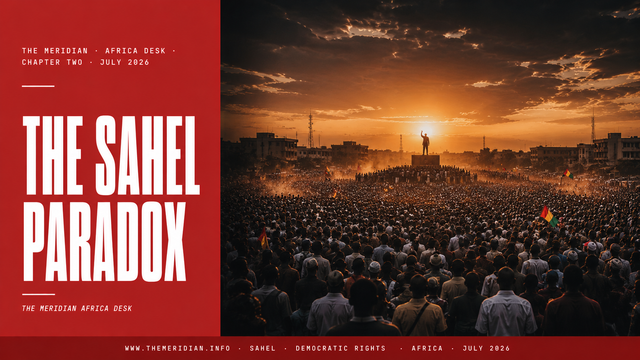
Burkina Faso. Mali. Niger. Three military governments that displaced elected ones between 2020 and 2023. Three juntas that the international community condemned. Three popular mandates that the international community has struggled to explain. The Meridian holds both truths simultaneously -- because the only honest way to analyse the Sahel is to ask what democracy was actually delivering to the people who now support the governments that ended it.
The international community’s response to the Sahel coups followed a familiar script. ECOWAS condemned them. The African Union suspended the three countries from its proceedings. The United States cut military aid. France withdrew its forces. The European Union suspended budget support. The language was consistent: unconstitutional change of government, violation of democratic norms, unacceptable precedent for the continent. The prescription was equally consistent: a rapid return to civilian rule, new elections, restoration of the democratic order that had been disrupted.
What the script did not address -- what it has never adequately addressed -- is the question that the populations of Burkina Faso, Mali, and Niger were asking before any of the coups occurred, and continue to ask now: what was the democratic order actually delivering to us? The international community has a framework for evaluating coups. It does not have an equally rigorous framework for evaluating the governments that coups displace. That asymmetry is not neutral. It is a political choice with consequences that the Sahel is now living.
Mali held elections in 2013 and 2018 under Ibrahim Boubacar Keita. By 2020, the year of the first coup, the country was experiencing its worst security situation since independence. Jihadist violence had expanded from the north into the centre of the country. Civilians were being massacred in villages that the state’s security forces either could not or would not protect. The government was widely perceived as corrupt and as having enriched a political elite while the majority of the population remained in poverty. The M5-RFP protest movement that preceded the coup was not a fringe operation. It was a mass mobilisation that drew hundreds of thousands of people into the streets of Bamako in the months before the military intervened.
Burkina Faso’s Roch Marc Christian Kabore was elected in 2015 and re-elected in 2020. By January 2022, the month of the first Burkinabe coup, more than two million people had been internally displaced by jihadist violence. Forty per cent of the country’s territory was beyond the effective control of the state. Villages were being burned. Humanitarian workers were being killed. The government’s response was assessed by independent analysts as inadequate. The soldiers who removed Kabore did so to widespread popular celebration in the streets of Ouagadougou.
Niger’s Mohamed Bazoum was a different case -- genuinely reform-minded, internationally respected, and removed in July 2023 in a coup that had less clear popular justification than the Malian or Burkinabe ones. But even in Niger, the coup did not trigger the popular resistance that a genuinely beloved government might have generated. The streets did not rise to defend Bazoum with the same energy that the streets had celebrated his predecessors’ removal in Mali and Burkina Faso.
The Universal Declaration of Human Rights guarantees democratic rights in Article 21: the will of the people shall be the basis of the authority of government, expressed through periodic and genuine elections. This is the article the international community invoked when condemning the Sahel coups. It is a legitimate invocation. Coups are unconstitutional. Elections matter. The principle of democratic governance is not negotiable.
But Article 21 does not stand alone. Article 3 guarantees the right to life, liberty, and security of person. Article 25 guarantees the right to an adequate standard of living. Article 28 states that everyone is entitled to a social and international order in which the rights and freedoms set forth in the Declaration can be fully realised. These articles were also in force in Mali, Burkina Faso, and Niger before the coups. They were being violated systematically -- by jihadist violence that the state could not suppress, by poverty that decades of elected government had not reduced, and by a security architecture that protected the political elite while leaving rural communities to burn.
The international community has a rigorous framework for evaluating coups. It does not have an equally rigorous framework for evaluating the elected governments that coups displace. That asymmetry is a political choice -- and the Sahel is living its consequences.
The question the Sahel paradox forces is not whether coups are acceptable. They are not. The question is whether democratic legitimacy -- the procedural legitimacy of an elected government -- is sufficient to constitute the full set of rights the UDHR guarantees, when that government is failing to deliver the substantive rights -- security, living standards, effective governance -- that the same document also requires.
Ibrahim Traore, Burkina Faso’s military leader, told state television in 2023 that people need to forget about democracy and that democracy is not for us. The statement was widely reported as evidence of authoritarian intent. It was. It was also a statement that a significant proportion of Burkina Faso’s population, measured by the absence of mass resistance to his government and by the street celebrations that followed the coup, appeared at the time to find more persuasive than the international community’s counter-argument.
Traore’s statement is wrong as political philosophy. Democracy is not a Western import. It is a universal human right. The right of every citizen to participate in the government of their country through genuine elections is not culturally conditional. It does not apply only where the historical conditions for it are convenient. Article 21 of the UDHR does not contain a footnote excusing its application in countries where colonial extraction left weak institutions.
But Traore’s statement is not entirely wrong as an observation about what democracy delivered to Burkina Faso’s majority between 2015 and 2022. A civilian government, twice elected, presided over a security collapse that displaced two million people and ceded forty per cent of the national territory to armed groups. The international community’s response to that collapse was to deploy troops, provide budget support, and continue calling the arrangement democratic. The population’s response, when the military intervened, was to celebrate in the streets.
Operation Barkhane, France’s military presence in the Sahel, deployed up to 5,100 troops across Mali, Burkina Faso, Niger, Chad, and Mauritania for nine years. Its mandate was counter-terrorism. Its record, as assessed by independent analysts and by the populations of the countries it operated in, was mixed at best.
Jihadist violence expanded geographically during the period of Barkhane’s operation. The groups it was designed to suppress -- JNIM and Islamic State Sahel Province -- grew in territorial reach and operational capacity. Meanwhile, the French military presence generated significant civilian resentment, allegations of civilian casualties, and a perception -- whether accurate or not -- that France’s primary interest was in regional stability for its own sake rather than in the security of Sahelian populations.
When the juntas expelled French forces -- Mali in 2022, Burkina Faso in 2023, Niger in 2023 -- the expulsions were popular. That popularity is a human rights data point that the international community’s condemnation framework does not know how to process.
The Sahel juntas’ turn toward Russia -- and specifically toward the Wagner Group and its successor structures -- has been presented by Western governments primarily as a geopolitical problem: Russian influence expanding in a strategically important region. It is that. But it is also a human rights data point of a different kind.
The juntas turned to Russia because Russia was available, because Russia asked fewer questions about governance and human rights, and because a significant proportion of their populations supported the turn -- partly from genuine preference and partly from a calculation that the Western security partnership had failed to deliver security. The Wagner Group’s record in Mali and Burkina Faso includes well-documented allegations of serious human rights abuses against civilian populations, including massacres. These are genuine human rights violations that The Meridian documents without equivocation.
But they do not explain away the underlying dynamic. Populations that experienced jihadist massacres under Western-backed elected governments, and then turned to Russian-backed military governments, are not populations that have chosen human rights violations over democracy. They are populations that made a calculation about which set of failures was more tolerable -- and that calculation is itself a human rights indictment of the decade that preceded it.
The UDHR does not provide a framework for choosing between a democratically elected government that fails to protect its population and a military government that promises to do so. It requires both democratic governance and physical security. It requires both free elections and freedom from violence. It does not offer a hierarchy of rights that would permit the suspension of Article 21 in order to pursue Article 3, or the suspension of Article 3 in order to preserve Article 21. It requires all of them, simultaneously, for everyone.
The Sahel paradox is precisely that the international human rights system has, in practice, treated Article 21 -- democratic governance -- as the master right whose preservation justifies the toleration of Article 3 failures, while condemning governments that cite Article 3 failures as justification for suspending Article 21. This is not a neutral position. It is a position that systematically advantages the procedural legitimacy of elected governments over the substantive delivery of rights to the populations those governments are supposed to serve.
A human rights framework that is serious about the Sahel must be able to say two things simultaneously. First: the coups were unconstitutional and democracy is a universal right that cannot be suspended by military decree. Second: the elected governments that were displaced had, over extended periods, failed to deliver the rights to security, adequate living standards, and effective governance that the same UDHR requires them to deliver -- and that failure created the conditions in which the coups became possible and popular.
The UDHR does not offer a hierarchy of rights. It requires democratic governance and physical security simultaneously, for everyone. The Sahel paradox is what happens when the international system treats one as the master right and tolerates the failure of all the others.
There is an observation that belongs in any honest analysis of the Sahel that the formal human rights framework struggles to accommodate. The populations of Burkina Faso, Mali, and Niger are not the first populations in history to find that the punishment of living under a failed state does not end when the state formally changes. The debt accumulated under corrupt elected governments continues to be serviced. The institutional weakness built over decades of patronage politics does not disappear with a new flag and a new governing council. The social and economic damage of years of jihadist violence does not reverse because a junta has replaced a civilian president.
This is the Sahel’s equivalent of the criminal record that follows an individual who has served their sentence. The state has paid its formal dues -- elections were held, presidents were inaugurated, international recognition was granted. But the record follows. The poverty follows. The insecurity follows. The institutional failure follows. And when the population eventually decides that the formal legitimacy of the arrangement is insufficient to compensate for the continuing reality of its consequences, the international community expresses surprise.
It should not be surprised. The UDHR promised every human being on earth not just the right to vote but the right to a life in which voting means something -- a life with security, with dignity, with an adequate standard of living, with institutions that function in their interest rather than against them. The Sahel’s populations were promised democracy. What they received, for the most part, was the form of democracy without its substance. The paradox is not that they eventually rejected it. The paradox is that it took as long as it did.
The Sahel coups were unconstitutional. Democracy is a universal right. The juntas that displaced elected governments have, in several documented cases, committed or permitted human rights violations that are serious and that The Meridian does not minimise. Ibrahim Traore’s statement that democracy is not for Africa is wrong as political philosophy and dangerous as political practice.
And: the elected governments that were displaced had, over years and in some cases decades, failed to deliver the rights that the UDHR requires alongside democratic governance -- security, adequate living standards, functioning institutions, protection from violence. The populations that celebrated the coups were not celebrating authoritarianism. They were expressing a judgment about what the democratic arrangement had actually delivered to them. That judgment deserves to be heard rather than explained away.
A human rights framework that can only condemn the coup and not examine the failure that made it possible is not a framework that will prevent the next one. The Sahel paradox is not a paradox at all. It is the predictable consequence of treating procedural democracy as sufficient when substantive rights go undelivered. The UDHR requires both. The international community has, for too long, been satisfied with one.
Add comment
Comments