Sri Lanka’s Collapse and the Rights It Took With It: When Austerity Becomes a Human Rights Violation
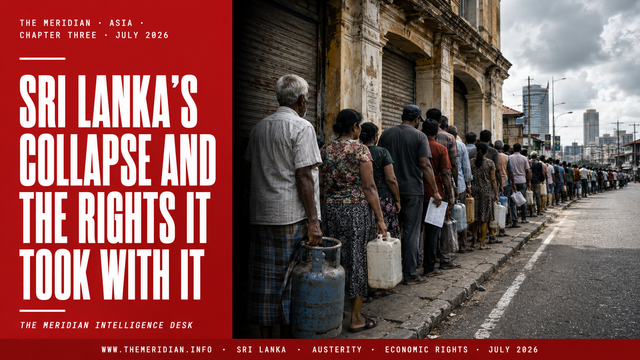
In 2022, Sri Lanka ran out of fuel, medicine, and foreign exchange simultaneously. Queues stretched for kilometres outside petrol stations. Hospitals cancelled surgeries. The President fled the country after protesters stormed his residence. The IMF arrived, stabilised the macroeconomy, and left behind a fiscal framework that cut the health budget, raised taxes on the poorest, and drove hundreds of thousands more Sri Lankans below the poverty line. The Meridian examines where economic crisis ends and human rights violation begins -- and finds the line was crossed long before the IMF arrived, and has not been uncrossed since.
The Aragalaya -- the Sinhala word for struggle -- began on the streets of Colombo in March 2022 and ended, in its most dramatic form, with protesters swimming in President Gotabaya Rajapaksa’s presidential pool on 9 July 2022, the day he fled the country. It was the most significant popular uprising in Sri Lanka’s post-independence history. It was also a human rights event in the most precise sense of the term: a population asserting, through mass action, its right under Article 21 of the UDHR to participate in the governance of its own country, in response to a government that had, through a combination of economic mismanagement, ideological stubbornness, and outright corruption, systematically violated its right under Article 25 to an adequate standard of living.
Sri Lanka’s economic collapse was not a natural disaster. It was produced by a specific sequence of policy decisions: a sudden shift to organic farming in 2021 that devastated agricultural output, deep tax cuts in 2019 that destroyed the fiscal base, a fixed exchange rate maintained long past the point at which Sri Lanka’s foreign exchange reserves could sustain it, and a reluctance to approach the IMF for a rescue programme until the reserves were effectively exhausted. These decisions were made by a government that had won a significant electoral mandate in 2020. Their consequences fell overwhelmingly on the citizens who had the least capacity to absorb them.
The statistics of Sri Lanka’s 2022 economic crisis are stark enough. Foreign exchange reserves fell to approximately $50 million in April 2022 -- barely enough to cover a single week of imports. Inflation reached 70 per cent in September 2022, with food inflation exceeding 90 per cent. The Sri Lankan rupee lost more than 80 per cent of its value against the US dollar in a matter of months. GDP contracted by approximately 7.8 per cent in 2022 -- the sharpest single-year contraction in Sri Lanka’s post-independence history.
But the statistics do not capture what the collapse meant to the families who experienced it. It meant a farmer who could not buy fertiliser because there was no foreign exchange to import it, watching his harvest fail and his income disappear. It meant a patient in a public hospital told that the surgery she needed could not be performed because the anaesthetics had run out. It meant a schoolchild sitting in a classroom in the dark because the school could not afford to run its generator during the twelve-hour power cuts that became standard across the country. It meant a small business owner watching the value of everything she had saved for twenty years halve in the space of a few months.
Sri Lanka’s collapse was not a natural disaster. It was a policy disaster. The distinction matters because natural disasters do not violate human rights. Policy disasters do -- and the people who made the policies that produced this one have faced no accountability under any international human rights framework.
Every one of these experiences is a human rights violation in the terms the UDHR establishes. Article 25 guarantees the right to a standard of living adequate for health and wellbeing, including food, medical care, and social services. Article 26 guarantees the right to education. These rights were not suspended by the Sri Lankan government through any formal declaration. They were suspended by the practical consequences of a macroeconomic collapse that the government produced and that the international community -- including the multilateral institutions whose mandate is to prevent exactly this kind of outcome -- failed to prevent.
The IMF’s Extended Fund Facility programme for Sri Lanka, agreed in March 2023 at a value of $2.9 billion, achieved its primary macroeconomic objectives with notable speed. The exchange rate stabilised. Inflation fell. Foreign exchange reserves recovered. The fiscal deficit narrowed. By 2024, Sri Lanka had returned to positive GDP growth. The IMF described the programme as broadly on track. International credit rating agencies began, cautiously, to revise their assessments of Sri Lanka’s creditworthiness upward.
The programme achieved these outcomes through a specific set of fiscal instruments. Value-added tax was increased from 12 per cent to 18 per cent -- a consumption tax whose burden falls disproportionately on lower-income households, which spend a higher proportion of their income on taxable goods and services. Fuel subsidies were eliminated. Electricity tariffs were increased by more than 60 per cent. The public sector wage bill was frozen. Health and education expenditure as a proportion of GDP, already low by regional standards, was constrained by the overall fiscal consolidation targets the programme required.
The World Bank estimated that the combined effect of the crisis and the adjustment programme pushed an additional 500,000 Sri Lankans into poverty. The poverty rate, which had been approximately 4 per cent before the crisis, rose to more than 25 per cent by 2023. The population that bore the cost of the stabilisation programme was not the population that made the decisions that produced the crisis. It was not the Rajapaksa family, whose members held multiple senior government positions during the period of policy failure. It was not the political class that voted for the tax cuts and the organic farming mandate and the fixed exchange rate. It was the 500,000 people who crossed the poverty line -- and the millions who remained above it but found that the distance between adequacy and inadequacy had narrowed significantly.
The IMF does not describe its programmes as human rights instruments. It describes them as macroeconomic stabilisation frameworks -- technical responses to fiscal and balance of payments crises, designed to restore debt sustainability and economic stability. The distinction matters legally, because international financial institutions have historically claimed that their programmes are economic rather than human rights in character, and that the human rights consequences of their conditions are the responsibility of the borrowing government rather than the institution imposing the conditions.
This distinction is, on examination, difficult to sustain. When an IMF programme condition requires a government to increase VAT by six percentage points, the fiscal instrument is economic. The consequence -- that households spending a fixed proportion of their income on food and fuel now spend more of that income on tax and less on health, education, and nutrition -- is a human rights outcome. The condition did not produce this outcome by accident. It produced it by design: the design of a fiscal consolidation framework that prioritises debt sustainability over the Article 25 rights of the population bearing the adjustment cost.
The IMF has, since 2016, formally committed to integrating social spending floors into its programmes -- minimum levels of health, education, and social protection spending below which programme conditions cannot require governments to cut. The Sri Lanka programme included social spending floors.
In practice, the floors have been set at levels that do not prevent significant deterioration in the quality of public services. Sri Lanka’s health spending remained below the regional average even with the floors in place. The floors protect against the most extreme fiscal cuts but do not guarantee the standard of provision that Articles 25 and 26 of the UDHR require.
The IMF’s social spending floors represent a genuine acknowledgement that adjustment programmes have human rights consequences. They do not yet represent a genuine integration of human rights standards into programme design. The gap between acknowledgement and integration is where the rights violations occur.
Sri Lanka’s debt crisis was not simply a product of domestic mismanagement, though domestic mismanagement contributed significantly to it. It was also a product of a global financial architecture that made external borrowing at variable interest rates attractive to middle-income countries during a period of low global interest rates, and then imposed severe adjustment costs on those same countries when rates rose. Sri Lanka borrowed extensively through international sovereign bonds during the 2010s, at rates that appeared manageable when global interest rates were near zero and became unmanageable when they rose following the post-pandemic inflation surge.
The creditors who lent to Sri Lanka at those rates -- international bondholders, Chinese state banks, Indian credit lines, multilateral development banks -- received their interest payments during the period of borrowing and have been engaged in protracted negotiations over debt restructuring since the crisis. The Sri Lankan population, which did not negotiate the loans, did not receive the full benefit of the borrowed funds -- a significant proportion of which went to infrastructure projects of disputed economic value and to the servicing of previous debt -- and is now bearing the adjustment cost through reduced public services and higher taxes.
This is the political economy of debt crisis as a human rights issue. The people who bear the adjustment cost are rarely the people who made the borrowing decisions or received the primary benefits of the borrowed funds. The people who hold the debt -- and whose interests the IMF programme is primarily designed to protect, by restoring Sri Lanka’s ability to service its obligations -- are not the people whose Article 25 rights are being constrained by the adjustment conditions. The asymmetry is structural, not incidental.
The Aragalaya was not only a protest against economic mismanagement. It was an assertion of the political rights guaranteed under Articles 19, 20, and 21 of the UDHR -- the right to freedom of expression, the right to peaceful assembly, and the right to participate in the governance of one’s country. When protesters occupied the presidential residence, the prime ministerial office, and the national broadcaster’s headquarters in July 2022, they were exercising, in a form that no government finds comfortable, the right to hold their government accountable that the UDHR was written to protect.
The Sri Lankan government’s response included the invocation of emergency regulations, the deployment of the military, curfews, and the arrest of hundreds of protesters. The arrests intensified after the immediate crisis period -- as the new government of President Ranil Wickremesinghe, installed through a parliamentary vote after Rajapaksa’s resignation, used the Prevention of Terrorism Act and other legislation to pursue Aragalaya organisers and participants. The right to protest that had, in July 2022, produced the most remarkable exercise of popular power in Sri Lanka’s recent history was subsequently treated by the state as a security threat rather than a constitutional right.
By 2025, Sri Lanka’s macroeconomic indicators had largely stabilised. GDP growth had returned. Inflation had fallen to single digits. The IMF programme was proceeding broadly on schedule. International observers described the recovery as a success story for IMF-supported adjustment -- a demonstration that fiscal consolidation, painful in the short term, could restore macroeconomic stability and lay the foundation for sustainable growth.
The recovery has not reached the 500,000 people pushed into poverty during the crisis, most of whom remain poor. It has not rebuilt the public health system to the standard that existed before the crisis, let alone to the standard that Article 25 of the UDHR requires. It has not compensated the farmers whose harvests failed, the patients whose surgeries were cancelled, the children whose schooling was disrupted, or the small business owners whose enterprises collapsed during the period of maximum instability. The macroeconomic recovery and the human rights recovery are not the same thing. They are not even on the same timeline.
This is the central human rights lesson of Sri Lanka’s collapse: economic stabilisation is a necessary condition for the restoration of rights, but it is not a sufficient one. The IMF programme restored the macroeconomic conditions within which rights can be delivered. It did not deliver them. The delivery of Article 25 rights -- to food, health, housing, and social protection adequate for a dignified life -- requires fiscal space, political will, and institutional capacity that the adjustment programme, by design, constrained. The gap between macroeconomic recovery and human rights recovery will not close on its own. It requires a deliberate policy choice that no government has yet made.
Sri Lanka’s collapse is a case study in the human rights consequences of economic governance failure -- at the domestic level, in the decisions made by successive governments that produced the crisis, and at the international level, in the adjustment framework that restored macroeconomic stability by imposing the adjustment cost on the people least able to bear it.
The UDHR does not exempt economic crises from its requirements. Article 25 does not contain a clause permitting the suspension of the right to an adequate standard of living during IMF adjustment programmes. Article 26 does not permit cuts to education when fiscal consolidation demands it. The rights are unconditional. The adjustment framework is not designed to honour them unconditionally. The gap between those two positions is where 500,000 Sri Lankans live -- below the poverty line that they were above before a sequence of policy decisions, made by people who have faced no binding accountability for their consequences, produced the crisis that put them there.
The macroeconomy is stable. The bonds are being serviced. The IMF programme is on track. The 500,000 people pushed into poverty are still poor. The surgeries that were cancelled during the crisis have not all been rescheduled. The children whose schooling was disrupted have not recovered the learning they lost. Recovery that does not reach the people who bore the adjustment cost is not recovery. It is consolidation for the benefit of creditors, paid for by the rights of citizens.
Add comment
Comments