Fortress Europe and the Death of Article 14: Pushbacks, Frontex, and the Right to Asylum the EU No Longer Believes In
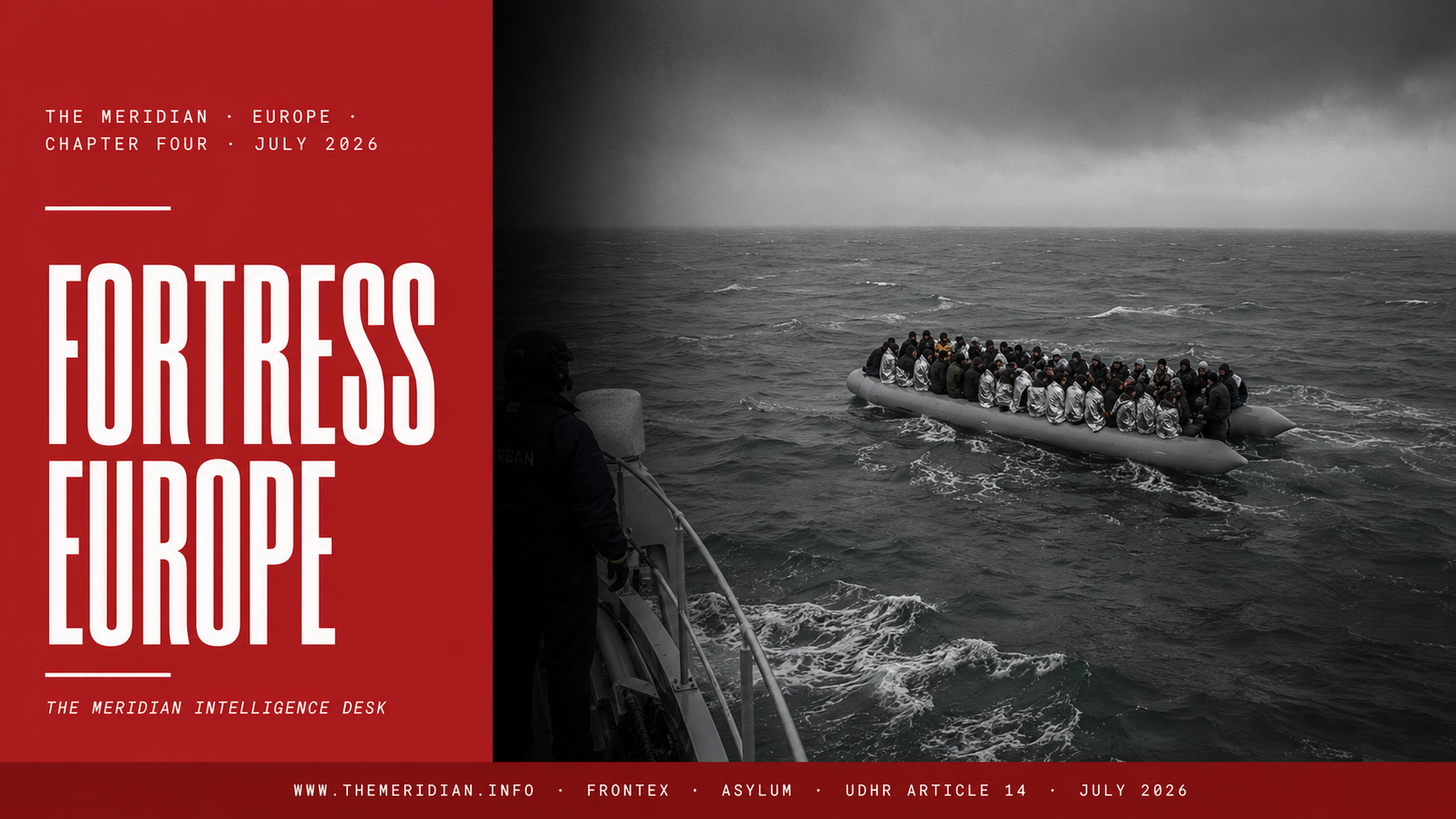
Article 14 of the Universal Declaration of Human Rights guarantees, without qualification, the right to seek and enjoy asylum from persecution. Frontex, the European Union's border and coast guard agency, has been credibly linked to or directly implicated in approximately 40,000 illegal pushback incidents since 2020 -- a practice that prevents the very people Article 14 protects from ever reaching the territory where that right could be exercised. The Meridian examines how the union that wrote much of modern human rights law has built, with its own funding and its own agency, one of the most systematic violations of that law currently in operation.
The European Union likes to describe itself, with some historical justification, as a project built on the foundation of human rights. Its founding treaties reference the European Convention on Human Rights. Its court has, on numerous occasions, struck down member state policies that violate fundamental rights. Its diplomatic posture toward the rest of the world routinely invokes human rights as a condition of trade relationships, development assistance, and political dialogue -- a posture this edition has examined elsewhere in the context of the EU's own selective enforcement of labour rights provisions in its trade agreements with Bangladesh, Cambodia, and Mauritius. On the question of who is permitted to reach European territory and claim the protection of Article 14 of the UDHR, the practice of the Union and its member states tells a different and considerably less comfortable story.
Article 14 states, without qualification, that everyone has the right to seek and to enjoy in other countries asylum from persecution. The right is not conditional on the means by which the person seeking asylum arrives. It is not conditional on possession of a valid visa or other entry documentation -- indeed, the 1951 Refugee Convention, in Article 31, explicitly prohibits states from penalising refugees for irregular entry, recognising that a person fleeing persecution is rarely in a position to obtain the documentation that orderly migration channels require. The right to seek asylum exists precisely for the person who arrives without authorisation, because that is, for the overwhelming majority of genuine refugees, the only way arrival is possible at all.
A pushback, in the technical vocabulary that has developed around European border practice, is the forcible return of a person or group of people across an international border, immediately following their crossing and without any individual assessment of their asylum claim, their protection needs, or their identity. It is distinct from deportation, which follows a legal process, however flawed that process may sometimes be. The pushback occurs before any process begins. It is, by design, a mechanism for preventing the asylum system from ever being triggered -- intercepting the person at or near the point of arrival and returning them to the territory, frequently Turkey in the case of the Aegean, from which they came, before they have the opportunity to make the claim that Article 14 guarantees them the right to make.
Investigations by journalists, human rights organisations, the European Parliament, and the EU's own anti-fraud office, OLAF, have documented pushback practices across multiple European border zones -- most extensively in the Aegean Sea between Greece and Turkey, but also along the Croatia-Bosnia border, the Poland-Belarus border, and in the Central Mediterranean. The practices documented include the forcible return of people at sea by Greek coast guard vessels, sometimes to inflatable life rafts deliberately set adrift without engines; the violent expulsion of people across land borders, frequently accompanied by the confiscation or destruction of phones, money, and documents; and, in several well-documented cases, direct Frontex involvement -- aircraft surveillance that fed targeting information to national authorities conducting pushbacks, and in some instances, Frontex vessels present at or participating in the operations themselves.
The pushback is not a failure to process an asylum claim correctly. It is a mechanism specifically designed to ensure the claim is never made at all. Article 14 cannot be violated more completely than by preventing the person it protects from ever reaching the point where the right could be exercised.
Frontex, formally the European Border and Coast Guard Agency, was established in 2004 and substantially expanded in scope and resourcing through reforms in 2016 and 2019, the latter of which gave the agency its own standing corps of border guards and a budget that has grown to exceed €800 million annually -- among the largest of any EU agency. Frontex's founding and amending regulations explicitly require the agency to operate in full compliance with fundamental rights, and the agency maintains an internal Fundamental Rights Officer role and a Consultative Forum on Fundamental Rights specifically to provide oversight of its compliance with this requirement.
The 2022 investigation by OLAF, the EU's anti-fraud office, found that Frontex officials, including then-Executive Director Fabrice Leggeri, had been aware of pushback practices by Greek authorities, had received credible reporting of Frontex's own involvement or proximity to specific pushback incidents, and had taken insufficient action to investigate or halt the practices -- in some instances actively working to obstruct internal and external scrutiny of the allegations. Leggeri resigned shortly after the report's findings became public. The European Parliament's own Frontex Scrutiny Working Group reached broadly similar conclusions in a parallel investigation. Neither investigation resulted in the suspension of Frontex operations in the Aegean, a formal reduction in the agency's budget, or any individual being held criminally accountable for the practices documented.
Frontex's Fundamental Rights Officer role and Consultative Forum exist precisely to prevent the kind of systematic rights violation the OLAF investigation documented. Both bodies were, according to the OLAF findings and subsequent parliamentary scrutiny, aware of credible pushback allegations involving Frontex personnel and assets well before the practices became a matter of public investigation.
The existence of an internal fundamental rights oversight architecture did not prevent the violations. It did not trigger an effective internal halt to the practices once credible evidence existed. This is the precise pattern this edition has documented in the voluntary corporate codes of conduct examined in the garment industry article: an oversight mechanism that exists, that is resourced, and that produces no binding consequence when it identifies the violation it was created to prevent.
The European Union's formal legal architecture on asylum is, on paper, considerably more developed than the international human rights framework this edition has examined in most other contexts. The Common European Asylum System establishes detailed procedural requirements for the assessment of asylum claims. The EU Charter of Fundamental Rights, legally binding on EU institutions and member states when implementing EU law, explicitly guarantees the right to asylum at Article 18 and prohibits collective expulsion and refoulement at Article 19. The European Court of Human Rights has, in cases including Hirsi Jamaa and Others v Italy in 2012, established clear precedent that interception and return of migrants at sea without individual assessment violates the European Convention on Human Rights.
The persistence of pushback practices in the face of this developed legal architecture illustrates a distinction this edition has returned to repeatedly: the existence of clear, binding legal standards does not, on its own, produce compliance, when the political incentive to violate those standards is strong and the mechanism for holding violators accountable is weak. Greece, the member state most directly implicated in the majority of documented Aegean pushbacks, has faced infringement proceedings and individual case judgments against it at the European Court of Human Rights. It has not faced the kind of systemic, binding intervention from EU institutions that would be required to actually halt the practice at a structural level. The European Commission, whose role includes ensuring member state compliance with EU law, has been notably more cautious in pursuing Greece on pushback allegations than it has been in pursuing member states on a range of other compliance matters with lower political salience.
The persistence of pushback practices, and the EU's institutional reluctance to confront them with the force its own legal architecture would permit, cannot be understood separately from the domestic political pressures operating in nearly every EU member state on the question of migration. Anti-immigration political movements have gained electoral ground across the European Union over the past decade, and mainstream parties across the political spectrum have, in response, increasingly adopted restrictive migration rhetoric and policy positions that were, a decade earlier, associated primarily with parties at the political margins.
In this political environment, a Frontex or a Greek coast guard that visibly and effectively prevents migrant arrivals carries domestic political value that a Frontex or Greek coast guard that processes every arrival through the full asylum determination procedure the law requires does not carry, regardless of which approach the law actually mandates. The pushback is, in this sense, not simply a rogue operational practice occurring despite EU policy. It is a practice that persists because it serves a domestic political function that formal EU asylum law does not acknowledge but that EU member state governments, and to a significant degree the EU institutions that are meant to hold those governments accountable, have shown limited appetite to confront.
Bringing European border practice into genuine compliance with Article 14 of the UDHR and the EU's own binding legal architecture would require, at minimum, the establishment of an independent monitoring mechanism with the power to access border operations in real time, rather than the after-the-fact investigative mechanisms that produced the OLAF report years after the practices it documented began. It would require a genuine willingness on the part of the European Commission to pursue infringement proceedings against member states with the same rigour applied to other categories of EU law violation, and a willingness on the part of EU institutions to attach binding budgetary or operational consequences to Frontex's own complicity, rather than relying on the resignation of individual officials as a substitute for institutional reform.
It would also require a more fundamental reckoning with the domestic political economy that makes pushbacks politically attractive to member state governments in the first place -- a reckoning that no EU institution has, to date, shown serious appetite to undertake, because doing so would require confronting the anti-immigration political pressures that the pushback practice is, in significant part, designed to satisfy.
Article 14 of the UDHR does not require states to grant asylum to everyone who requests it. It requires that everyone be permitted to seek it -- to reach a territory, to make a claim, and to have that claim individually assessed against the legal standards that apply. The pushback is a mechanism specifically engineered to prevent this minimum threshold from ever being met. It does not deny an asylum claim. It prevents the claim from existing.
Forty thousand documented pushback incidents since 2020 represent, on a conservative reading, forty thousand instances in which a person's right under Article 14 was not weighed, assessed, and found wanting through legal process, but simply prevented from ever being exercised through physical force, intimidation, or the deliberate creation of conditions -- an engineless life raft set adrift at sea -- designed to ensure the person never reaches a point where the right could be claimed.
The European Union helped write the modern human rights architecture this edition has examined throughout. Its own border agency, funded at over €800 million a year and operating under an explicit fundamental rights mandate, has been credibly linked to the systematic prevention of one of that architecture's most basic guarantees. The Union's response to its own internal investigation's findings has been the resignation of one official and the continuation, in modified form, of the practices that official's agency was found to have enabled. That is not accountability. That is documentation without consequence -- the precise pattern this edition has found, with grim consistency, everywhere the powerful are asked to answer for what the powerless cannot compel them to answer for.
Add comment
Comments