The Rs 2.5 Billion Shadow Economy: What Mauritius's Illegal Cannabis Market Costs the State
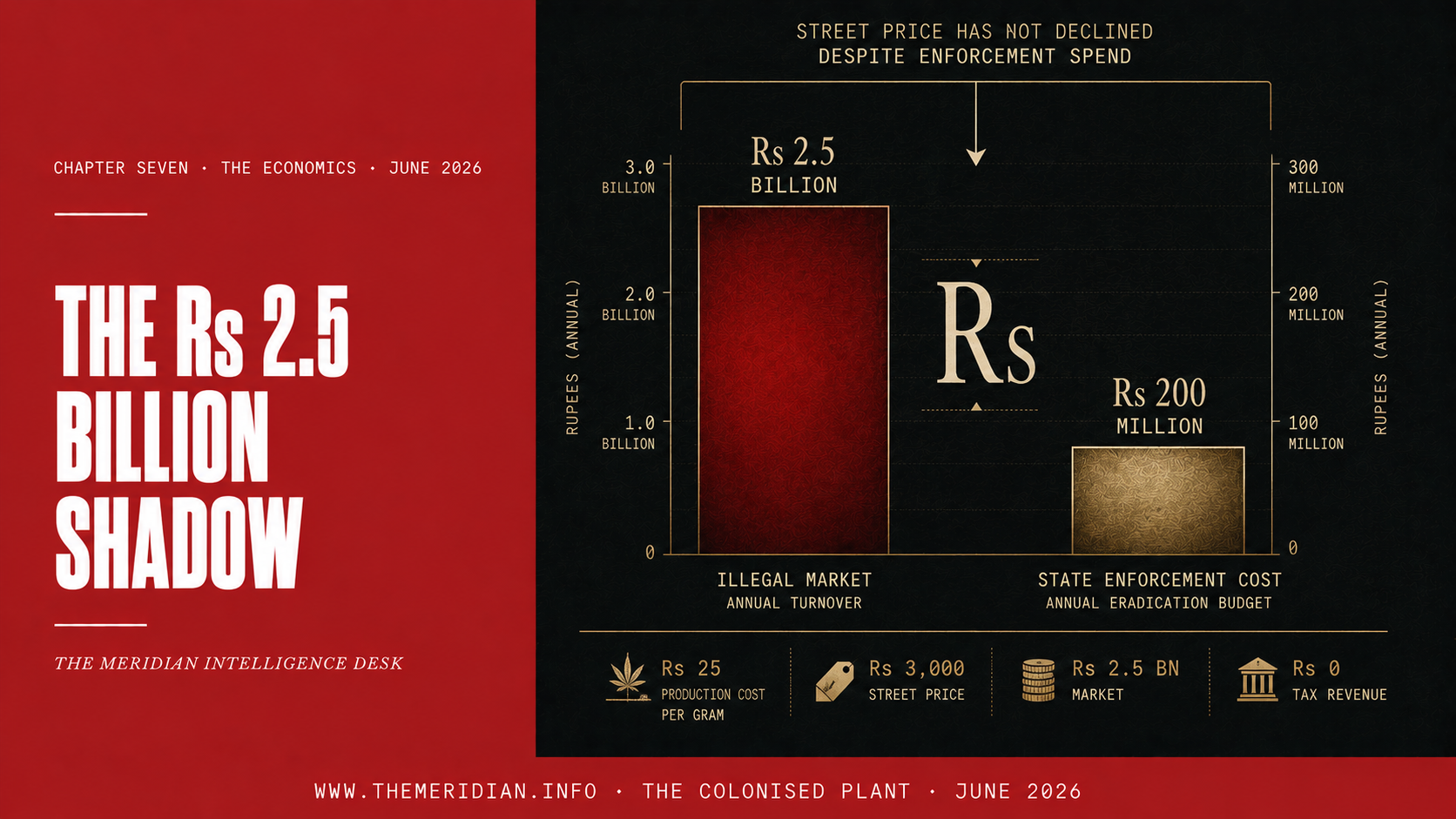
Cannabis costs Rs 25 per gram to produce under regulated cultivation conditions in comparable tropical jurisdictions. On the streets of Mauritius in June 2026 it sells for between Rs 1,200 and Rs 3,000 per gram. The difference between those two numbers, the prohibition premium, is the entire fiscal and social cost of the Dangerous Drugs Act 2000 expressed in a single price ratio. The estimated Rs 2.5 billion in annual turnover of the Mauritian illegal cannabis market is entirely untaxed, entirely unregulated, and entirely controlled by criminal distribution networks. The state simultaneously funds the Rs 200 million enforcement operation that demonstrably fails to suppress that market and foregoes the fiscal revenue that regulation would generate. The Meridian Intelligence Desk constructs the fiscal arithmetic of cannabis prohibition in Mauritius, models what a regulated market would produce, and documents the gap between what the state is spending and what it is choosing not to earn.
The economics of cannabis prohibition follow a structure that is consistent across every jurisdiction that has maintained it for a sustained period. The state bans the plant, drives the production cost underground, and in doing so creates a price premium that is captured entirely by unregulated criminal distribution networks. The state then funds an enforcement operation to suppress the market that the premium sustains. The enforcement operation demonstrably fails to suppress the market, as evidenced by the fact that the market continues to exist and the price has not declined. The state continues to fund the enforcement operation anyway, because admitting that it has failed would require admitting that the policy has failed. The fiscal cost of this cycle, in Mauritius, is the Rs 2.5 billion that flows annually through an illegal market the state created by pricing a plant out of the regulated economy.
Mauritius cannabis shadow economy Rs 2.5 billion illegal market prohibition premium fiscal arithmetic tax revenue cannabis regulation Colorado Lesotho revenue model synthetic market suppression excise tax
The fiscal arithmetic of cannabis prohibition in Mauritius operates on three simultaneous ledgers. The first is the direct enforcement expenditure: the budget of the Anti-Drug and Smuggling Unit, the MRA Cannabis Unit aerial eradication programme, the Special Striking Team, the judicial processing of cannabis cases, and the prison costs of custodial sentences for cannabis offences. The second is the foregone revenue: the excise tax, VAT, licensing fees, and corporate tax that a regulated cannabis market would generate and that the current policy ensures are captured instead by criminal networks. The third is the indirect cost: the Rs 2.5 billion in economic activity that flows outside the formal economy, generating no employment records, no social insurance contributions, no income tax, and no consumer protection for the Mauritian citizens purchasing from it.
The mechanism by which cannabis prohibition creates the black market it then fails to suppress is not complex. Cannabis is an agricultural product. In jurisdictions where it is legally cultivated under regulated conditions, comparable to tobacco or tea in terms of production economics, it costs between Rs 20 and Rs 50 per gram to produce at commercial scale in tropical climates. The FAREI hemp pilot at Reduit confirmed that Mauritian soil and climate conditions are suitable for cannabis cultivation. In the absence of prohibition, Mauritian-produced cannabis would enter a competitive market at a price point broadly consistent with other agricultural commodities.
Prohibition eliminates that competitive market. It does not eliminate demand. It redirects demand to an illegal supply chain that prices the prohibition risk into the product. Every transaction in the illegal cannabis market carries a risk premium: the risk of arrest for the cultivator, the risk of seizure for the transporter, the risk of prosecution for the retailer. Each layer of the supply chain adds its risk premium to the price. By the time the product reaches the street, the Rs 25 production cost has become Rs 1,200 at minimum and Rs 3,000 at the high end. The state has, through its enforcement activity, created a price structure that generates Rs 2.5 billion in annual revenue for criminal networks and zero revenue for the public purse.
The state is not suppressing the cannabis market. It is subsidising it. Every rupee spent on enforcement that fails to reduce supply makes the remaining supply more valuable. The Rs 200 million aerial eradication programme does not eliminate the cannabis market. It maintains the scarcity that keeps the price at Rs 3,000 per gram and the criminal networks that distribute it in business.
The Rs 3,000 per gram street price of cannabis in Mauritius does not describe a luxury market. It describes a pricing structure that excludes the majority of cannabis consumers, particularly young people and those in lower-income communities, from the botanical product and creates demand for the synthetic substitute. Chimique sells for Rs 100 per dose. The price differential between natural cannabis at Rs 3,000 per gram and synthetic cannabinoids at Rs 100 per dose is not a coincidence. It is the direct economic consequence of the prohibition premium.
The 652 adolescent hospitalisations for synthetic cannabinoid exposure documented in parliamentary data between 2021 and 2025 are not a separate problem from the cannabis prohibition premium. They are the same problem expressed in a different ledger. The state's Rs 450 million annual enforcement expenditure does not appear anywhere in the Ministry of Health's budget for synthetic cannabinoid treatment. But it is directly connected to it. The enforcement expenditure maintains the prohibition premium. The prohibition premium sustains the synthetic market. The synthetic market produces the adolescent hospitalisations. The hospitalisations produce the health system expenditure. The entire chain originates in the decision to spend Rs 450 million suppressing a market that would, under regulation, generate Rs 375 million in tax revenue and eliminate the economic conditions that created the synthetic substitute.
Colorado legalised adult recreational cannabis in 2012 and generated $423 million in cannabis tax revenue in its first full year of legal retail operation. That figure has grown consistently year on year, exceeding $500 million annually in subsequent years. Colorado's cannabis excise framework applies a 15% retail excise tax, a 15% special cannabis tax, and standard sales tax. The state has used cannabis tax revenue to fund public school construction, public health programmes, and drug treatment services.
The Colorado model is not directly replicable in Mauritius, which is a small island developing state with a population approximately one-fifteenth the size of Colorado's. However, the structural revenue arithmetic is replicable. A regulated medical cannabis market in Mauritius, priced to suppress the illegal market at Rs 400 per gram, generating an estimated 625,000 grams in annual regulated sales, at a combined excise and VAT rate of 25%, would generate approximately Rs 62.5 million in direct tax revenue in its first year of operation. That figure does not include licensing fees from cultivation and processing operators, corporate tax on regulated businesses, or the VAT on ancillary retail activity in cannabis-adjacent markets.
Lesotho's model is more directly instructive for Mauritius. Lesotho's medical cannabis export framework, established in 2017, generated foreign exchange earnings that have grown consistently since inception. Its regulatory framework cost less to establish than one year of Mauritius's aerial eradication programme. The return on regulatory investment, measured in terms of revenue generated per rupee equivalent spent on establishing the framework, substantially exceeds the return on Mauritius's current enforcement investment, which is negative by every measurable metric.
The fiscal arithmetic of cannabis prohibition in Mauritius does not require sophisticated modelling to produce a clear verdict. The state spends an estimated Rs 450 million annually on enforcement that demonstrably fails to suppress the market it targets. It foregoes an estimated Rs 375 million in annual tax revenue that a regulated market would generate. It hands an estimated Rs 2.5 billion in annual market turnover to criminal distribution networks that pay no tax, employ no licensed staff, verify no age, and quality-control no product. It then watches 652 adolescents get hospitalised by the synthetic substitute that the prohibition premium made economically inevitable.
The combined annual fiscal swing from regulation, enforcement savings plus tax revenue generation, is estimated conservatively at Rs 825 million in year one of a medical access framework. That figure grows as the regulated market matures and as the synthetic market contracts in response to a competitively priced legal alternative. The state is not making a difficult fiscal trade-off when it maintains prohibition. It is making an economically illiterate one.
The Rs 2.5 billion shadow economy is not a natural phenomenon. It is a policy construction. The Dangerous Drugs Act 2000 built it. The Rs 200 million aerial eradication programme maintains it by sustaining the scarcity that keeps the price at Rs 3,000 per gram. And the Dangerous Drugs (Amendment) Act 2022, sitting unproclaimed in the Government Gazette, contains the instrument that would begin to dismantle it. The fiscal case for proclamation is not ideological. It is arithmetic.
This is the first article of Chapter Seven: The Economics, in The Colonised Plant: The Cannabis Edition, June 2026. The next article examines the incarceration economy: the full institutional cost of deploying police, courts, and prison capacity against a plant that kills no one. The complete edition is published at themeridian.info/june-2026.
Add comment
Comments