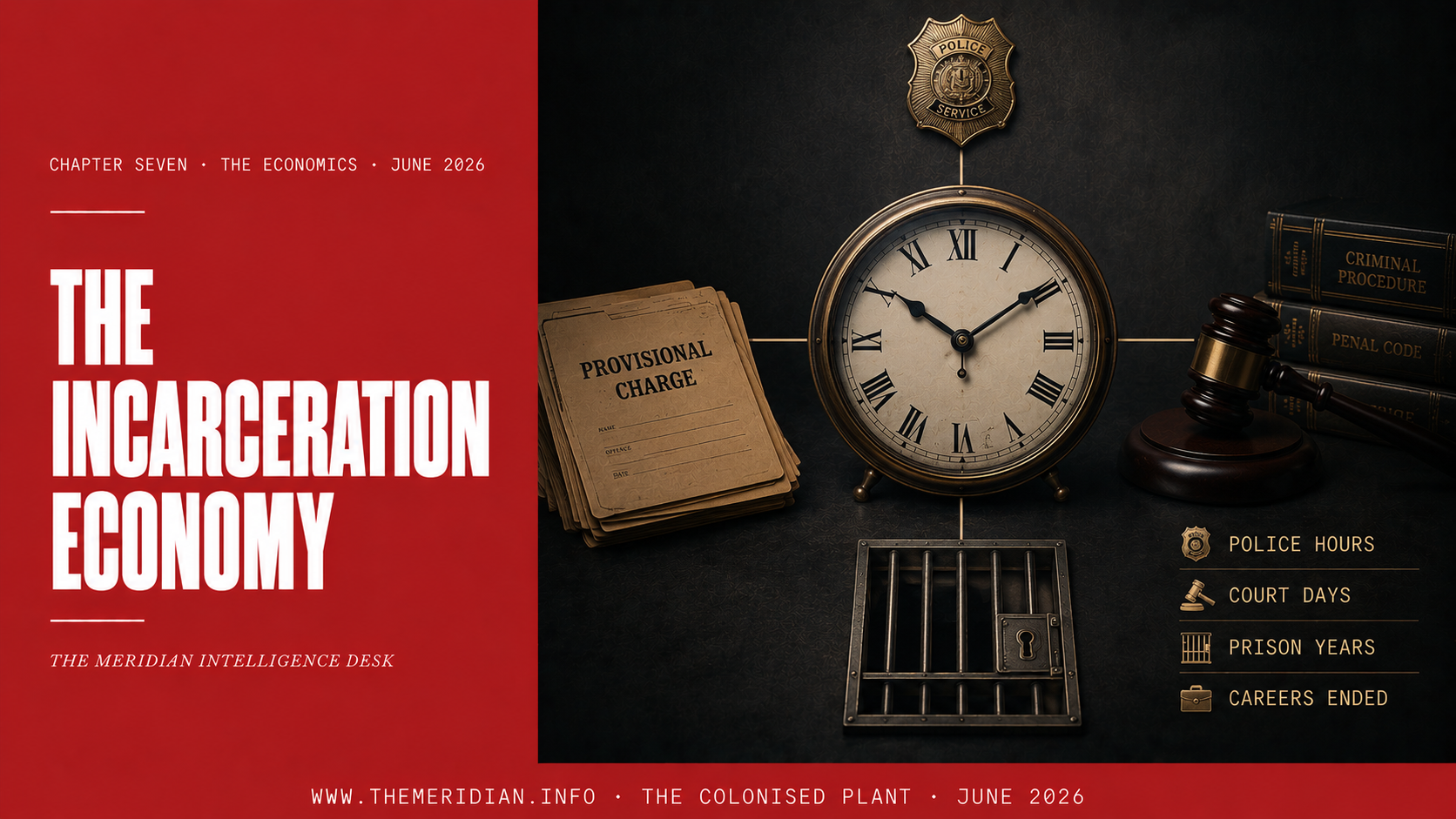
Police time. Court time. Prison time. Prosecutor time. Legal aid time. Judge time. The Dangerous Drugs Act 2000 deploys the full institutional weight of the Mauritian state against a plant that has never killed anyone. Every cannabis arrest initiates a pipeline of institutional resource consumption that continues through investigation, provisional charge, bail hearing, magistrate sitting, DPP review, trial, sentencing, and in custodial cases, incarceration. None of that resource consumption produces a public health benefit. None of it reduces cannabis consumption. None of it addresses the synthetic cannabinoid crisis that prohibition created. The Meridian Intelligence Desk constructs the aggregate institutional cost of cannabis enforcement in Mauritius and asks what those resources would produce if they were redirected toward the crisis they are currently making worse.
The incarceration economy of cannabis prohibition is not measured only in money. It is measured in the institutional capacity that Mauritius has permanently allocated to processing a substance that kills no one. It is measured in the ADSU officers who spend their careers arresting cannabis users instead of dismantling the synthetic cannabinoid import networks that are hospitalising adolescents. It is measured in the magistrates whose dockets are crowded with cannabis possession cases instead of the financial crimes, domestic violence cases, and organised crime prosecutions that their courts exist to resolve. It is measured in the prison cells occupied by cannabis offenders instead of the violent criminals whose incarceration would produce a measurable public safety benefit. And it is measured, most invisibly, in the careers ended and the lives suspended by a provisional charge mechanism that imposes punishment before any verdict has been reached.
Mauritius incarceration economy cannabis prohibition institutional cost police ADSU courts prison provisional charge opportunity cost synthetic cannabinoid redirection DDA 2000 cannabis enforcement resource waste
The Cannabis Enforcement Pipeline: Seven Stages of Institutional Resource Consumption
A cannabis arrest in Mauritius does not begin and end with the arrest. It initiates a pipeline of institutional resource consumption that touches six separate institutional bodies and can run for four years before any resolution. The Meridian Intelligence Desk traces each stage of that pipeline, estimates the institutional resource consumed at each stage, and aggregates the cost of a system that processes thousands of cannabis cases annually to no demonstrable public health benefit.
1
Stage One · Police Investigation
ADSU and Police Cannabis Investigation: Surveillance, Arrest, Initial Processing
Cannabis investigations consume ADSU officer time at every stage: surveillance operations, arrest execution, evidence collection, seizure documentation, and initial suspect processing. A single cannabis cultivation arrest, particularly one involving aerial eradication operations, can consume dozens of officer-hours across the investigation and arrest phases. The ADSU's cannabis caseload represents a significant proportion of its total operational activity. Every hour an ADSU officer spends on a cannabis possession case is an hour not spent on the synthetic cannabinoid import networks currently hospitalising Mauritian adolescents.
Estimated cost per case: Rs 15,000 to Rs 60,000 in officer time
2
Stage Two · Provisional Charge and Bail Hearing
Provisional Charge Lodged Before DPP Review: Magistrate Sitting, Bail Assessment
The provisional charge is lodged before the DPP has reviewed the evidence and before the Forensic Science Laboratory has returned analysis results. This requires a magistrate sitting, a bail hearing, a police prosecutor presentation, and a defence advocate response. The accused may be remanded in custody for weeks or months while the FSL processes the seized material. The cost of a single bail hearing, including magistrate time, police prosecutor time, and legal aid expenditure where the accused cannot afford representation, is substantial. Across thousands of cannabis cases annually, the aggregate magistrate time consumed by provisional charge hearings represents a significant proportion of the District Court's criminal docket.
Estimated cost per case: Rs 8,000 to Rs 25,000 in judicial and legal resource
3
Stage Three · FSL Analysis and DPP Review
Forensic Science Laboratory Processing and Director of Public Prosecutions Case Review
Every cannabis seizure must be chemically analysed by the Mauritius Forensic Science Laboratory before charges can be formally lodged. The FSL's analytical capacity is finite. Cannabis cases represent a significant proportion of its drug analysis caseload. The backlog of FSL analyses is a documented constraint on the Mauritian criminal justice system's processing speed. Each cannabis case consumes FSL chemist time, equipment capacity, and storage infrastructure. The DPP review adds further prosecutorial time to the pipeline. The opportunity cost of FSL capacity consumed by cannabis cases is the complex drug chemistry analysis, digital forensics, and financial crime evidence processing that the FSL cannot perform because its capacity is allocated to confirming that seized plant material is cannabis.
Estimated cost per case: Rs 12,000 to Rs 35,000 in forensic and prosecutorial resource
4
Stage Four · Trial and Judicial Processing
Magistrate or Supreme Court Trial: Hearing Days, Judicial Sitting Time, Legal Representation
Cannabis trials in Mauritius range from straightforward possession hearings before a Magistrate to complex Supreme Court proceedings for cultivation cases carrying potential sentences of up to twenty-five years. A cannabis trial before the Intermediate Court or Supreme Court can consume multiple hearing days spread over months or years. Each hearing day consumes judge or magistrate sitting time, court registrar time, police prosecutor or DPP advocate time, defence counsel time, and court administrative resource. Cannabis cases with multiple accused, contested evidence, or complex legal arguments may run for years before resolution, consuming court capacity throughout.
Estimated cost per case: Rs 20,000 to Rs 150,000 depending on court level and complexity
5
Stage Five · Incarceration
Beau-Bassin Prison, New Prison at Melrose, or Remand: Daily Per-Prisoner Cost Applied to Cannabis Sentences
Where a custodial sentence is imposed, the incarceration cost adds to the pipeline total. The daily cost of incarceration in Mauritius, encompassing prison officer wages, facility operation, healthcare, and food, is estimated at Rs 1,500 to Rs 2,500 per prisoner per day. A cannabis cultivator sentenced to five years of penal servitude generates a prison cost of Rs 2.7 million to Rs 4.6 million over the sentence term. A significant proportion of Mauritius's prison population is serving cannabis-related sentences. That proportion of the prison budget represents a direct fiscal cost of maintaining prohibition rather than a public safety investment.
Estimated cost per custodial year: Rs 550,000 to Rs 900,000 per prisoner
6
Stage Six · Probation and Post-Release Supervision
Probation Service Caseload, Post-Release Monitoring, Rehabilitation Panel Processing
Cannabis offenders diverted to the Rehabilitation Panel under the 2022 amendment provisions, where those provisions are applied, consume probation officer time, panel administration resource, and follow-up monitoring capacity. Where a custodial sentence has been served, post-release supervision and reintegration support consume additional probation and social welfare resource. The social welfare costs of cannabis-related incarceration on dependent families, including child welfare, social assistance payments, and community health service demand, are not captured in the direct enforcement budget but represent a real and documented cost to the state.
Estimated cost per case: Rs 5,000 to Rs 30,000 in probation and social welfare resource
7
Stage Seven · The Provisional Charge Penalty (Pre-Conviction)
Civil Service Suspension, Professional Licence Freeze, Travel Restriction: Punishment Before Verdict
The provisional charge mechanism under the DDA 2000 imposes a de facto punishment before any verdict is reached. A person provisionally charged with a cannabis offence is immediately suspended from civil service eligibility, has professional licences frozen, and faces international travel restrictions that may last for the four-year duration of the investigation and trial. The economic cost of this pre-conviction punishment, in terms of lost earning capacity, lost professional development, and lost economic productivity, falls entirely on the accused and on the Mauritian economy. It does not appear in any enforcement budget. It is nevertheless real, documented in case studies across The Meridian's Cannabis Edition, and institutional in its operation.
Human cost: Immeasurable. Economic cost to Mauritius: Rs tens of millions in lost productivity annually
The Provisional Charge as Pre-Conviction Punishment
The Provisional Charge Mechanism: How the DDA 2000 Punishes Before It Prosecutes
Dangerous Drugs Act 2000 · Section 30(1)(f) · Consumer upgraded to trafficker before FSL analysis · Pre-conviction penalties imposed immediately
The provisional charge is the most economically destructive mechanism in the DDA 2000's enforcement architecture, precisely because its costs are invisible to the state's own accounting. When the ADSU arrests a cannabis user and lodges a provisional charge under Section 30 for drug dealing, the state does not record the economic consequences that follow. It records only the charge. But the consequences are immediate and severe.
A person provisionally charged under Section 30 of the DDA 2000 for cannabis offences faces the following automatic consequences while the case remains active, which may be for four years or more. These consequences apply before any trial. They apply before any verdict. They apply on the basis of a police accusation that has not been tested by any court. They constitute, in practical terms, a substantial punishment administered without any of the procedural safeguards that criminal law requires for a conviction. On 27 May 2026, two Grade Six pupils aged approximately eleven were placed under police investigation for cannabis. The DDA 2000 does not ask their age. It opens a file. The file follows them.
Civil Service Eligibility
Suspended for the duration of the provisional charge period. Cannot apply for any government employment, government-affiliated position, or public sector role while the charge is active. Period routinely extends to four years. Economic cost: total exclusion from the largest employment sector in Mauritius.
Professional Licences
Medical, legal, nursing, teaching, financial services, and other professional licences are frozen for the duration of the provisional charge. A nurse provisionally charged cannot practise. A teacher cannot teach. An accountant cannot be registered. The professional's career is suspended before any verdict, potentially for years.
International Travel
Restricted for the duration of the charge. International employment opportunities, study programmes, and conference participation are foreclosed. For Mauritians whose careers require international mobility, the provisional charge imposes a geographic confinement that compounds the economic damage of the employment suspension.
Reputational and Social Cost
The provisional charge is a matter of public record. It carries a social stigma that community members, employers, and institutions respond to as though it were a conviction. The DDA 2000 creates a record that follows the accused regardless of the eventual outcome. Acquittal does not erase the economic and social damage that the provisional charge period produced.
The provisional charge is not a safeguard. It is a punishment mechanism that operates outside the protections of criminal law. It imposes economic and social consequences on the basis of a police accusation that has not been tested, examined, or upheld by any court. It is the most efficient instrument of social control in the DDA 2000's enforcement architecture, precisely because it requires no conviction to work.
The Opportunity Cost: What Those Resources Could Do Instead
The institutional cost of cannabis enforcement is not merely the direct expenditure documented above. It is also the opportunity cost: the value of what those same police, judicial, forensic, and correctional resources would produce if they were deployed against the problems that the DDA 2000's cannabis enforcement is currently preventing them from addressing. The most significant opportunity cost in Mauritius in June 2026 is the synthetic cannabinoid crisis.
Current Allocation: Cannabis Enforcement
ADSU officers conducting cannabis surveillance and arrest operations
FSL chemists analysing cannabis plant material seized in eradication operations
Magistrates and judges processing cannabis possession and cultivation hearings
Prison officers managing cannabis offenders serving custodial sentences
DPP prosecutors preparing cannabis cases for trial
MRA aerial assets conducting cannabis eradication flights
Probation officers monitoring cannabis offenders under post-conviction supervision
Redirection Potential: Synthetic Cannabinoid Crisis
ADSU officers targeting the Chinese chemical import networks supplying 5F-ADB and AB-FUBINACA through courier services
FSL chemists analysing synthetic cannabinoid variants and identifying new chemical analogues before they reach the street
Judicial capacity freed for organised crime prosecutions targeting synthetic distribution networks
Prison capacity freed for violent offenders whose incarceration produces a measurable public safety benefit
MRA resources redirected from aerial cannabis eradication to parcel post interception of synthetic chemical imports
Probation and social welfare capacity redirected to community synthetic drug treatment and harm reduction
The redirection case is not theoretical. It is directly supported by the parliamentary data that ADSU and Ministry of Health officials have themselves presented. Synthetic cannabinoids are hospitalising 173 Mauritian adolescents annually. The compounds responsible are being imported through the postal system from Chinese chemical suppliers in powder form. The ADSU has documented seizures of synthetic cannabinoid precursors arriving through courier services. The supply chain is traceable, the import mechanism is known, and the enforcement challenge is a matter of resource allocation, not capability. The resources that are currently allocated to arresting cannabis users could, under a reformed policy framework, be entirely redirected toward the importers and distributors of the compounds that are actually killing people.
The Meridian Intelligence Desk · Institutional Cost Assessment · Chapter Seven
The Incarceration Economy Produces No Public Safety Benefit. It Produces Only Cost, Displacement, and the Perpetuation of the Synthetic Crisis It Created.
The aggregate institutional cost of cannabis enforcement in Mauritius, across the seven-stage pipeline from arrest through incarceration, is estimated at Rs 450 million or more annually. That figure, combined with the Rs 375 million in foregone tax revenue documented in Chapter Seven's first article, represents a total annual fiscal cost of prohibition approaching Rs 825 million. Against that cost, the state can point to no reduction in cannabis consumption, no reduction in cannabis street prices, no reduction in adolescent drug hospitalisation rates, and no measurable public health improvement attributable to enforcement activity.
The provisional charge mechanism amplifies the institutional cost by adding a pre-conviction punishment layer that destroys economic productivity and imposes social costs on thousands of Mauritians annually without any of the procedural safeguards that criminal law requires for a legitimate conviction. The careers documented in Chapter Five of The Colonised Plant are not isolated tragedies. They are the systemic product of an enforcement architecture designed to maximise institutional control rather than to achieve any public health objective.
The incarceration economy of cannabis prohibition in Mauritius is not a side effect of the DDA 2000. It is its primary product. The law was not designed to produce public health. It was designed to produce control. The Rs 450 million annual institutional expenditure is the price of that control. The 652 adolescent hospitalisations from synthetic cannabinoids are the public health cost of the resources that control consumes. The arithmetic closes on the same conclusion that every chapter of The Colonised Plant has reached by a different route: the policy has failed on every dimension it can be measured against, and the resources it consumes would produce better outcomes if deployed differently.
This is the second article of Chapter Seven: The Economics, in The Colonised Plant: The Cannabis Edition, June 2026. The third and closing article of Chapter Seven examines the medicated island: the clinical case for cannabis as a structural health system intervention in a country that cannot afford the pharmaceutical alternative. The complete edition is published at themeridian.info/june-2026.
The Meridian Intelligence Desk
Chapter Seven: The Economics · The Colonised Plant · June 2026
The Meridian · 2 June 2026
Add comment
Comments