Where Does Nigeria's Ecological Fund Go? How Billions Meant for Flood Protection Are Failing 14,000 Communities
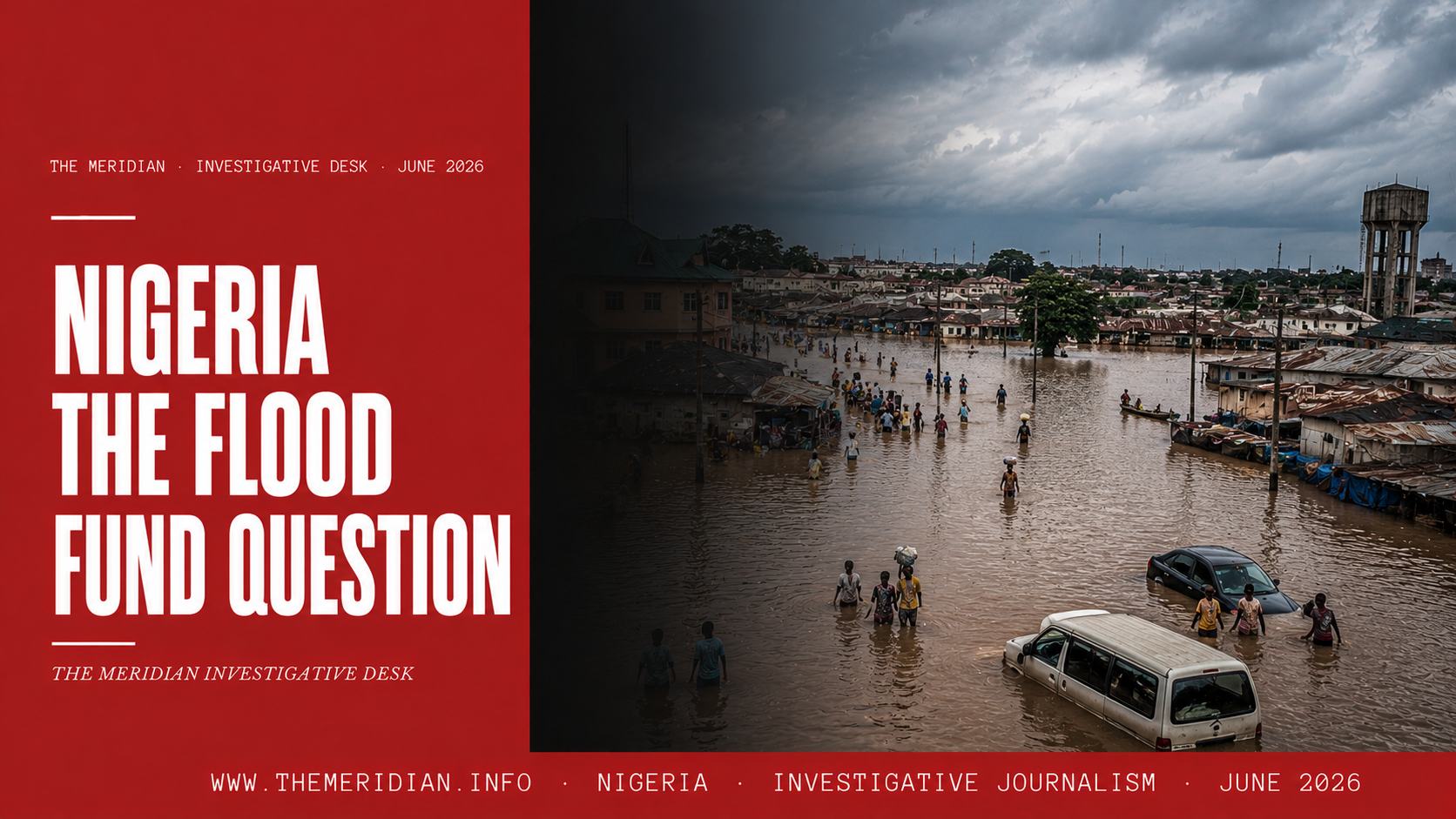
The National Emergency Management Agency has warned that over 14,000 communities across 33 Nigerian states face severe flood risk in 2026. The Nigerian Meteorological Agency has flagged 13 states for longer-than-normal rainy seasons. NEMA has specifically identified 178 communities in Kano State alone at moderate-to-high risk. Nigeria has a dedicated fund in the Federation Account specifically designed to prevent exactly this kind of disaster. The Meridian Investigative Desk asks the question that is not being asked: where does that money actually go?
Every year, the Nigerian government takes three per cent of the Federation Account allocation and sets it aside. This money -- drawn from oil revenues shared monthly between the federal government and the 36 states -- is designated for ecological problems. Soil erosion. Desertification. Urban drainage failure. Flood mitigation. The fund has existed for decades, distributes billions of naira annually, and is managed by an office within the Presidency. And every rainy season, Nigerian communities flood. Farmlands are destroyed. Families are displaced. Roads are submerged. The question of what the Ecological Fund is actually funding is one of the most important and least-answered questions in Nigerian public finance.
The 2022 Nigerian floods remain the benchmark against which every rainy season is now measured. That year, flooding across 34 states displaced approximately 1.4 million people, destroyed an estimated 440,000 hectares of farmland, and caused economic damage estimated at over billion. The Benue, Niger, and Anambra river basins overflowed. Entire LGAs were submerged for weeks. The emergency response was overwhelmed. And within months of the disaster, civil society groups and investigative journalists began asking the same question they had asked after previous flood seasons: if Nigeria has an Ecological Fund specifically designed to build flood defences, maintain drainage infrastructure, and mitigate environmental disasters -- why are the disasters getting worse?
The NiMet seasonal climate prediction for 2026 indicates that the rainy season will be longer than average, with above-normal rainfall in the Niger Delta, the Middle Belt, and the northwest. These are precisely the regions that suffered the worst flooding in 2022. Agricultural planners are already revising crop yield forecasts downward. Logistics companies are rerouting supply chains away from flood-prone corridors. And the 178 communities in Kano State flagged by NEMA this week are already searching for information on whether their local government has any evacuation plan.
Nigeria's Ecological Fund draws its mandate from Section 162(3) of the 1999 Constitution, which provides for a special account from which the federal government, states, and local governments share funds for ecological purposes. The three per cent carve-out from the Federation Account translates, at current oil revenue levels, into hundreds of billions of naira distributed annually. On paper, this is one of the most generously funded environmental protection mechanisms on the African continent.
In practice, the accountability trail is almost impossible to follow. The Ecological Fund Office, which sits within the Presidency, receives and disburses allocations to state governments for specific ecological projects. States are required to submit project proposals, receive approval, and report on utilisation. The auditing infrastructure exists in statute. The actual audit trail -- who received what, what was built, what was inspected, what worked -- is largely opaque to the public, to civil society, and, in many documented cases, to the auditors themselves.
Nigeria has a dedicated constitutional fund for ecological protection. It distributes hundreds of billions of naira every year. And 14,000 communities are facing severe flood risk in 2026. These two facts are not in contradiction. They are the same story.
The Federation Account Allocation Committee publishes monthly disbursement data. Citizens and transparency groups can track how much each state receives from the total Federation Account. What is far harder to track is what each state does with its ecological allocation specifically -- which drainage projects were funded, which erosion control works were completed, which flood mitigation infrastructure was built, and whether any of it was inspected before the rains arrived. The gap between disbursement and delivery is where Nigeria's flood crisis lives.
Kano State's 178 flood-risk communities are a precise illustration of how the ecological fund gap operates at the municipal level. Kano is Nigeria's second-largest city and the commercial capital of the north. Its urban drainage system was designed for a city of roughly 600,000 people. The current metropolitan population is estimated at over four million. The drainage infrastructure has not been comprehensively upgraded since the 1980s. Every major rainy season produces urban flooding that destroys property, closes roads, and damages the informal economy that sustains millions of low-income residents.
Citizens in Kano are currently searching "is my area in Kano at risk of flooding 2026" and "Kano state government flood preparation 2026." The searches reveal both the anxiety and the distrust -- people are not assuming their government has prepared. They are trying to find out for themselves, because the official information is not reaching them. Meanwhile, the Ecological Fund has been distributing allocations to Kano State for years. The drains remain blocked. The roads remain unpaved in flood-prone wards. The erosion continues unchecked.
This pattern -- fund disbursed, infrastructure absent -- repeats across every region. In the Niger Delta, where Shell's oil spill cleanup progress is still being searched by communities waiting years for remediation. In Benue State, where the farmer-herder conflict is compounded every rainy season by flooding that destroys crops and displaces already-vulnerable communities. In Lagos, where Lekki residents track flash flood events in real time on social media because the government's drainage maintenance schedule is invisible to the public.
The question being searched across Nigeria right now is not abstract. It is being asked by farmers who need to know whether to plant in certain fields. By logistics operators who need to plan alternative routes. By families in low-lying areas who need to know whether to move valuables to higher ground. NEMA's warnings are specific enough to create genuine anxiety. They are not specific enough, in most cases, to enable individual households to make informed decisions.
The conditions for a severe flood season in 2026 are present: above-normal rainfall forecast, degraded drainage infrastructure, and a population of over 200 million with insufficient early warning systems at the community level. Whether 2026 exceeds 2022 will depend significantly on factors the government cannot control -- rainfall volume, dam management decisions at Lagdo in Cameroon, which releases water into the Benue River. It will also depend on factors the government absolutely can control: whether blocked drains have been cleared, whether flood-prone roads have been elevated, whether early warning information reaches communities before the waters rise.
Nigeria does not lack a legal framework for ecological protection. It does not lack a funding mechanism. It has both. What it lacks -- and what 14,000 communities at flood risk in June 2026 are paying the price for -- is a functional accountability system that connects disbursement to delivery, allocation to infrastructure, and political promise to physical drain.
The searches surging across Nigerian digital platforms this week -- "ecological fund allocation to states 2026," "NEMA flood warning affected states," "Kano flood preparation 2026" -- are citizens trying to perform the oversight function that their institutions are not performing. They are searching for information their governments have not provided. They are trying to find out whether the money meant to protect them has actually protected them.
The answer, in most of the 14,000 communities NEMA has flagged, is that it has not. Nigeria's flood crisis is not a climate crisis alone. It is a governance crisis wearing the face of a climate crisis. And the Ecological Fund -- constitutionally mandated, consistently disbursed, and consistently unaccounted for -- is the financial evidence of exactly how that governance failure works.
Add comment
Comments