Borno Cholera 2026: What 4,204 Cases and 39 Deaths Tell Us About Nigeria's Water Governance Failure
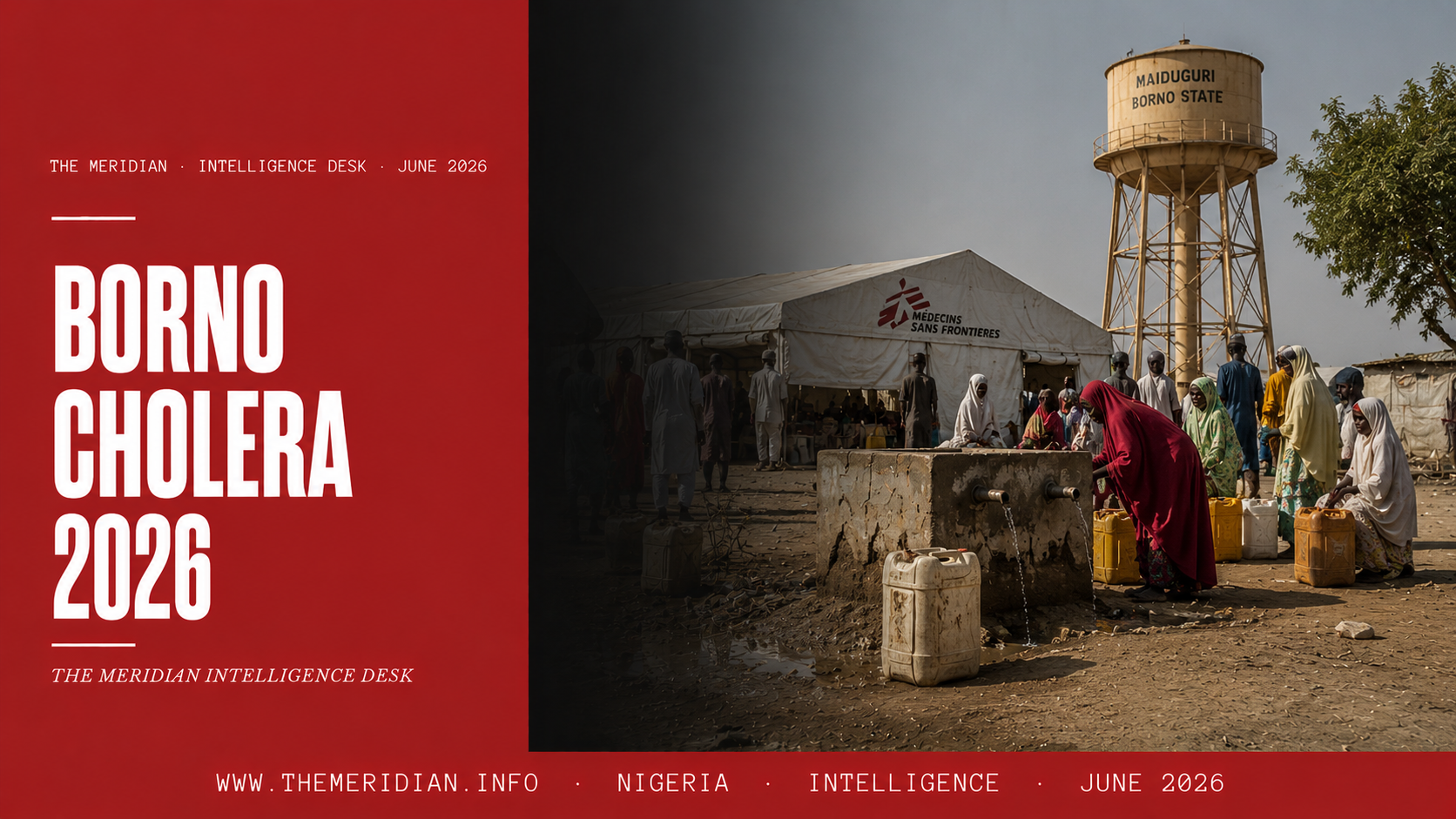
Over 4,204 suspected cholera cases and 39 confirmed deaths have been recorded in Borno State in 2026. The question dominating Nigerian search traffic is whether the outbreak is spreading to other states, particularly Kano and Lagos. But the more important question -- the one that explains why Borno is always at the epicentre of Nigeria's worst disease outbreaks -- is not about the pathogen. It is about the infrastructure. Cholera does not spread in places with clean water. It spreads in places where clean water does not exist.
Cholera is a nineteenth-century disease. It was largely eliminated from most of the world through a twentieth-century solution: clean water infrastructure. Pipe water. Sewage treatment. Protected boreholes. Basic sanitation. The countries that built these systems stopped having cholera outbreaks. The countries that did not -- or that had their infrastructure destroyed -- continue having them. Borno State's 2026 cholera crisis is not primarily a story about a bacterium. It is a story about fifteen years of conflict, the systematic destruction of public infrastructure, and the failure of both state and federal authorities to rebuild what was lost.
A case fatality rate above one per cent in a cholera outbreak is considered a public health emergency by the World Health Organisation. At 39 deaths from 4,204 suspected cases, Borno's 2026 outbreak is operating at a fatality rate that indicates severely strained healthcare capacity and delayed access to oral rehydration therapy. Cholera kills through dehydration. It is one of the most treatable diseases in medicine -- if treatment is available. When 39 people have died from a disease that is almost universally survivable with basic rehydration salts, the story is not about the disease. It is about the distance between patients and care.
Borno State is in Nigeria's northeast -- the epicentre of the Boko Haram insurgency that began in 2009 and evolved into the Islamic State West Africa Province. Over fifteen years of conflict, hundreds of clinics, boreholes, water treatment facilities, and sanitation systems have been destroyed, abandoned, or rendered inaccessible. Over two million people were displaced at the conflict's peak. Many remain in internally displaced persons camps on the periphery of Maiduguri, the state capital, where water and sanitation infrastructure is inadequate for the population density.
Vibrio cholerae -- the bacterium that causes cholera -- spreads through contaminated water and food. It does not spread through the air or through casual contact. Every cholera outbreak is therefore, at its most basic level, a water contamination event. The specific risk factors in Borno State are documentable and structural.
First, the Lake Chad basin. Borno borders Lake Chad, one of the most ecologically stressed bodies of water in the world. The lake has shrunk by approximately 90 per cent since the 1960s due to climate change, irrigation extraction, and population growth. As the lake recedes, communities that previously accessed clean water from the lake are now drawing from increasingly shallow, increasingly contaminated sources. Cholera thrives in exactly these conditions -- warm, shallow, contaminated water bodies with high population exposure.
Second, the IDP camp network. Maiduguri and its surrounding areas house some of Nigeria's largest concentrations of internally displaced persons. IDP camps, even well-managed ones, create conditions of high population density with shared water sources and shared sanitation facilities. When water source protection breaks down -- a cracked storage tank, a contaminated borehole, a broken pipe -- the speed of cholera transmission in a dense camp environment is rapid. The 2026 outbreak's trajectory through Borno's IDP-heavy areas is consistent with this mechanism.
Third, the rainy season dynamic. Cholera outbreaks in Nigeria almost always intensify during and immediately after the rainy season. Floodwater contaminates open water sources, overwhelms pit latrines, and creates the surface water conditions in which cholera spreads most efficiently. The 2026 rainy season, flagged by NiMet as above-normal in intensity, has arrived in the northeast earlier than modelled. The combination of pre-existing water source contamination and accelerated flooding is producing exactly the outbreak pattern that public health officials and humanitarian organisations predicted.
Cholera does not spread in places with clean water. It spreads in places where clean water does not exist. Borno's outbreak is not a health crisis. It is a fifteen-year infrastructure deficit with a pathogen attached.
The question being searched most urgently across Nigeria right now is whether the Borno outbreak is spreading to Kano, Lagos, and other major population centres. The analytical answer requires distinguishing between epidemic spread -- person-to-person transmission moving through a connected population -- and endemic presence, which is the baseline level of cholera that exists in Nigeria's water system regardless of any specific outbreak.
Nigeria has documented cholera cases in most of its 36 states in any given year. The disease is endemic in the country's water system. What the Borno outbreak represents is a severe acute flare in a region where the underlying risk factors are most concentrated. The risk of a similar severe flare in Kano, Lagos, or Port Harcourt depends primarily on the quality of water infrastructure in those cities -- not on direct epidemiological linkage to Borno.
Lagos is the highest-risk major city for a severe cholera event outside the northeast, not because of Borno's outbreak, but because of Lagos's own infrastructure dynamics: a metropolitan population of over 20 million, a water distribution system that serves perhaps 30 per cent of residents with piped water, and a flood season that is already producing Lekki flash floods in early June. The early rains flooding Lekki's drainage channels are the same mechanism that contaminates the open water sources used by residents without piped access.
Preventing cholera in the short term requires the same intervention it has always required: oral rehydration salts at community level, chlorination of water sources, and emergency WASH (Water, Sanitation, and Hygiene) deployment in high-risk areas. Preventing it in the medium term requires the infrastructure investment that the Ecological Fund, the counterpart of the humanitarian response cycle, is supposed to be financing. The same governance gap that explains why Nigerian communities flood every year also explains why Nigerian communities get cholera every year.
The 4,204 suspected cases and 39 deaths in Borno State in 2026 are the most visible expression of a water governance failure that exists, in varying degrees of severity, across Nigeria. Borno is at the extreme end of the spectrum because fifteen years of conflict have systematically destroyed the water infrastructure that existed, displaced the population that depended on it, and created the camp conditions in which waterborne disease spreads most rapidly.
But the underlying condition -- populations without reliable access to clean water, serviced by infrastructure that is underfunded, undermaintained, and under-audited -- is a national condition. The federal Ecological Fund distributes hundreds of billions of naira for environmental protection. The counterpart humanitarian and WASH budgets at state and federal level are substantial. The outcomes, measured in cholera case counts and flood displacement figures, are getting worse.
The cholera outbreak in Borno in 2026 is a public health emergency. It is also a political economy indictment. Every naira disbursed from the Ecological Fund, every WASH project approved and not delivered, every borehole funded and not sunk is quantifiable in the case counts coming out of Maiduguri. The pathogen is the symptom. The governance failure is the disease.
Add comment
Comments