Can the Peter Obi and Kwankwaso NDC Alliance Actually Beat Tinubu in 2027?
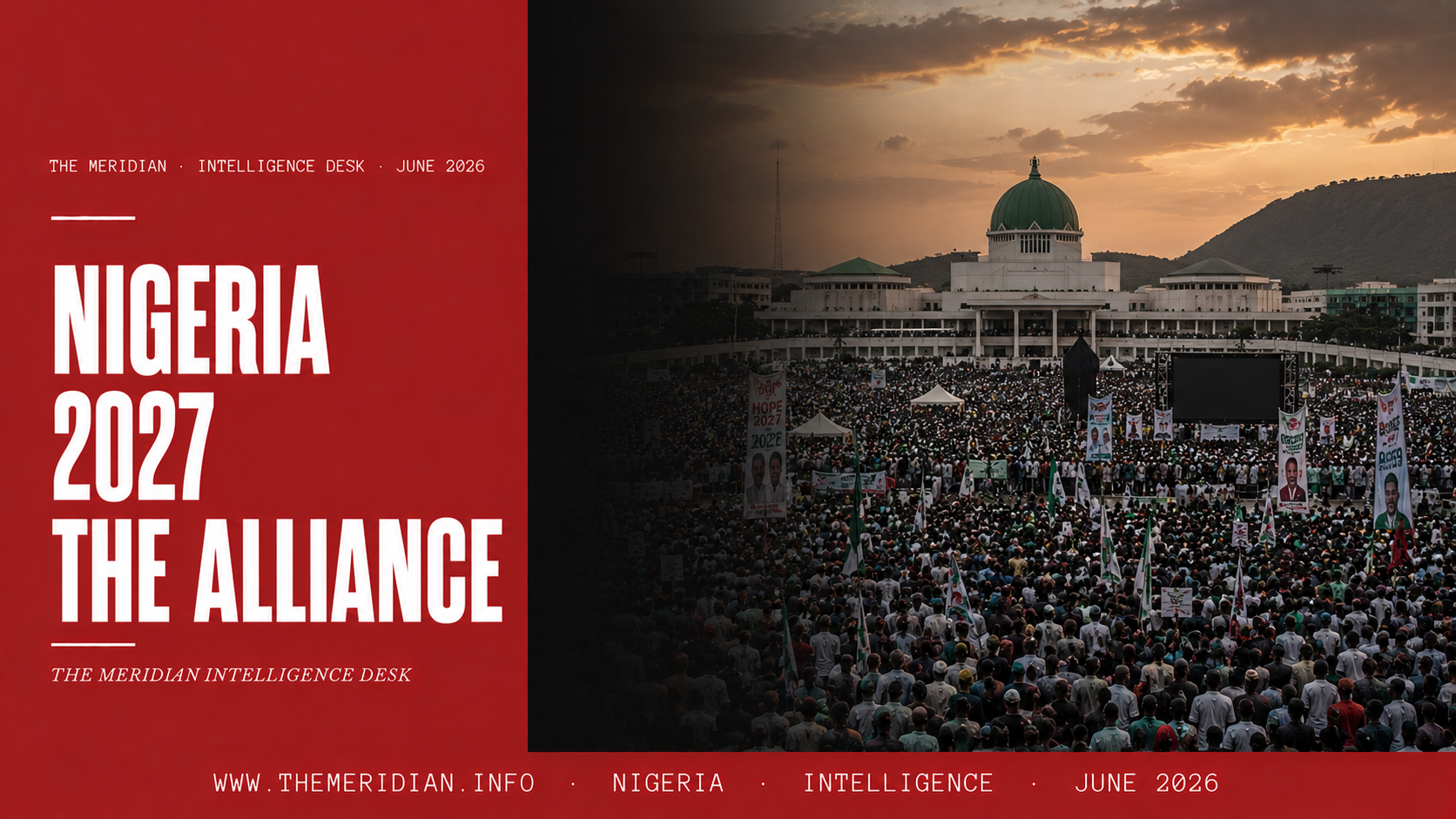
The campaign posters for a new political vehicle called the Nigeria Democratic Congress are being burnt in Kano. In Ungogo Local Government Area, supporters of an emerging Peter Obi-Kwankwaso alliance are being confronted by opponents before a single vote has been cast or a single primary conducted. The 2027 Nigerian presidential election is 18 months away. It has effectively already begun. The Meridian Intelligence Desk examines the coalition arithmetic and whether an Obi-Kwankwaso ticket can actually defeat an incumbent president with the full machinery of the state behind him.
The 2023 Nigerian presidential election produced the most fragmented result in the country's democratic history. Bola Tinubu of the APC won with approximately 37 per cent of the total votes -- the lowest winning percentage ever recorded in a Nigerian presidential election. Peter Obi of the Labour Party came second with roughly 29 per cent, drawing unprecedented support from urban, educated, and first-time voters in a pattern that disrupted decades of regional voting orthodoxy. Rabiu Kwankwaso of the NNPP secured approximately 12 per cent, concentrated overwhelmingly in Kano State where his political machine remains formidable. The combined opposition vote -- across Obi, Kwankwaso, and Atiku of the PDP -- substantially exceeded Tinubu's total. The 2027 question, which is driving search traffic across Nigeria right now, is whether that fragmented opposition can consolidate into a winning coalition.
The mathematics of a potential Obi-Kwankwaso alliance is seductive at first glance. If you simply add their 2023 vote shares together -- 29 per cent plus 12 per cent -- you get 41 per cent, which exceeds Tinubu's 37 per cent. But electoral coalitions do not work by simple addition. Voters do not automatically transfer with their candidates. The question is not whether Obi and Kwankwaso's combined voter base exceeds Tinubu's. The question is whether Obi's voters will vote for a ticket that includes Kwankwaso, whether Kwankwaso's voters will vote for a ticket that includes Obi, and whether the coalition can perform competitively in enough states to satisfy the constitutional requirement for a presidential victory.
Nigeria's constitutional threshold for a presidential victory requires not just a plurality of votes but a minimum of 25 per cent of votes in at least 24 of the country's 36 states. This geographic distribution requirement is the mechanism that forces presidential candidates to build truly national coalitions rather than winning through regional concentration. In 2023, Tinubu met this threshold partly through his strength in the southwest and his political organisation's reach into the north. Obi met it partly but not fully -- he performed exceptionally well in the southeast and in Lagos but underperformed in the north and in some Middle Belt states. Kwankwaso essentially did not meet it at all -- his vote was too concentrated in Kano to satisfy the distribution requirement.
The burning of NDC campaign posters in Ungogo LGA, Kano, is not simply political violence. It is an indication of how seriously the existing political machinery in Kano is taking the prospect of a Kwankwaso-backed NDC challenge. Kano State, with a population of over 15 million, is the single most important electoral prize in northern Nigeria. A candidate who cannot win or strongly contest Kano cannot win the presidency. Tinubu's 2023 victory was possible partly because Kwankwaso and Atiku split the Kano vote, preventing either from delivering the state decisively to the opposition.
If Kwankwaso consolidates behind a single opposition ticket -- bringing his political machine, his governorship network, and his deep roots in Kano's political culture into one vehicle -- the calculus in the north changes significantly. This is what the NDC formation is attempting. The question is whether Kwankwaso's political brand is strong enough in 2027, three years after his own 2023 campaign peaked, to deliver Kano to a ticket on which he is not the presidential candidate. Historical precedent suggests this is difficult. Nigerian political machines are highly personal -- they follow the principal figure, not the vehicle he chooses to endorse.
The 2023 opposition combined vote exceeded Tinubu's total by a significant margin. The 2027 question is whether Nigeria's most consequential political alliance can be built from two leaders whose egos, regional bases, and political styles have more differences than similarities.
Peter Obi's 2023 campaign generated something genuinely new in Nigerian politics: an urban, educated, cross-ethnic coalition of young voters who identified with the "Obidient" movement more as a civic awakening than as a conventional political campaign. This coalition was real, it was motivated, and it produced a second-place finish in a three-horse race -- a result that would have been considered impossible twelve months before the election.
But the Obi coalition has structural limitations that a 2027 campaign needs to address. Its strength is concentrated in the southeast (Obi's home region), in Lagos, and in other major urban centres. Its weakness is in the rural north, in the Middle Belt swing states, and in the southwest, where Tinubu's APC has deep organisational roots and where Yoruba political solidarity provided a significant bloc in 2023. A coalition between Obi and Kwankwaso is explicitly designed to address these limitations -- Kwankwaso's northern base complementing Obi's southern and urban strength.
The complication is that the two men nearly formed an alliance in 2023 and ultimately could not agree on terms -- specifically on who would be presidential candidate and who would be running mate. The same negotiation will need to be conducted for 2027, under greater political pressure and with higher stakes. Both men have significant egos, significant followings, and significant grounds for believing they should be the senior partner. Whether the NDC formation represents a genuine resolution of that tension or a temporary alignment that will fracture under pressure is the central uncertainty in Nigerian opposition politics heading into 2027.
Any analysis of the 2027 opposition's prospects must be honest about what incumbency means in Nigerian politics. A sitting president commands the federal security apparatus, the allocation of federal contracts and appointments, and the informal pressure mechanisms that shape the behaviour of state governors, local government chairmen, and party officials across the country. The APC's organisational infrastructure, combined with the resources of incumbency, represents a formidable structural advantage.
There is also the economic variable. If Tinubu's reforms -- the fuel subsidy removal, the naira floatation, the minimum wage increase -- begin to produce visible improvements in living standards between now and February 2027, the electoral landscape shifts in his favour. If inflation remains elevated, the naira continues to depreciate, and the poverty rate remains at 63 per cent, the economic conditions favour the opposition. The economy, more than any coalition arithmetic, may be the determining factor.
Can a Peter Obi and Kwankwaso NDC alliance beat Tinubu in 2027? The answer, based on 2023 vote arithmetic and 2026 political conditions, is: yes -- but only under specific conditions that are not yet met and may not be met.
The conditions are these: the two men must formally agree on a ticket and a division of political labour without the negotiation collapsing as it did in 2023. Kwankwaso's machine must deliver a substantial Kano vote to a ticket on which he is not the presidential candidate. Obi's urban coalition must hold and expand into swing states. The PDP must not field a competitive candidate that splits the opposition vote again. And the NDC as a new political vehicle must survive the legal challenges that any serious opposition party in Nigeria will face from the moment it registers.
The poster burnings in Ungogo tell you that the alliance is being taken seriously by the people who have the most to lose from it. That is not nothing. But being taken seriously by your opponents and actually winning a presidential election in Nigeria are separated by a very large distance -- a distance measured in coalition discipline, legal resilience, and a national organisation capable of delivering votes in 24 states. The NDC is at the beginning of that journey. Whether it completes it is the defining political story of the next 18 months.
Add comment
Comments