Colombia Runoff 2026: What the Right Turn Means for Latin America
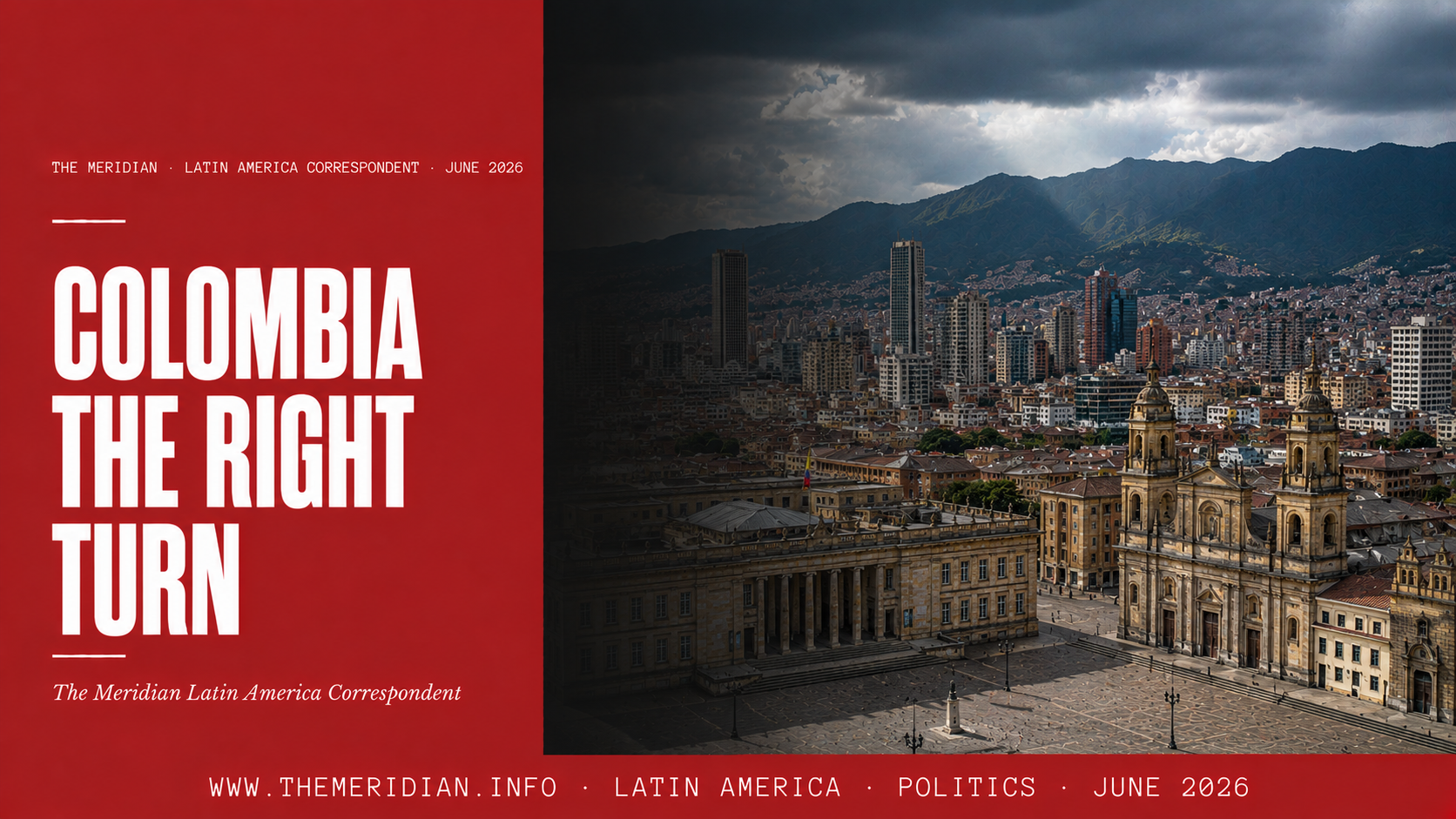
On 31 May 2026, Colombia held the first round of its presidential election. Far-right outsider Abelardo de la Espriella secured 43.7 per cent. Leftist senator Iván Cepeda, representing outgoing President Gustavo Petro's Historic Pact, took 40.9 per cent. The June 21 runoff will determine more than Colombia's presidency. It will determine whether the Latin American political realignment that began with Jair Bolsonaro's election in Brazil and accelerated through Argentina's adoption of Javier Milei's libertarian shock therapy has now reached the continent's fourth-largest economy. The Meridian Latin America Correspondent examines what both outcomes mean for the region.
The first-round result was closer than most pre-election surveys projected. De la Espriella, a millionaire criminal attorney styling himself as a tough-on-crime political outsider and campaigning under the persona "El Tigre," was expected to lead but not by the margin he achieved. The 2.8 percentage point gap is narrow enough to make the runoff genuinely competitive. But the underlying dynamics -- an electorate exhausted by domestic insecurity, a progressive administration whose flagship peace policy has been structurally compromised, and a challenger whose biography contains geopolitical contradictions that complicate his relationship with Washington -- make this one of the most analytically complex elections in recent Latin American history.
Iván Cepeda was the primary architect of outgoing President Gustavo Petro's "Total Peace" framework -- the most ambitious effort in Colombian history to substitute military action with diplomacy when dealing with the ELN guerrillas, FARC dissidents, and organised paramilitary structures. The policy represented a genuine ideological departure from the militarised security model that had dominated Colombian governance since the Uribe era. It also, structurally, failed in ways that have handed De la Espriella his campaign.
The core problem with Total Peace was not the diplomatic intent but the institutional execution. Criminal syndicates systematically exploited state ceasefires to consolidate territorial control, expand illegal mining operations, and bolster illicit revenue streams. The result was that kidnapping reached its highest levels in nearly a decade during the Petro administration -- a metric that resonates viscerally with an electorate that measures security not in policy frameworks but in the safety of its own roads, schools, and marketplaces. De la Espriella has made this failure the centrepiece of his campaign, and the first-round result suggests it has worked.
Citizens who feel physically unsafe in their own municipalities will reject long-term socioeconomic restructuring in favour of the immediate, forceful restoration of state order. Colombia's first round is the clearest demonstration of this dynamic in the region since Bolsonaro's 2018 victory.
Cepeda's challenge in the runoff is to make the case that the security deterioration under Total Peace was the product of implementation failures rather than structural unsoundness -- and that abandoning diplomacy entirely in favour of De la Espriella's militarised approach will reproduce the cycle of repression and re-emergence that characterised the pre-Petro era. Whether a 40.9 per cent first-round result gives him the political capital to make that argument convincingly against a 43.7 per cent challenger is the central question of the next three weeks.
Continuation of Petro's suspension of new oil and gas exploration contracts. Capital directed toward agriculture, digital innovation, and green industrialisation. Oil sector contracted 4% in 2025. Short-term fiscal pain in exchange for long-term structural diversification away from raw commodity dependency. This is the model The Meridian has documented in Ethiopia -- deliberate structural investment over extractive windfall.
Immediate resumption of hydrocarbon exploration contracts. Rolling back of climate-centric corporate regulations. Aggressive courting of foreign direct investment into mining and energy. Short-term macroeconomic stabilisation through dollarised royalties. The same enclave economics model The Meridian has documented across West and Central Africa -- growth concentrated in offshore extraction that never diffuses into the domestic working class.
The economic choice is structurally significant beyond Colombia's borders. Petro's green transition experiment was being watched across Latin America as a test of whether a major hydrocarbon producer could deliberately engineer its own energy transition through state policy. The experiment has been economically jarring -- the oil sector's 4 per cent contraction in 2025 contributed to capital flight concerns and a widening fiscal deficit -- but it was also genuinely novel. A De la Espriella victory would terminate the experiment and return Colombia to the extractive model that has characterised most of the region's development trajectory since independence.
The most analytically striking element of the Colombian runoff is the geopolitical contradiction embedded in De la Espriella's biography. A right-wing, pro-extraction candidate in Bogotá would, in conventional regional analysis, be welcomed unconditionally by Washington as a bulwark against the leftist governments in Caracas, Havana, and Mexico City. De la Espriella presents a profound complication to this framework.
Before his political emergence, De la Espriella built his legal fortune representing highly controversial figures. Most significantly, he served as the defence attorney for Álex Saab -- the Colombian businessman identified by US intelligence as the primary financial frontman for Nicolás Maduro's regime in Venezuela, responsible for managing the international financial network that enabled the Maduro government to evade American sanctions. Saab was arrested in Cape Verde in 2020 and extradited to the United States in 2021 on money laundering charges.
This creates a structural contradiction that Washington cannot easily resolve. A De la Espriella administration would officially adopt a hardline, antagonistic rhetorical stance toward Caracas to satisfy his conservative base. Yet his historical ties to the very financial architects of the Maduro sanctions evasion network make US intelligence agencies deeply suspicious of his ultimate loyalties and policy intentions. Rather than seamlessly integrating into American regional security frameworks, a De la Espriella presidency may find itself subject to elevated scrutiny from the State Department and intelligence community -- an irony that few right-wing Latin American electorates have previously had to navigate.
If De la Espriella wins on 21 June, it will consolidate a regional pattern that began in Brazil, accelerated through Argentina, and has now reached Colombia. The electorate's willingness to abandon progressive economic restructuring in exchange for heavy-handed security is not irrational -- it is the rational response of populations whose lived experience of the Pink Tide included genuine macroeconomic ambition alongside genuine deterioration in physical safety. The structural limits of the left's recent regional ascendancy were always embedded in its inability to deliver security alongside social programmes.
If Cepeda wins, the narrow margin of victory will constrain his mandate severely. A 40.9 per cent first-round result governing against a 43.7 per cent challenger is not a mandate for deeper structural reform. It is a survival result that buys time without providing the political capital to implement the green transition at the speed and scale the Petro administration originally envisioned.
Colombia on 21 June is not simply choosing between two candidates. It is choosing between two models of development, two theories of security, and two visions of how a medium-sized Latin American economy relates to the global capital architecture. The Meridian will publish full result analysis within hours of the official count. Whatever the outcome, the Andes will not look the same on 22 June as they do today.
Add comment
Comments