Three Years of Tinubu: What the Economic Numbers Actually Show
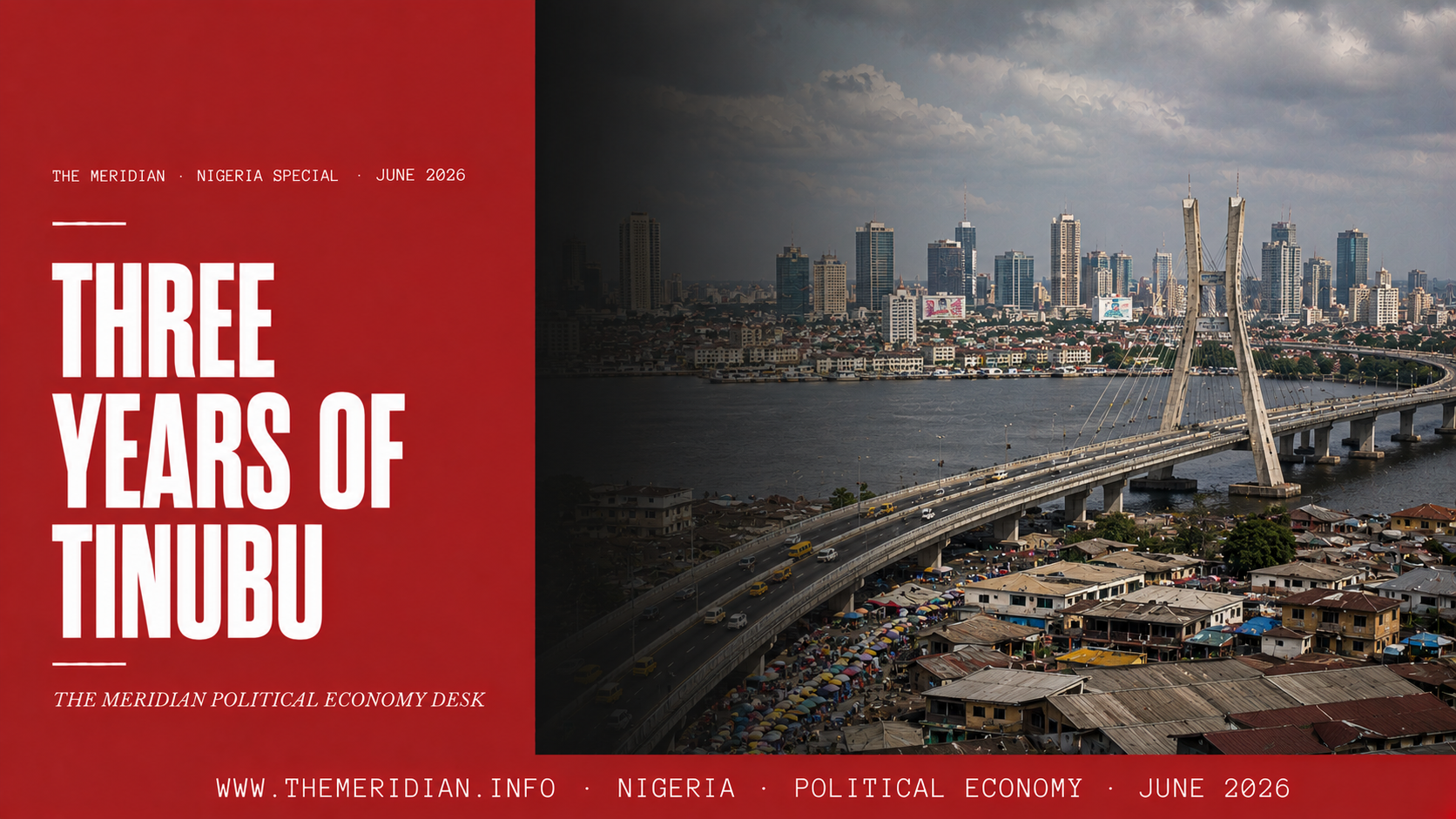
On 29 May 2023, President Bola Ahmed Tinubu uttered the four words that immediately rewired Africa's largest economy: "The fuel subsidy is gone." Coupled with the aggressive floating of the naira, the administration gambled that overwhelming short-term shock therapy would yield long-term macroeconomic salvation. Three years on, the data from the National Bureau of Statistics, the World Bank's April 2026 Development Update, and the Central Bank of Nigeria provide a conclusive, forensic verdict on that gamble. The Meridian Political Economy Desk publishes the full report card.
The administration's economic architects are pointing to returning GDP growth, halved inflation, and a domestic refining renaissance as evidence that the shock therapy has worked. They are not wrong about the metrics. Real GDP grew by 3.89 per cent year-on-year in the first quarter of 2026. Headline inflation has fallen from its 34.80 per cent peak in late 2024 to approximately 15.15 per cent. The Dangote Refinery has surpassed 700,000 barrels per day and Nigeria is now exporting aviation fuel to European markets. The sovereign credit rating has been upgraded. By the strict metrics of the International Monetary Fund and international creditors, the balance sheet has been stabilised. But macroeconomic compliance is not sovereign development. The World Bank's April 2026 Development Update confirms that 63 per cent of the Nigerian population -- approximately 140 million people -- now live below the poverty line. The ledger is healthier. The citizens are not.
The disconnect between the GDP growth headline and the poverty rate is the central analytical paradox of the Tinubu administration. Cross-referencing the NBS's 3.89 per cent growth figure against the World Bank's 63 per cent poverty assessment produces what the research literature calls structural misalignment: growth that is statistically real and practically invisible to the majority of the population. The GDP expansion is highly concentrated in isolated sectors -- financial services, telecommunications, elite retail, and the domestic refining enclave -- that employ only a fraction of Nigeria's labour force. Agriculture, which employs over a third of the national workforce and is the primary income source for the majority of the country's poor, has stagnated. The wealth generated at the top of the sectoral distribution is almost entirely insulated from the working class. The 3.89 per cent growth figure is accurate. For the average Nigerian, it is a localised illusion.
The administration's most fiercely defended metric in 2026 is the inflation trajectory. After peaking at 34.80 per cent in late 2024, headline inflation fell to approximately 15.15 per cent by December 2025 and has continued to ease into 2026. This is a genuine macroeconomic achievement -- containing inflation from a near-hyperinflationary trajectory is a significant stabilisation. The administration is entitled to point to it.
What the administration cannot point to is the household balance sheet beneath the inflation headline. Disinflation does not mean prices are falling. It means they are rising more slowly. The cumulative damage inflicted on Nigerian household purchasing power between May 2023 and December 2025 is permanent. The naira, which traded at approximately N460 per dollar before Tinubu took office, now sits in a stabilised market band of N1,410 to N1,540 per dollar. This currency collapse -- exceeding 55 per cent of the naira's pre-administration value -- functioned as a massive, regressive wealth transfer. It permanently wiped out the middle class's ability to access imported essentials, private healthcare, and higher education. It raised the naira cost of every fuel-dependent good and service -- which in a country without reliable public transport means almost every good and service -- by the equivalent of the currency depreciation.
The government successfully eliminated the parasitic FX arbitrage that defined the Buhari years. The cost of that institutional correction was entirely outsourced to the working class, whose incomes never grew fast enough to offset the initial triple-digit percentage increase in the cost of living.
The N18.4 billion per day in fuel subsidies that Tinubu eliminated on his first day in office was genuinely unsustainable. The subsidy system was corrupt, regressive in its distribution, and a fiscal haemorrhage that was consuming resources Nigeria could not afford to spend. The administration was right to remove it. What it failed to do -- what distinguishes a stabilisation that reaches the working class from one that does not -- was implement the compensatory social protection mechanisms that would have shielded the poorest Nigerians from the cascading price shock. The subsidy was removed. The naira was floated. The compensation never arrived at sufficient scale.
The undeniable bright spot of the Tinubu era is not a government infrastructure project but a private sector industrial achievement. The Dangote Petroleum Refinery has surpassed its 650,000 barrel per day nameplate capacity and is processing 700,000 barrels per day as of June 2026. Nigeria has transitioned from chronic fuel scarcity -- a humiliation that saw Africa's largest oil producer importing its own refined petroleum -- to absolute fuel abundance. The refinery is now exporting aviation fuel to European markets and has stabilised the Central Bank's foreign exchange reserves sufficiently to trigger a sovereign credit rating upgrade from S&P Global.
These are genuine structural achievements. Ending the import dependency on refined petroleum removes a permanent drain on Nigeria's foreign exchange reserves and breaks one of the most damaging cycles in the country's economic history. The Meridian acknowledges this without reservation.
The structural question -- which we have asked about Dangote's merchant refining model in our African Oil Moment analysis -- is whether the facility breaks the enclave economy or relocates it. The refinery is housed within the Lekki Free Zone, processes global crude grades including US WTI Midland and Middle Eastern streams under a "fully merchant refining model," and has consolidated absolute downstream pricing power into a single corporate entity. The working class is no longer paying foreign import prices for petrol. It is now dependent on the operational decisions of a single domestic corporation functioning as a heavily protected national monopoly. The structural vulnerability has been transformed, not eliminated. And for 140 million Nigerians below the poverty line, the distinction between a foreign monopolist and a domestic one is secondary to the price at the pump.
The Tinubu administration inherited an economy on fiscal life support and performed the necessary, brutal surgery. The sovereign debt loop was managed. The parasitic FX subsidies were dismantled. Domestic refining capacity was brought online. By the metrics that international creditors and rating agencies use to assess macroeconomic competence, the administration has delivered a credible stabilisation.
But stabilising the sovereign ledger is not the same as developing the nation. The Tinubu doctrine has proven that a state can achieve macroeconomic compliance -- can impress the IMF, secure GDP growth, and earn a credit rating upgrade -- while simultaneously pushing 140 million of its citizens deeper into poverty. The poverty rate rose from 56 per cent to 63 per cent over three years of positive GDP growth. That is not a rounding error. That is a structural indictment of a growth model that generates wealth in enclaves and distributes the cost of stabilisation across the working class.
A 63 per cent poverty rate is not merely a humanitarian crisis. It is a macroeconomic risk. A nation cannot tax, industrialise, or build a resilient domestic market when 140 million of its citizens lack the disposable income to participate in the economy. Until the Tinubu administration pivots from a ledger-first doctrine to one centred on agricultural modernisation, localised job creation, and wage growth that keeps pace with the cost of living, Democracy Day will remain a celebration for the markets -- and a day of reckoning for the masses.
Add comment
Comments