From Wellhead to Pump: The Complete Value Chain
Between the geological accident that created oil and the moment a consumer pays for it at the pump lies one of the most complex and deliberately opaque value chains in the global economy. At every stage, margin is captured. At every stage, someone profits. The question is who, and how much.
The barrel of oil that arrives at a refinery in Rotterdam has already passed through many hands. It was extracted from a reservoir two or three kilometres beneath the surface by a drill bit attached to a string of steel pipe, lifted to the surface by the pressure of the formation itself or by artificial lift mechanisms, gathered through a network of flowlines to a processing facility, separated from the water and gas that accompany it from the reservoir, measured, tested for quality, and pumped into a pipeline or loaded onto a tanker. None of this is simple or cheap. And none of it, in the eyes of the consumer who eventually buys the petrol, diesel or aviation fuel that the barrel ultimately becomes, is visible.
The oil value chain is long, capital-intensive and structured in ways that systematically advantage those who control the chokepoints. Understanding it is not a technical exercise. It is a political one. The distribution of profit along the chain, from the wellhead where crude is produced to the pump where it is consumed, reflects not the competitive allocation of returns to productive activity but the accumulated power of those who control the infrastructure, the information and the institutional arrangements at each stage.
The upstream segment of the oil industry covers everything from exploration to the point at which crude oil or natural gas reaches the surface. It is the segment most people associate with the industry: the drilling rig, the pump jack, the offshore platform. It is also the segment with the most variable economics, because the cost of producing a barrel of oil differs enormously depending on the geology of the reservoir, its depth, its location and the maturity of the surrounding infrastructure.
A barrel of Arab Light crude produced in Saudi Arabia by Saudi Aramco costs roughly two to four dollars to lift from the reservoir, process at surface and deliver to the export terminal. A barrel of oil sands bitumen produced in Alberta costs between twenty and thirty dollars to extract, upgrade and transport to a refinery. A barrel of deepwater crude produced from a subsalt reservoir offshore Brazil may cost forty to sixty dollars to produce, when the full capital cost of the floating production vessel is accounted for. These differences in production cost are the foundational economic reality of the industry: they determine which producers survive periods of low prices, which ones require sustained high prices to remain economically viable, and which ones set the floor beneath which the global price cannot sustainably fall.
The lowest-cost producers capture rent simply by existing. Their geological inheritance is a perpetual competitive advantage that no amount of innovation elsewhere in the chain can eliminate.
The upstream segment is dominated by two types of actor: national oil companies and international oil majors. National oil companies, including Saudi Aramco, the National Iranian Oil Company, Iraq National Oil Company, Abu Dhabi National Oil Company and Kuwait Petroleum Corporation, control the majority of the world's proven reserves and produce the majority of global output. They operate under state mandate, often with social and political obligations that complicate purely commercial decision-making, and their production costs are generally low because their reserves are geologically favourable. International oil majors, including Shell, ExxonMobil, BP, TotalEnergies and Chevron, operate across multiple geographies, often in technically challenging environments, and have progressively ceded access to the most attractive reserves as producing states nationalised their resources through the 1960s and 1970s.
Once crude oil reaches the surface and passes initial processing, it enters the midstream: the network of pipelines, tankers, terminals and storage facilities that move it from producing regions to consuming ones. The midstream is less glamorous than upstream exploration and less visible than downstream retail, but it is arguably the most strategically significant segment of the chain. Whoever controls the infrastructure through which oil must pass controls, to a meaningful degree, the economics of everyone upstream and downstream of them.
Pipelines are the most capital-intensive and geographically fixed element of midstream infrastructure. A pipeline, once built, determines the flow of oil for decades. Its routing reflects the political geography of the moment it was constructed as much as the logistics of moving crude efficiently: the routes chosen for pipelines from Central Asia, from the Caspian basin, from the Kurdish regions of Iraq, have all been determined as much by the geopolitical interests of the states through whose territory they pass as by the engineering requirements of the infrastructure itself. States that control pipeline routes capture transit fees and, more importantly, hold leverage over both the producers who need to export and the consumers who need to import.
Maritime transport carries roughly two thirds of globally traded crude oil. The tanker market is one of the most volatile in the world: freight rates can swing by several hundred per cent within weeks, depending on the balance between vessel supply and cargo demand. This volatility is itself a source of profit for those who understand it. The commodity trading houses that dominate physical oil trading also play the tanker market: chartering vessels when rates are low, fixing cargo movements to exploit rate differentials, and sometimes owning fleets outright to capture the transport margin directly rather than paying it to independent shipowners.
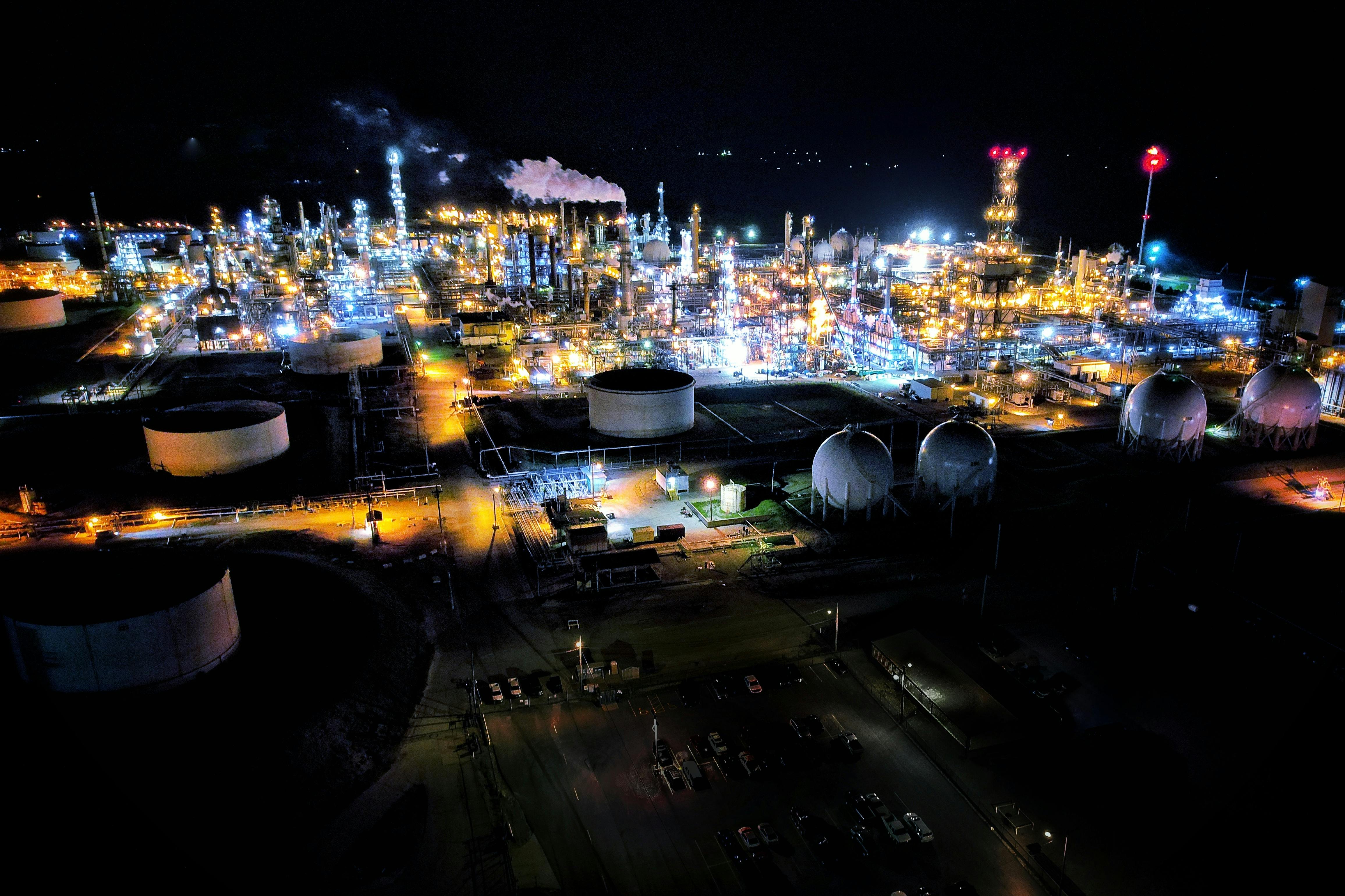
Crude oil in its raw form has no direct use. It must be refined, subjected to physical separation, chemical conversion and treating processes, before it becomes the products that consumers and industries actually require. Refining is where crude oil is transformed into gasoline, diesel, jet fuel, fuel oil, liquefied petroleum gas, naphtha, bitumen, lubricants and a range of petrochemical feedstocks. It is also where the chemical characteristics of a crude, including its density, its sulphur content and its distillation profile, translate into commercial value or discount.
The basic refining process begins with atmospheric distillation: heating crude oil and separating its components by boiling point. The lightest fractions, including propane, butane and naphtha, come off the top of the distillation column. The heaviest fractions, including fuel oil and bitumen, remain at the bottom. The middle distillates, principally kerosene, diesel and jet fuel, occupy the economically most valuable portion of the barrel in most market conditions. A simple distillation refinery, sometimes called a hydroskimming refinery, can separate crude into these fractions but cannot convert the heavy residual material into lighter, more valuable products. It is therefore limited in the value it can extract from each barrel and heavily dependent on finding buyers for its fuel oil output.
More complex refineries add conversion units: fluid catalytic crackers, hydrocrackers and cokers that break down heavy molecules into lighter, more valuable ones. A complex refinery with full conversion capability can extract significantly more value from each barrel of crude, particularly from heavy or sour crudes that carry quality discounts. This complexity gap between simple and complex refineries is itself a structural feature of the value chain: simple refineries, often located in developing countries, process crude and sell products at thin margins; complex refineries, concentrated in the United States, Western Europe and increasingly in Asia, capture a larger share of the value embedded in each barrel.
Refining complexity is a structural barrier to entry. Nations without it process crude for others. Nations with it capture the conversion margin for themselves.
The refinery margin, which is the difference between the value of the products a refinery produces and the cost of the crude it processes, is the fundamental measure of refining economics. It fluctuates with both crude prices and product prices, and it varies significantly by refinery configuration and location. In periods of tight product supply, refinery margins can expand dramatically, rewarding those who own complex, well-located refining capacity. In periods of oversupply, margins compress and marginal refineries, typically those that are older, simpler and less well-positioned, are forced to reduce runs or shut down entirely.
The downstream segment covers the distribution of refined products from the refinery gate to the end consumer. It includes product pipelines, storage terminals, wholesale distribution networks, retail fuel stations and the commercial and industrial supply chains that deliver aviation fuel to airports, diesel to power generators and fuel oil to shipping operators. It is the segment closest to the consumer and the one most directly visible in the form of the petrol station forecourt.
The retail margin — the difference between the wholesale price of fuel and the price paid by the motorist at the pump — is the most politically visible element of the entire value chain. Governments in most countries layer significant taxation on top of the wholesale price: fuel duty, value added tax, carbon levies and various other charges that can represent fifty per cent or more of the final pump price in high-tax jurisdictions. In lower-income countries, governments often apply the reverse logic: subsidising fuel prices to keep them below the market-clearing level, at significant fiscal cost.
Mauritius sits in this second category. The State Trading Corporation purchases petroleum products on international markets and does not operate its own refinery. It sells them domestically at regulated prices. The price structure includes a cross-subsidy mechanism funded by a levy applied to certain fuel grades and used to subsidise others, as well as the prices of basic goods including flour, rice and liquefied petroleum gas. The fiscal cost of this mechanism fluctuates directly with global crude and product prices. When Brent rises, the subsidy bill rises. When product freight rates spike, as they did during the Red Sea disruptions of 2024, the landed cost of imports rises independently of the crude price, adding a further layer of cost that the domestic price structure must absorb or transmit.
Mapped across the full length of the value chain, the distribution of margin reveals a clear structural pattern. The producing states with the lowest-cost reserves capture the largest resource rent per barrel: the difference between the two-dollar lifting cost of Arabian crude and the eighty-dollar market price is fundamentally a geological rent, captured by the state that owns the resource. The trading houses capture the arbitrage margin: the difference between what crude costs in one market and what it can be sold for in another, accounting for transport, insurance and quality adjustment. The complex refiners capture the conversion margin: the difference between the value of the products they produce and the cost of the crude they process. The retailers capture the distribution margin, supplemented or reduced by government taxation policy.
At the end of this chain, the consumer pays the sum of all these margins plus the taxes their government applies. The consumer has no visibility into how the price was constructed, no leverage over any of the actors who determined it, and no alternative in most cases but to pay. This is the fundamental political economy of the oil value chain: value is created at the geological level and captured progressively at each subsequent stage by whoever controls the relevant chokepoint. The consumer at the pump is the last in a long line of payers, and the first to be blamed when prices rise.
Add comment
Comments