Hantavirus: What the Media Is Not Telling You About the MV Hondius Outbreak
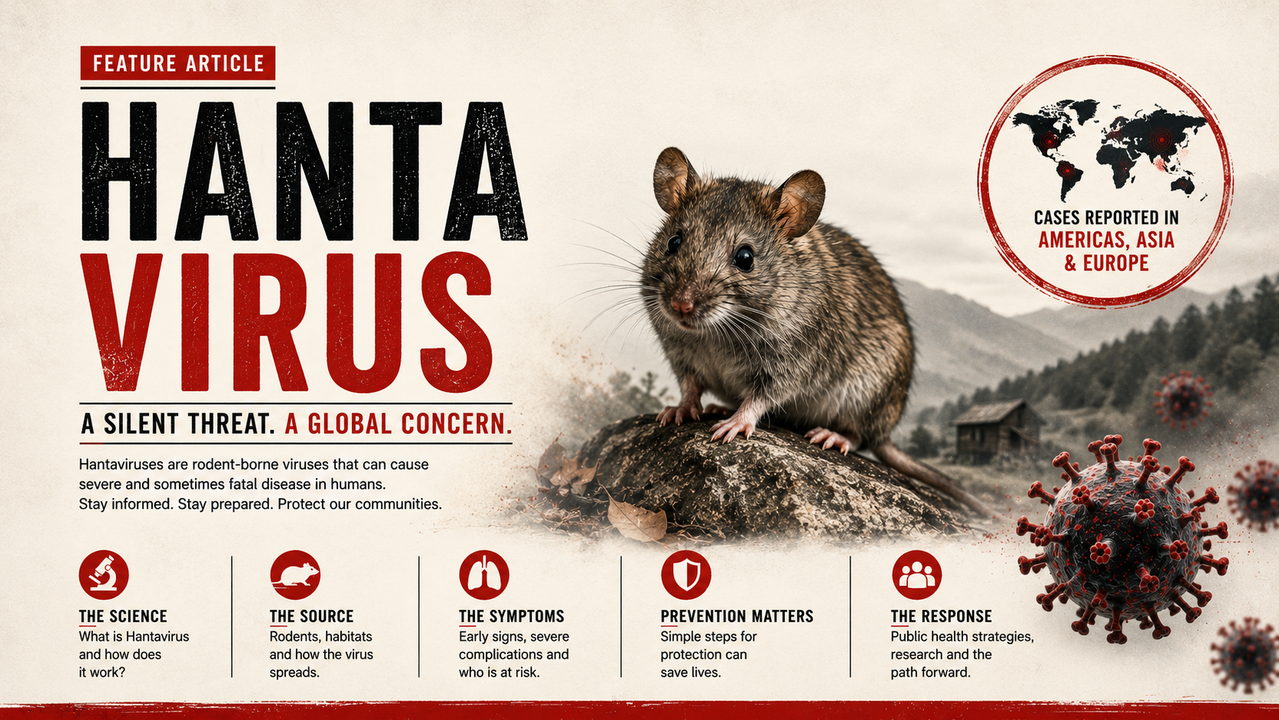
A Dutch-flagged cruise ship. Three dead. Nine infected across twenty-three nationalities. The virus: Andes hantavirus, the only strain known to transmit between humans. The mainstream media has reported the facts but not the context. The Meridian publishes the complete public awareness briefing covering history, science, symptoms, treatment, consequences and the precautions that every person should know.
On 2 May 2026, the World Health Organisation received notification from the United Kingdom of a cluster of severe acute respiratory illness aboard the MV Hondius, a Dutch-flagged cruise ship operating in the South Atlantic. By 6 May, the WHO had confirmed the cause: Andes virus, a strain of hantavirus native to South America and the only member of the hantavirus family with documented capacity for human-to-human transmission. By 11 May, nine cases had been confirmed or suspected, three people were dead, and passengers from twenty-three nationalities had disembarked in Tenerife to return to their home countries across Europe, North America and beyond. The WHO assessed global public risk as low. That assessment is correct. But low risk for the world does not mean no risk for individuals, and the mainstream media's coverage of this outbreak has been heavy on the numbers and light on the information that actually matters to people who want to understand what hantavirus is, where it came from, what it does to the human body and how to protect against it.
WHO / ABC News, 11 May 2026
WHO DON599, ECDC
ECDC assessment, 6 May 2026
Above historical HPS average of 38%
History of hantavirus discovery Korea China 1950s origins
Hantavirus is not a new pathogen. The disease it causes has been documented in human populations for far longer than its formal scientific identification, and its history illuminates both the nature of the current outbreak and the reasons why the public understanding of it remains so limited.
The earliest recorded descriptions of what is now recognised as haemorrhagic fever with renal syndrome, one of the two major clinical syndromes caused by hantavirus, appear in Chinese medical literature dating to approximately 960 CE, during the Song Dynasty. The texts describe a disease characterised by fever, bleeding and kidney failure, which is the precise clinical picture of hantavirus haemorrhagic fever. The condition was known in China for centuries before Western medicine encountered it.
The modern scientific story begins in the early 1950s, during the Korean War. Between 1951 and 1954, more than 3,000 United Nations troops, predominantly American soldiers, developed a severe and mysterious illness characterised by fever, haemorrhage and acute kidney failure. Approximately 12 per cent of those who developed the full syndrome died. The disease was initially called Korean haemorrhagic fever and later epidemic haemorrhagic fever. It baffled military physicians because no known pathogen could explain its pattern of transmission, which appeared connected to exposure to the Korean countryside and fields rather than to other infected people.
The formal identification of the virus came in 1978, when Korean scientist Ho Wang Lee and his colleagues isolated the causative agent from the striped field mouse, Apodemus agrarius, near the Hantan River in South Korea. They named it Hantaan virus, after the river. It was the first member of what would become a large and geographically diverse family of rodent-borne viruses, subsequently named hantaviruses after the founding member.
How hantavirus spreads transmission rodent urine faeces aerosol
Hantaviruses are RNA viruses belonging to the family Hantaviridae. Each strain is carried by a specific rodent host species, in which the virus causes persistent infection without making the animal visibly ill. The rodent sheds the virus in its urine, faeces and saliva, sometimes for its entire life. The primary route of human infection is inhalation of aerosol particles contaminated with these excretionsFor example, when dried rodent droppings are disturbed during cleaning, when grain is handled in storage areas frequented by rodents, or when enclosed spaces containing rodent nests are entered without adequate ventilation.
The Andes virus, which is responsible for the MV Hondius outbreak, is carried primarily by the long-tailed pygmy rice rat, Oligoryzomys longicaudatus, found across Argentina, Chile and adjacent parts of South America. What distinguishes the Andes strain from virtually all other hantaviruses is its documented capacity for human-to-human transmission. In outbreaks of Andes virus haemorrhagic fever, close contacts of patients, particularly sexual partners and household members, have developed the disease without any rodent exposure. Healthcare workers have also been infected when caring for patients without adequate personal protective equipment. This characteristic makes the Andes strain a qualitatively different public health concern from other hantaviruses, and it is the feature of the current MV Hondius outbreak that justifies the elevated international response.
The Andes strain is the only hantavirus known to pass between humans. This is not a minor technical distinction. It is the difference between a disease that requires rodent contact and one that can spread in a closed environment among people with no rodent exposure whatsoever.
Hantavirus symptoms hantavirus pulmonary syndrome HPS stages progression
Hantavirus pulmonary syndrome, the clinical form caused by Andes virus and the American hantavirus strains, progresses through distinct phases that can move from mild to life-threatening within 24 to 48 hours. Understanding this progression is essential because the window for effective intervention is narrow and the early symptoms are deceptively non-specific.
The incubation period ranges from one to eight weeks following exposure, though most cases develop symptoms within two to four weeks. During incubation the infected person feels entirely well. There are no symptoms, no warning signs and no way to identify infection without laboratory testing.
The early phase lasts three to five days and presents with symptoms that are easily confused with influenza or gastroenteritis: fever, severe muscle aches particularly in the thighs, hips and back, fatigue, headache, dizziness and chills. Gastrointestinal symptoms including nausea, vomiting, diarrhoea and abdominal pain are present in approximately half of cases and are more prominent in hantavirus pulmonary syndrome than in influenza. There is typically no cough or sore throat in the early phase.
The late phase is the medical emergency. Appearing as early as four days after symptom onset, it is characterised by the sudden development of shortness of breath as fluid accumulates in the lungs. This progression can be extraordinarily rapid, ranging from mild breathlessness to complete respiratory failure requiring mechanical ventilation within hours. The mechanism is not pneumonia in the conventional sense but a profound leakage of fluid from blood vessels into the lung tissue, causing what clinicians call non-cardiogenic pulmonary oedema. Simultaneously, blood pressure may fall, heart rhythm may become unstable, and the patient may develop shock. The case fatality rate for those who reach this late phase is approximately 38 per cent globally, but the current MV Hondius outbreak has seen a fatality rate of 60 per cent among confirmed cases, which is above the historical average, likely reflecting the severity of the particular Andes strain involved and the challenges of early diagnosis in a shipboard setting.
If you have had any potential rodent exposure in the past eight weeks, or were aboard the MV Hondius or in contact with someone who was, and you develop any of the following: fever combined with severe muscle aches, unexplained fatigue, or any shortness of breath, seek emergency medical care immediately and inform the treating clinician of your potential exposure. Do not wait for symptoms to worsen. The window for effective intervention is short.
If you were a passenger or crew member of the MV Hondius, contact your local health authority immediately and follow the 45-day monitoring protocol recommended by public health agencies.
Hantavirus treatment ECMO ICU survival rate no vaccine no antiviral
There is no approved vaccine for hantavirus in Western countries as of 2026. China has developed and approved a bivalent vaccine providing protection against Hantaan and Seoul viruses, the strains responsible for haemorrhagic fever with renal syndrome, but this vaccine offers no protection against Andes virus or the American strains causing pulmonary syndrome. Research into hantavirus vaccines is ongoing but no candidate has reached the approval stage in Western regulatory systems.
There is no specific antiviral treatment for hantavirus pulmonary syndrome. Ribavirin, an antiviral drug, has been evaluated in clinical trials for hantavirus haemorrhagic fever and shown some benefit when given early, but has not demonstrated consistent efficacy against hantavirus pulmonary syndrome. Treatment is therefore entirely supportive, which means keeping the patient alive through the critical phase while the immune system fights the infection.
The critical intervention that has most dramatically changed survival outcomes is extracorporeal membrane oxygenation (ECMO), a technology that takes over the function of the heart and lungs by circulating blood through an external machine that adds oxygen and removes carbon dioxide. When started early in patients who develop severe respiratory failure, ECMO improves survival rates to approximately 80 per cent. This is why early hospitalisation and transfer to a facility equipped with ECMO capability is the most important action for any patient developing respiratory symptoms in a suspected hantavirus case. The critical phase is typically short, and survivors who receive appropriate intensive care can recover quickly and completely.
Hantavirus prevention precautions rodent droppings cleaning CDC guidance
Because hantavirus has no vaccine and no specific treatment, prevention through avoiding exposure is the only reliable protection. The following precautions are drawn from CDC guidance and apply to anyone dealing with potential rodent contamination in homes, workplaces or outdoor settings.
- Seal your home against rodents. Inspect the exterior of your home for gaps, cracks and holes and seal them with steel wool, caulk or hardware cloth. A mouse can enter through a gap as small as 6mm, which is approximately the width of a pencil. Pay particular attention to areas where pipes and cables enter the building.
- Store food in rodent-proof containers. Keep all human food and pet food in sealed metal or heavy plastic containers. Remove rubbish regularly. Clean up fallen fruit, birdseed and other food sources that attract rodents to your property.
- Ventilate before entering enclosed spaces. Before cleaning a cabin, shed, garage or any enclosed space that may have had rodent activity, open doors and windows and allow the space to ventilate for at least 30 minutes. Leave before re-entering.
- Never dry sweep or vacuum rodent droppings. This is the single most important precaution. Dry sweeping and vacuuming aerosolise the virus, creating exactly the conditions under which infection occurs. Wet the droppings and contaminated surfaces thoroughly with a 10 per cent bleach solution, using one part household bleach to nine parts water, and allow it to soak for at least five minutes before wiping.
- Wear personal protective equipment. When cleaning any area with evidence of rodent activity, wear rubber or latex gloves and an N95 respirator. Do not touch your face. After completing the cleaning, disinfect the gloves before removing them, then wash your hands thoroughly with soap and water.
- Bag and seal all contaminated waste. Place all cleaned material, used gloves, cloths and waste in sealed plastic bags. Double-bag the waste and dispose of it in a covered rubbish bin. Do not burn rodent-contaminated material.
- Seek medical care immediately if symptoms develop. If you develop fever, severe muscle aches or any unexplained shortness of breath within eight weeks of potential rodent exposure, seek emergency medical care and inform the clinician of the exposure. Early hospitalisation dramatically improves outcomes. Do not wait.
MV Hondius hantavirus outbreak index case Argentina Chile Uruguay
The MV Hondius is a Dutch-flagged expedition cruise ship operated by Oceanwide Expeditions, designed for voyages to remote polar and sub-Antarctic destinations. On 2 May 2026, the United Kingdom notified the WHO of a cluster of severe respiratory illness on the ship, which at that point had recorded two deaths and one critically ill patient. Laboratory testing in South Africa confirmed hantavirus on 3 May. By 6 May, WHO had confirmed the Andes strain specifically, and the total case count had risen to seven, including three deaths.
The leading hypothesis for the origin of the outbreak centres on the index case, described by Argentine health authorities as a Dutch citizen who had completed a four-month road trip through Chile, Uruguay and Argentina between November 2025 and April 2026 before boarding the vessel. All three of these countries are endemic areas for Andes virus. The hypothesis is that this passenger contracted the virus through rodent exposure during the road trip, then brought it aboard the ship, where the confined environment and close passenger contact facilitated further transmission. The Andes strain's unique capacity for human-to-human transmission made this spread possible in a setting where no other passenger had rodent exposure.
Passengers disembarked in Tenerife, Canary Islands on 10 May 2026, where they were transferred to charter flights back to their home countries. Seventeen American citizens were repatriated to Nebraska, where the CDC had arranged specialised monitoring facilities. Symptomatic patients have been identified or treated in South Africa, Switzerland, Germany, the Netherlands, France, Spain and Saint Helena. One additional case was diagnosed after a passenger returned to Switzerland and developed symptoms on land.
The media has reported three deaths. What it has not adequately explained is why Andes virus behaves differently from every other hantavirus strain, what that means for the people who shared a ship with an infected person, and what every person on earth should know about how this family of viruses is acquired and prevented.
Is hantavirus a pandemic risk 2026 WHO assessment global risk
The WHO's assessment of global public risk as low is well-founded and should be taken seriously. Hantavirus, including the Andes strain, is not comparable to SARS-CoV-2 or influenza in its pandemic potential. The reasons are structural. The primary route of transmission remains rodent-to-human through environmental exposure. The Andes strain's human-to-human transmission, while real and documented, requires close prolonged contactas it does not spread through casual respiratory exposure in the way that respiratory viruses like influenza or COVID-19 do. The virus does not have the efficient airborne transmission machinery that made COVID-19 pandemic-capable.
Furthermore, hantavirus does not mutate rapidly in the way that influenza does. It does not have the same evolutionary pressure toward increased transmissibility because it is not primarily a human pathogenit is a rodent pathogen that occasionally infects humans. The epidemiological history of Andes virus over the three decades since its identification supports this assessment: there have been outbreaks, including some with human-to-human transmission chains, but none has generated the exponential growth characteristic of pandemic pathogens.
What this outbreak does represent is a reminder that the world's rodent population is a permanent reservoir of viral diversity, that travel and transport can move locally acquired infections into international settings with extraordinary speed, and that the absence of a vaccine and specific treatment for hantavirus leaves early detection and supportive care as the only tools available when an outbreak occurs. The MV Hondius outbreak was contained by rapid international public health coordination. The next outbreak of this kind will require the same response, and the people best positioned to enable that response are an informed public that knows the symptoms, understands the precautions and seeks medical care without delay.
Add comment
Comments