OPEC is Breaking: What Replaces the Organisation That Governed Oil for 66 Years
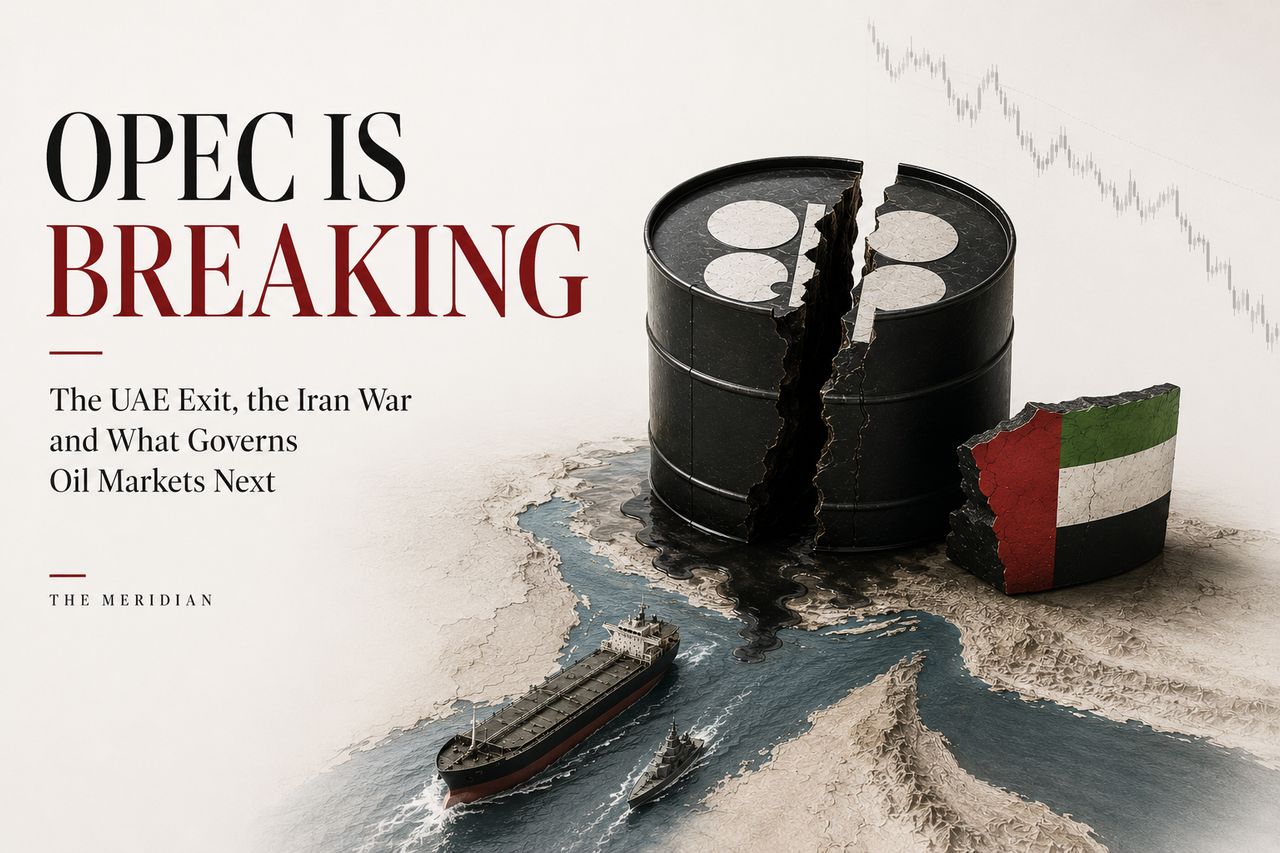
The UAE left OPEC on 1 May 2026 after 59 years of membership. It is the most significant departure in the cartel's 66-year history. Angola left in 2024. Qatar in 2019. Ecuador in 2020. OPEC now has 11 members and controls 33 per cent of global crude output — down from 80 per cent when it was founded in 1960. The Iran war has done what decades of internal tension could not: it has forced a reckoning with what OPEC actually is, what it can deliver, and whether the architecture that governed global oil markets since Baghdad in 1960 is structurally capable of governing them for another generation. The Meridian Intelligence Desk analyses what broke OPEC, what remains of it, and what — if anything — replaces it.
On 1 May 2026, the United Arab Emirates became the most consequential country to leave the Organisation of the Petroleum Exporting Countries since the organisation was founded at the Baghdad Conference in September 1960. The UAE had been an OPEC member since 1967, when the Emirate of Abu Dhabi joined the group five years before the federation of seven emirates became a unified state. In the 59 years of that membership, the UAE transformed from a modest producer into the world's seventh-largest oil producer and one of only two OPEC members with genuine independent market intelligence and pricing sophistication. Its departure is not merely the loss of a production quota. It is the loss of the institutional credibility that comes from having a member capable of exercising independent judgment about market dynamics rather than simply following Riyadh's lead. And it comes at the worst possible moment — when one OPEC member, Iran, has closed the strait through which most of the other members' oil must pass, creating an internal contradiction the organisation has no mechanism to resolve.
UAE leaves OPEC 2026 reasons quota ADNOC capacity Abraham Accords Iran war
The UAE's departure was not a sudden decision. The tensions that produced it had been building since at least 2019 when the UAE first raised the possibility of leaving. Three structural forces converged to make May 2026 the moment of exit. The first was a persistent and irreconcilable quota misalignment. The Abu Dhabi National Oil Company invested approximately $150 billion in expanding production capacity from 3 million barrels per day to a ceiling approaching 5 million by 2027. OPEC's production framework constrained the UAE to a target of 3.43 million barrels per day. Every barrel of capacity above that ceiling represented a direct economic cost of membership — investment made but revenue foregone to maintain cartel discipline. At $100 per barrel, the gap between UAE capacity and its OPEC quota represented a potential revenue loss of well over $100 million per day. No commercial logic sustains that position indefinitely.
The second force was geopolitical divergence from Saudi Arabia. The UAE signed the Abraham Accords with Israel in September 2020, becoming the first major Gulf state to normalise relations with Israel. That positioning aligned the UAE more closely with the United States and Israel and increasingly at odds with Saudi Arabia's posture toward the Iran war, the Palestinian question and the broader regional architecture. The UAE Energy Minister Suhail Al Mazrouei confirmed the UAE did not consult with Saudi Arabia before announcing its departure — a signal of how far the bilateral relationship had deteriorated from the coordination that had historically characterised Gulf OPEC membership.
The third and most immediately practical force was the Habshan-Fujairah pipeline. This 380-kilometre infrastructure allows the UAE to pump oil from its Abu Dhabi fields directly to the port of Fujairah on the Gulf of Oman, bypassing the Strait of Hormuz entirely. Before the Iran war, the UAE exported approximately 1.7 million barrels per day through this route — not enough to meet its full production ambitions but enough to demonstrate that Hormuz closure did not make the UAE economically helpless in the way it made other Gulf producers helpless. When Iran began attacking UAE infrastructure, including strikes on the port of Fujairah itself, the UAE's calculation shifted: membership in an organisation that includes the country attacking its infrastructure was no longer defensible on any terms.
Down from 13 at peak membership
Down from 80% at founding in 1960
UAE was third-largest OPEC producer
Up from 3.4 mbpd current. ADNOC confirmed
Iran OPEC member Hormuz closure other OPEC members Saudi Arabia Iraq Kuwait exports blocked
The most structurally damaging aspect of the current crisis for OPEC is one that the organisation's governance framework has no capacity to address. Iran is an OPEC founding member — one of the five countries that created the organisation at the Baghdad Conference in 1960. It remains a member today. And since 28 February 2026, Iran has controlled the Strait of Hormuz in a manner that has severely constrained the ability of its fellow OPEC members to export their oil to the world.
Saudi Arabia, Iraq and Kuwait — between them accounting for the overwhelming majority of remaining OPEC production capacity — must ship most of their exports through the Strait of Hormuz. Iran's control of the strait through small craft, drones and robotic ships has constrained their export capacity, damaged their revenue and forced Saudi Aramco to warn that normalisation will take until 2027 even if the strait reopens today. One OPEC member is imposing economic damage on the other OPEC members through control of the shipping lane they depend on for their exports. OPEC has no provision in its charter for this situation. It has no mechanism to censure a member for blockading other members' exports. It has no enforcement capacity. The contradiction is structural and unresolvable within the existing institutional framework.
OPEC was founded to protect oil producers from Western oil companies that controlled prices. It was not designed for a world in which one of its own founding members uses geography as a weapon against the others. That design failure is now visible to everyone.
OPEC future Saudi Arabia leadership remaining members production coordination 2026
OPEC will not disappear. The organisation that survived the 1973 embargo, the 1986 price crash, the 1998 Asian financial crisis collapse, the 2014 shale revolution price war and the 2020 Covid demand destruction will survive the UAE's departure and the Iran war. What it will not survive unchanged is the pretence that it functions as a unified collective governing a meaningful share of global oil supply according to shared rules that all members honour.
What remains after the UAE exit is an organisation dominated more completely than ever by Saudi Arabia. Iraq holds the second-largest production capacity among remaining members but has struggled for years to advance capacity expansion and export infrastructure projects due to political instability and governance fragmentation. Its April 2026 output of just 1.40 million barrels per day against a 4.30 million barrels per day target reflects not only Hormuz disruption but also deeper structural limitations. Kuwait, Libya, Nigeria and Algeria each have production profiles constrained by underinvestment, infrastructure decay or political instability that limit their capacity to assume a more authoritative policy role. Venezuela's production remains at a fraction of its historical levels. The remaining eleven members are, in aggregate, more dependent on Saudi leadership and less capable of providing the institutional counterweight that the UAE once provided.
Robin Mills, non-resident fellow at Columbia University's Center on Global Energy Policy, observed that OPEC will be less influential than before but will not disappear. The ability to act collectively on managing the market and ensure that prices do not go too high or too low was the reason to form OPEC, and that rationale persists. The question is whether an eleven-member organisation controlling 33 per cent of global supply, with one of its members blockading another's exports and Saudi Arabia's own spare capacity genuinely uncertain, can credibly exercise the market management function that justifies the organisation's continued existence.
UAE ADNOC production expansion 5 million barrels Fujairah pipeline post-OPEC strategy 2027
The UAE's strategic logic post-OPEC is clear and has been clearly articulated. ADNOC will pursue its capacity expansion toward 5 million barrels per day by 2027 unconstrained by any production ceiling. The Habshan-Fujairah pipeline provides partial Hormuz bypass capacity. Once the Strait reopens — whether through the Beijing summit producing Chinese pressure on Iran or through a direct US-Iran agreement — the UAE will be positioned to flood the market with additional supply at a rate that could meaningfully reduce the Brent crude price from its current levels above $110 per barrel.
Peterson Institute for International Economics nonresident senior fellow Adnan Mazarei estimated that the UAE's production expansion could increase global supply by approximately 2 million barrels per day once conditions normalise, which would pull down pricing pressure depending on how demand develops relative to global prices. That 2 million barrel per day addition from a single producer represents a supply shock large enough to move the market materially — potentially by $20 to $30 per barrel if demand does not absorb the additional volume.
For the Global South this potential supply increase is the most concrete positive consequence of the UAE's OPEC exit. The cartel's production discipline has historically kept a floor under oil prices that benefits producers but taxes importers. A UAE operating outside that discipline and pursuing maximum production has an incentive structure aligned with price reduction rather than price support. Whether that incentive translates into sustained lower prices depends on whether Saudi Arabia responds with its own production increases — risking a price war — or accepts a lower price environment to maintain market share. That strategic decision, made in Riyadh rather than Vienna, will determine whether the UAE's OPEC exit produces the oil price relief that developing economies need.
What replaces OPEC global oil market governance IEA US shale China demand 2026
No institution is waiting in the wings to assume OPEC's market governance function. The International Energy Agency, founded in 1974 in response to the Arab oil embargo, represents consumer countries rather than producers and has a mandate focused on emergency oil reserves and energy security rather than production coordination. The G20 Energy Ministers process provides a dialogue forum but no enforcement mechanism. Bilateral agreements between producers and consumers — the China-Iran relationship being the most significant current example — provide price certainty for specific pairs of countries but do not constitute market governance at a global level.
The most likely outcome is a fragmented multi-polar oil market governed by competing forces rather than a single coordinating institution. The United States, as the world's largest producer at approximately 13 million barrels per day, sets production through market signals rather than coordinated policy. The UAE, freed from quota constraints, pursues maximum production in its national interest. Saudi Arabia attempts to maintain the remaining OPEC coordination with a diminished membership. China anchors its supply security through bilateral agreements with Iran and other producers at discounted prices outside the market-clearing mechanism. The result is an oil market with less coordinated supply management, more price volatility and a less predictable environment for the developing economies that depend on stable oil import costs for their fiscal planning.
The 1960 founding of OPEC was an assertion of sovereignty by producer nations against Western corporate control of their resources. That assertion had genuine historical legitimacy. The organisation it created served its founding purpose for decades, though at significant cost to oil-importing developing economies that had no seat at the table where production decisions were made. The institution that is now fracturing was always an imperfect instrument for an impossible task — coordinating the competing national interests of sovereign states across three continents around a single commodity whose price determines the fiscal survival of governments. The Iran war has made that impossibility visible in a way it has not been since 1973. What comes next will be shaped not in Vienna but in Riyadh, Beijing, Washington and — eventually — Tehran. OPEC's 66-year run as the primary governance architecture for the world's most consequential commodity market is ending. The replacement has not yet been named.
Add comment
Comments