The New Colonisers: How China, Iran and Russia Are Rewriting the Rules of Extraction
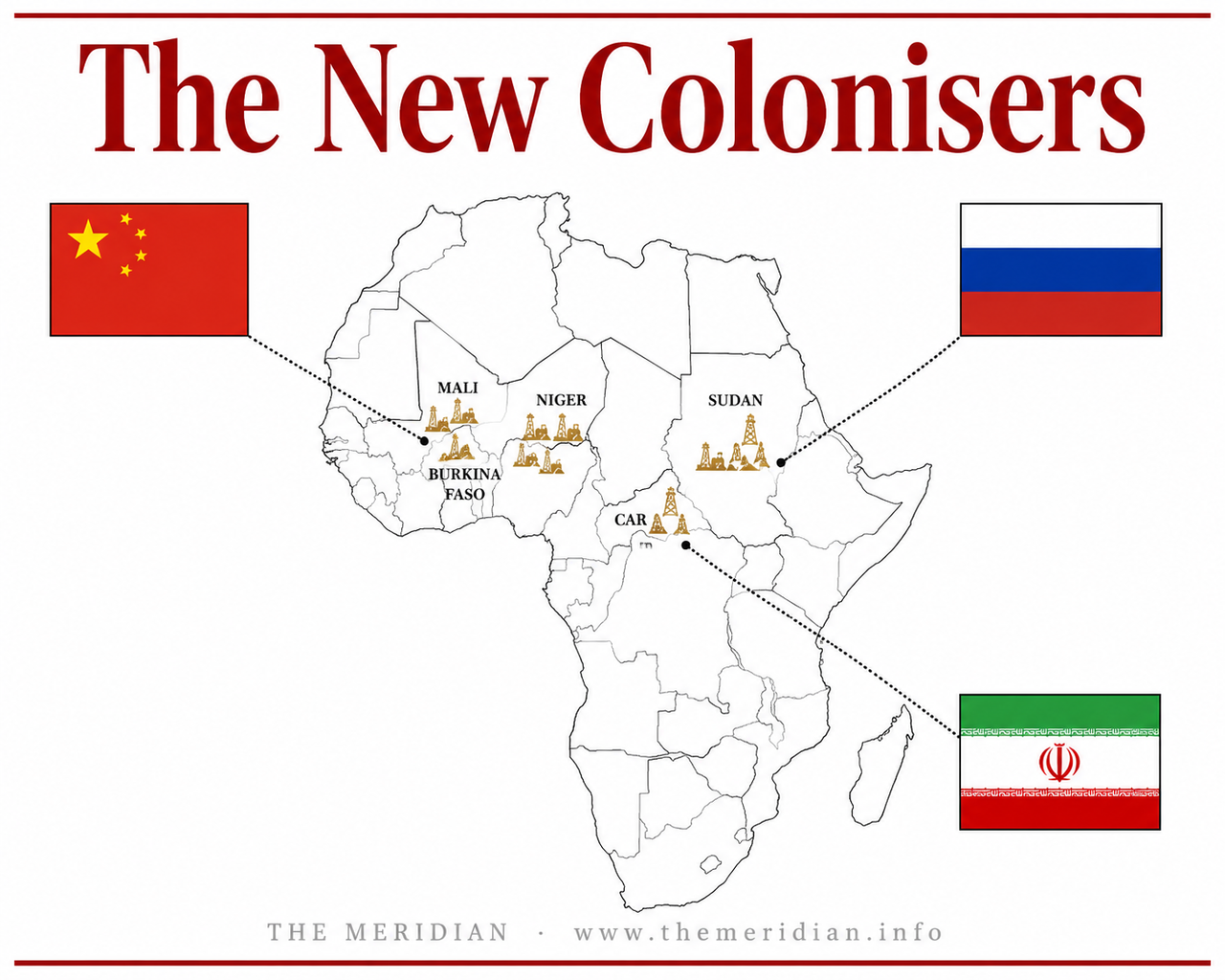
The Global South has been offered a narrative of liberation from Western dominance. China presents itself as an unjudgmental development partner. Russia presents itself as a security guarantor for governments the West has abandoned. Iran presents itself as a resistance power standing against American imperialism. The Meridian Intelligence Desk examines what these three powers are actually doing in the Global South — in verified, documented detail — and asks whether what is being offered is liberation or a change of master.
Colonialism was never primarily about ideology. It was about extraction — the systematic removal of resources, labour and wealth from peripheral territories to enrich metropolitan centres, justified by whatever ideological framework was most convenient at the time. The British extracted cotton from India and called it free trade. The French extracted rubber from the Congo and called it civilisation. The Belgians extracted everything from the Congo and called it development. The language of justification changed across centuries. The underlying mechanism did not. What the Meridian Intelligence Desk is documenting in this article is not a moral equivalence between historical Western colonialism and the current behaviour of China, Russia and Iran in the Global South. Historical colonialism was enacted through direct territorial control, slavery and systematic depopulation at a scale that has no contemporary parallel. What is being documented is something structurally analogous in its extraction logic, if different in its instruments: three powers offering security, investment and solidarity while systematically removing resources, foreclosing sovereign options and building dependencies that serve their strategic interests rather than the development interests of the countries they engage.
Since Ukraine invasion Feb 2022. Blood Gold Report Dec 2023
2000-2022. Boston University GDP Center
Above pre-war Brent since Feb 2026
Russia Wagner Africa Corps gold extraction Mali CAR Burkina Faso Niger uranium
Russia's model in Africa is the most overtly transactional of the three. It offers fragile or authoritarian governments what they most immediately need — regime survival — in exchange for what Russia most immediately needs: resources to sustain its war in Ukraine and hard currency to bypass Western sanctions. The mechanism that made this exchange visible to the world was the Wagner Group, the Kremlin-linked private military company that since roughly 2017 has exchanged paramilitary services in African states for Russian geopolitical gains and access to gold, diamonds, uranium, timber and other natural resources.
In the Central African Republic, Wagner secured the Ndassima gold mine — estimated to hold $2.8 billion in reserves — in exchange for providing security to President Touadéra's government. Wagner front companies including Midas Resources, Lobaye Invest and Diamville operated in what the Kimberley Process classified as conflict zones, extracting gold and diamonds through shell companies that laundered the proceeds through parallel financial channels. In Mali, the military junta paid Wagner more than $200 million since 2021, much of it funded by gold mining revenues, according to US intelligence. In Sudan, data leaked from the Sudanese Central Bank suggested that as much as 32.7 tonnes of gold were unaccounted for in 2021, with Wagner smuggling identified as the primary source of the deficit. At a market rate of $60 million per tonne, Wagner could have earned approximately $1.9 billion from that single operation.
The resource extraction has not been merely commercial. It has been directly militarised. The Center for Advanced Defense Studies published a May 2025 report documenting that the Kremlin gave at least $104 million in gold bars — extracted from African mines — to a Tehran-based company linked to the Iranian government to help build Russia's drone manufacturing industry. African gold paid for Iranian drones. Iranian drones attacked Ukrainian cities. The triangular loop connecting African resource extraction to the Iran war to the Ukraine war is not a conspiracy theory. It is a documented financial flow between three states that have found strategic complementarity in each other's needs.
Following Prigozhin's death in August 2023, Moscow restructured Wagner's African operations under direct state control, creating Africa Corps — a paramilitary formation fully subordinate to Russia's Ministry of Defense. The rebrand preserved most of Wagner's functionality. The extraction model continued. As of early 2026, approximately 2,500 Russian personnel were reported in Mali alone. The model has also encountered its limits: the April 2026 jihadist offensive in Mali struck Bamako, Kati and multiple provincial cities simultaneously. Russia's Defence Minister Sandaogo Camara was killed in a suicide bombing. Africa Corps evacuated Kidal under escort, leaving Malian soldiers behind as prisoners. Russia is discovering what France discovered before it: providing security to a state that has lost the consent of significant portions of its own population is not a stable long-term position, regardless of how many gold mines one controls in the process.
Russia offers African governments regime survival. In exchange it takes gold, diamonds and uranium. The gold funds drones. The drones go to Iran. Iran builds more. Russia uses them in Ukraine. African resources are financing a European war through an Iranian intermediary. The Global South has not been told this clearly enough.
China debt trap Africa infrastructure loans Zambia Sri Lanka Kenya Hambantota Belt Road
China's model is more patient and more sophisticated than Russia's, which makes it harder to identify and easier to defend. China builds things. Roads, railways, ports, power stations, hospitals, stadiums. These are real physical assets that in many cases deliver genuine services to real populations. The argument that Chinese infrastructure lending is categorically harmful ignores the fact that infrastructure investment was what many African and developing economies most needed and most struggled to obtain from Western financial institutions at acceptable cost. The argument that Chinese infrastructure lending is categorically beneficial ignores the documented cases in which the terms of that lending have produced outcomes that serve Chinese strategic interests rather than local development interests.
The pattern that has emerged across multiple documented cases is consistent. Chinese loans for infrastructure are typically tied to Chinese contractors, Chinese labour, Chinese equipment and Chinese technical specifications. The technology transfer to local engineers and workers that would build sustainable domestic capacity is systematically limited. When the project is completed, the infrastructure exists but the capability to operate, maintain and upgrade it independently does not fully exist. The debt remains. And when the debt cannot be serviced from the revenues generated by the infrastructure — which is the case more often than Chinese promotional materials acknowledge — the consequences have ranged from restructuring on Chinese terms to the transfer of strategic asset control.
Sri Lanka's Hambantota Port is the most widely cited case. Built with a Chinese loan using Chinese contractors, the port could not generate sufficient revenue to service the debt. In 2017, Sri Lanka handed operational control of the port to China Merchants Port Holdings on a 99-year lease. China now operates a deep-water port on the Indian Ocean shipping lanes on a near-century timeframe. Kenya's Standard Gauge Railway, built with a Chinese government loan through the Export-Import Bank of China at a cost of approximately $3.2 billion, carries annual debt servicing costs that the railway's passenger and freight revenues cannot cover. Kenya is paying for Chinese-built infrastructure that does not generate enough income to repay the Chinese loan that built it. Zambia defaulted on Chinese sovereign debt and entered restructuring negotiations in which Chinese creditors held significant leverage over terms.
China provided approximately $170 billion in loans to 49 African governments between 2000 and 2022, according to Boston University's Global Development Policy Center — 64 per cent of the World Bank's equivalent lending over the same period and almost five times the African Development Bank's sovereign loans to Africa. This is a lending programme of genuine continental scale. Its aggregate developmental impact is contested. Its aggregate strategic impact — ports, railways, digital infrastructure, financial relationships — is less contested by those who have examined it carefully.
China builds the road. China brings the workers. China owns the loan. When the road cannot pay for itself, China negotiates the terms of what comes next. This is not development finance. It is infrastructure as leverage — patient, deniable and cumulative.
Iran Hormuz Global South oil price toll collector gatekeeper proxy network yuan coercion
Iran's role in the new extraction architecture is analytically distinct from Russia's and China's — and that distinction matters for intellectual honesty. Russia extracts resources directly. China extracts debt leverage directly. Iran does neither of these things in the Global South. Iran is not holding African mining concessions. It does not have a portfolio of Asian sovereign debt. Its role is different, and in some respects more insidious: Iran is the toll collector at the gate of the world's energy system. It controls the Strait of Hormuz — the 33-kilometre passage through which approximately 20 per cent of global oil supply and 17 per cent of global LNG must transit to reach world markets — and it uses that control to charge the entire global economy a permanent strategic rent. The Global South, which had no part in creating that situation and no power to end it, pays the toll on every barrel it imports.
The toll is not metaphorical. Brent crude above $110 per barrel adds a war premium of approximately $35 per barrel above pre-war levels to every oil import bill. For a country like Mauritius, which imports 100 per cent of its petroleum requirements, this premium is an unbudgeted fiscal shock that crowds out spending on health, education and social protection. For Sub-Saharan African economies from Kenya to Ghana to Senegal, elevated oil costs filter through to transport, food production and electricity generation in ways that the official macroeconomic data consistently underrepresent. Pakistan, Sri Lanka and the small island states of the Indian Ocean and Pacific are paying a war premium for a conflict in a strait they depend on but cannot influence. They are paying Iran's toll.
Iran's toll has a second component that is rarely attributed to its source. The Houthi campaign in the Red Sea in 2024 and 2025 — funded, armed and operationally directed by Iran's IRGC Quds Force — drove container freight rates through the Red Sea corridor up by more than 300 per cent at peak disruption. African ports that depend on this lane for their imports from Asia absorbed that cost in higher landed prices for everything from electronics to medicines to manufactured goods. This was not a natural disaster. It was a deliberate Iranian strategic deployment using a Yemeni proxy as the instrument and the Global South's trade infrastructure as the target. And now, having demonstrated its capacity to close Hormuz and disrupt the Red Sea simultaneously, Iran is conditioning tanker passage through the strait on yuan-denominated settlement — effectively charging a currency toll on top of the physical one, advancing a dollar displacement agenda that serves Chinese strategic interests while the Global South absorbs the transition costs of a monetary system it had no voice in designing and no vote in changing.
The coloniser framing for Iran therefore requires precision. Iran is not colonising the Global South in the extractive sense that Russia and China are. It is doing something structurally different: it is making the Global South's access to its own energy supply contingent on accepting terms set by Tehran and Beijing. That is not extraction in the direct sense. It is toll extraction — the systematic charging of a premium for passage through a geography that the Global South has no alternative to using. The old colonial powers controlled the shipping lanes and called it freedom of navigation. Iran controls the Hormuz chokepoint and calls it resistance. The Global South pays either way.
China Russia Iran coordination Global South strategy loop gold drones oil yuan
China, Russia and Iran are not operating a formally coordinated strategy against the Global South. They have different objectives, different instruments and different geographies of interest. What they share is a set of structural interests that make their simultaneous engagement in the Global South mutually reinforcing even without explicit coordination. Russia needs resources and hard currency. China needs energy security and strategic infrastructure. Iran needs economic lifelines and political allies. The Global South provides all three with what they need, often simultaneously and in overlapping geographies.
The documented operational connections between the three are more specific than mere strategic alignment. Russia pays Iran in African gold for drone manufacturing capacity. China pays Iran in oil purchases and construction for Hormuz access and partnership in challenging the dollar system. Iran provides Russia with drones that use Chinese components. The triangular relationships are not random. They are the product of three sanctioned or semi-sanctioned states finding complementarity in each other's needs and using the Global South as the resource base that makes the entire system function.
The most important question the Global South must ask is not whether these three powers are worse than the West. That is the wrong comparison and it leads to the wrong conclusion. The relevant comparison is not between colonialism past and extraction present. It is between what the Global South was promised — development, sovereignty, genuine partnership — and what it is actually receiving from each of these relationships. Russia is taking gold and leaving instability. China is building infrastructure and leaving debt. Iran is taking oil revenue and leaving a war premium that everyone else pays. The language of solidarity, multipolarity and South-South cooperation that frames these relationships has not yet been tested against those concrete outcomes in the way it deserves to be.
Global South sovereignty China Russia Iran extractive relationships demands reform
The Global South is not powerless in these relationships even if it is structurally weaker. It has resources that all three powers need. It has diplomatic weight in international forums that all three powers seek. It has the capacity, if it exercises it collectively, to set terms rather than simply receive them. The African Union's common position framework, the G77 plus China bloc at the United Nations, the small island states coalitions at climate negotiations — these are mechanisms through which collective bargaining can produce better terms than bilateral dependency.
What the Global South must demand from China is transparency in lending terms, genuine technology transfer requirements embedded in infrastructure contracts, local labour content obligations that build domestic capacity rather than import Chinese workers, and debt restructuring frameworks that do not require the surrender of strategic assets. What it must demand from Russia is accountability for resource extraction under internationally recognised frameworks, not shadow fleet gold smuggling and mining concessions secured through paramilitary coercion. What it must demand from Iran is the reopening of the Strait of Hormuz and the dismantling of the proxy network that has disrupted its shipping lanes and trading relationships for four decades.
None of these demands will be made effectively by individual small states negotiating bilaterally with powers that have vastly greater leverage. They require collective action, institutional frameworks and the kind of analytical clarity about who is actually extracting value from whom that The Meridian has attempted to provide in this article. The old colonisers at least had the honesty to call their extraction by its name. The new colonisers have learned to dress it in the language of partnership. The Global South's most important task is to learn to read the difference.
Add comment
Comments